
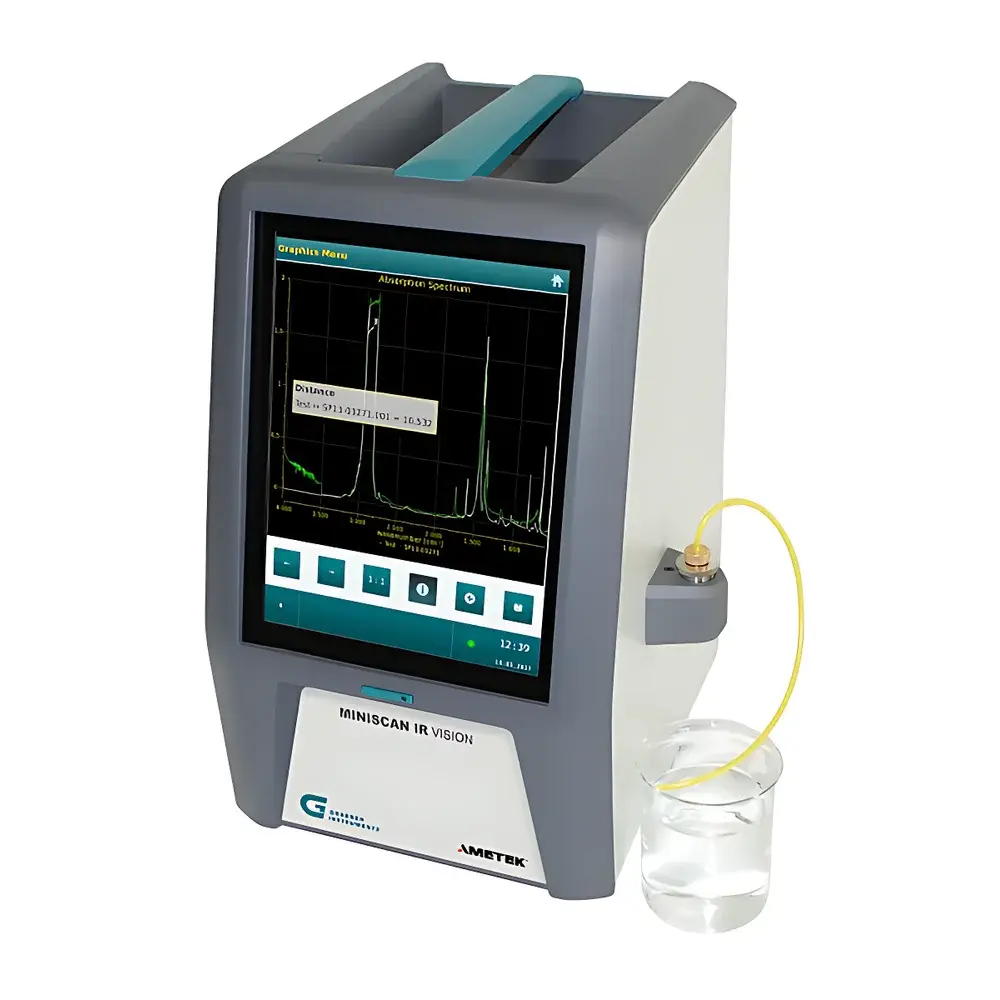
Grabner MINISCAN IR Vision Gasoline Mid-Infrared Analyzer
| Brand | Grabner |
|---|---|
| Origin | Austria |
| Manufacturer Type | Manufacturer |
| Origin Category | Imported |
| Model | MINISCAN IR Vision Gasoline |
| Portability | Portable |
| Detection Principle | Mid-Infrared Spectroscopy |
| Measurement Range | 70–110 (RON/MON) |
| Measurement Accuracy | ±0.1 |
| Analysis Time | ≤60 s |
| Sample Volume | 6 mL |
| Compliance | GB/T 33648–2017, ASTM D5845, ASTM D6277, EN 238, SH/T 0797, ASTM E1655, GB/T 29858 |
| Calibration Method | PLS (Partial Least Squares) Multivariate Regression |
| Density Measurement | Integrated thermoelectrically controlled densitometer (±0.0001 g/cm³) |
| Spectrometer Core | Dual-interferometer with automatic mirror alignment |
| Beam Splitter | Ge substrate with KBr coating |
| Sample Cell Design | 2+1 intelligent thermostatted cells |
| Display | 10-inch industrial-grade full-color touchscreen |
| Data Interface | 2× USB, 2× LAN |
| Power Supply | 100–264 V AC, 47–63 Hz, 130 W |
| Optional DC Operation | 12 V vehicle adapter |
| Dimensions | 293 × 390 × 280 mm |
| Weight | 12 kg |
Overview
The Grabner MINISCAN IR Vision Gasoline is a field-deployable mid-infrared (MIR) spectrometer engineered for precise, real-time quantitative analysis of gasoline composition and performance parameters. Operating on the principle of Fourier-transform infrared (FTIR) spectroscopy in the 4000–600 cm⁻¹ spectral range, it captures high-fidelity absorbance spectra from neat liquid samples and applies chemometric modeling—specifically Partial Least Squares (PLS) regression—to correlate spectral features with physicochemical properties. Its core analytical capability centers on determining research octane number (RON) and motor octane number (MON) within a validated range of 70–110, with reproducible accuracy of ±0.1 units under controlled thermal conditions. The instrument integrates a thermoelectrically regulated densitometer (±0.0001 g/cm³), enabling simultaneous volumetric (v%) and mass-based (m%) quantification—critical for regulatory compliance and blending optimization. Designed to meet stringent international standard requirements—including ASTM E1655 (standard practice for multivariate calibration), ASTM D5845 (oxygenates), ASTM D6277 (benzene), EN 238, SH/T 0797, and GB/T 33648–2017 (detection of non-conventional additives)—the MINISCAN IR Vision Gasoline delivers laboratory-grade results outside fixed facilities.
Key Features
- Portable, ruggedized platform certified for shock and vibration resistance (IEC 60068-2 series), suitable for refinery perimeters, depot inspection points, and mobile fuel quality surveillance.
- Dual-interferometer architecture with automatic laser-referenced mirror alignment—ensures optical stability after transport over uneven terrain or repeated field deployment.
- 2+1 intelligent sample cell design: two dedicated thermostatted cells for routine analysis and one reference cell for background correction, all maintained at constant temperature via Peltier elements.
- Patented bubble-free metal injection system eliminates air entrapment artifacts, ensuring consistent pathlength and signal-to-noise ratio across repeated injections.
- Integrated density measurement module with real-time thermal compensation, supporting ASTM D1298 and ISO 3675 traceability without external hydrometers or pycnometers.
- 10-inch industrial-grade capacitive touchscreen with high-brightness display (1000 cd/m²), glove-compatible interface, and configurable button layout for operation in ambient light extremes.
- Onboard spectral library containing >70 validated gasoline parameters—including RON/MON, total aromatics, total olefins, benzene, MTBE, ethanol, methanol, DME, methylal, and dimethyl carbonate—derived from SGS-verified reference materials.
- Comprehensive connectivity suite: dual LAN ports for LIMS integration, dual USB-A for peripheral support (keyboard, printer, flash storage), and optional remote diagnostics via secure TLS-enabled web interface.
Sample Compatibility & Compliance
The MINISCAN IR Vision Gasoline accepts undiluted, homogenized gasoline samples (6 mL volume) meeting ASTM D4057 sampling protocols. It is compatible with conventional hydrocarbon blends (e.g., reformulated gasoline, oxygenated fuels, ethanol-gasoline mixtures up to E85), as well as fuels containing legally permitted additives (e.g., detergents, corrosion inhibitors) and unauthorized adulterants (e.g., aliphatic ethers, esters, and aldehydes). All calibrations are developed using primary reference standards traceable to NIST SRMs and validated against interlaboratory round-robin studies. Instrument software enforces audit-trail functionality compliant with FDA 21 CFR Part 11 requirements for electronic records and signatures, including user-level access control, timestamped metadata, and immutable result archiving. Routine verification follows ASTM D6299 guidelines for statistical process control of analytical systems.
Software & Data Management
The embedded operating system runs Grabner’s proprietary VisionSoft v5.x firmware, supporting GLP-compliant workflow management. Each analysis generates a complete digital record: raw interferogram, processed absorbance spectrum, PLS-predicted values with confidence intervals, density reading, temperature logs, and operator ID. Data are stored locally on a 64 GB industrial SSD with automatic cyclic overwrite protection and exportable in CSV, XML, and ASTM E1382-compliant .jdx formats. Remote access enables real-time monitoring, method updates, and spectral reprocessing via encrypted HTTPS session. Integration with enterprise LIMS is achieved through ASTM E1461-compliant middleware or direct SQL database push (ODBC/JDBC drivers included). All calibration models undergo version-controlled lifecycle management with change documentation and revalidation triggers aligned with ISO/IEC 17025 clause 7.7.
Applications
- Refinery process control: rapid verification of blendstock composition pre- and post-treatment, minimizing off-spec production.
- Terminal and depot quality assurance: on-site screening for octane deviation, oxygenate fraud, and aromatic content nonconformance.
- Regulatory enforcement: field detection of prohibited additives per GB/T 33648–2017 and EU Directive 2009/30/EC Annex II.
- Fleet fuel management: validation of specification compliance prior to delivery to service stations or captive fleets.
- R&D laboratories: high-throughput generation of spectral libraries for new fuel formulations and surrogate development.
- Third-party inspection agencies: accredited testing per ISO/IEC 17025 with full traceability to calibration certificates and uncertainty budgets.
FAQ
What regulatory standards does the MINISCAN IR Vision Gasoline support?
It complies with ASTM D5845 (oxygen content), ASTM D6277 (benzene), EN 238, SH/T 0797, ASTM E1655 (chemometric modeling), GB/T 29858 (molecular spectroscopy), and GB/T 33648–2017 (non-conventional additive detection).
Can the instrument analyze diesel or jet fuel?
The MINISCAN IR Vision Gasoline model is optimized exclusively for gasoline matrices. Diesel and aviation turbine fuel analysis require the dedicated MINISCAN IR Vision Diesel or MINISCAN IR Vision Professional configurations.
How is calibration maintained in field environments?
Calibration stability is ensured by dual internal reference interferometers, automated mirror alignment, and periodic verification using certified reference materials (CRM) traceable to national metrology institutes. Software includes built-in drift correction algorithms based on water vapor and CO₂ atmospheric bands.
Is density measurement fully integrated and traceable?
Yes—the instrument incorporates a Peltier-regulated oscillating U-tube densitometer calibrated against NIST SRM 1816 and verified per ASTM D4052. Density data are automatically applied to normalize concentration results to mass or volume basis.
What data security and audit capabilities are available?
VisionSoft implements role-based user authentication, electronic signature capture, immutable audit trails with hash-secured logs, and export controls aligned with ISO 27001 and FDA 21 CFR Part 11 requirements for regulated environments.





