
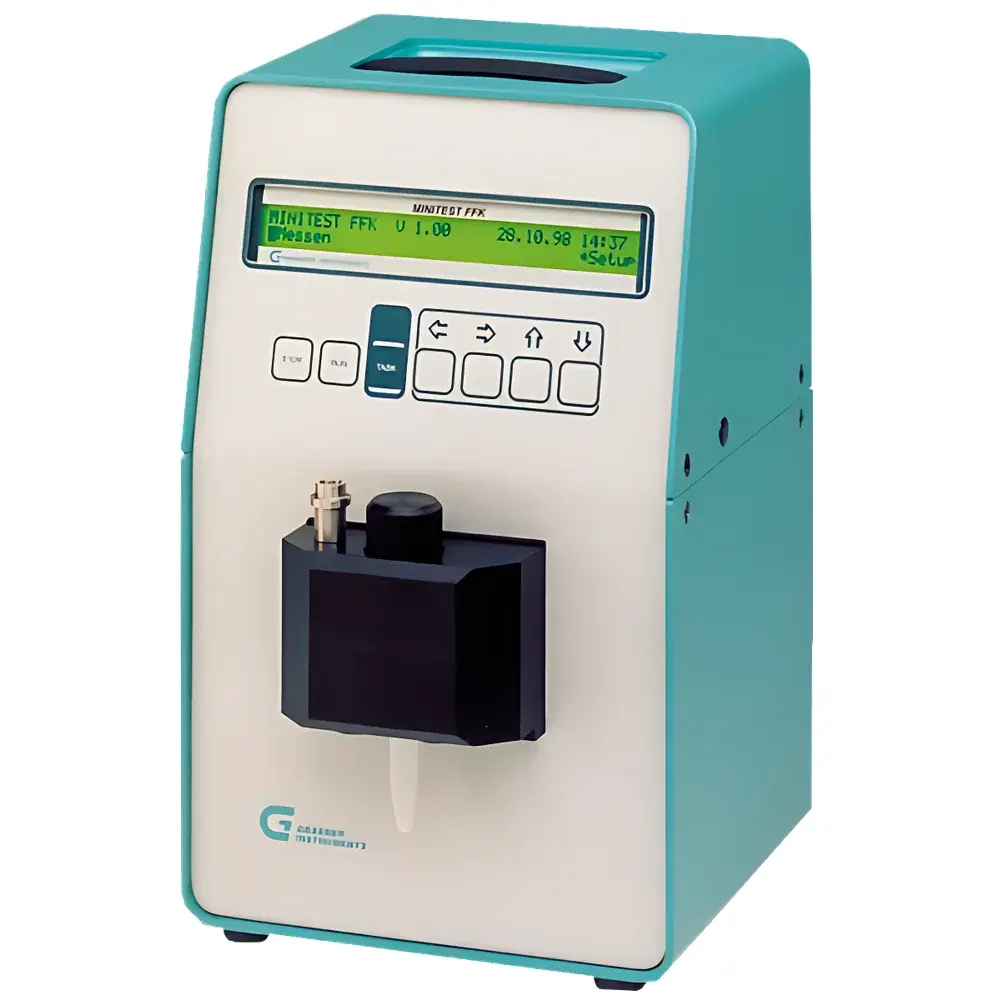
GRABNER MINITEST FFK Automated Grease Low-Temperature Flow Tester
| Brand | GRABNER |
|---|---|
| Origin | Austria |
| Model | MINITEST FFK |
| Application Standard | DIN 51805 |
| Temperature Range | –60 °C to +30 °C |
| Temperature Accuracy | ±0.1 °C |
| Pressure Range | 0–300 kPa |
| Pressure Accuracy | ±0.1 kPa |
| Power Supply | 100–240 V AC, 50/60 Hz, 200 W or 12 V DC / 10 A |
| Dimensions (W×H×D) | 196 × 315 × 175 mm |
| Weight | 10 kg |
| Interface | RS232 |
| Display Languages | English, German |
| Cooling Method | Peltier-based |
| Sample Compatibility | NLGI Grades 000–3 Greases |
Overview
The GRABNER MINITEST FFK is an automated, benchtop instrument engineered for the precise determination of low-temperature flow pressure of lubricating greases in accordance with DIN 51805 (“Corrosion Test Method for Greases”). This standardized test evaluates the resistance of grease to extrusion under controlled thermal and mechanical conditions—specifically, the pressure required to force grease through a defined orifice at sub-ambient temperatures. Unlike empirical drop-point or penetration tests, the MINITEST FFK quantifies functional performance relevant to central lubrication systems operating in cold climates, where inadequate flow can lead to insufficient bearing protection and premature mechanical failure. The instrument employs a dual-stage Peltier thermoelectric cooling system capable of reaching –60 °C without cryogenic refrigerants, enabling reproducible thermal conditioning of both sample and test fixture prior to pressurization. Its closed-loop temperature control ensures stability within ±0.1 °C across the full operational range (–60 °C to +30 °C), critical for detecting subtle rheological transitions near the grease’s low-temperature limit.
Key Features
- Fully automated measurement sequence—from temperature equilibration to pressure ramping and data capture—eliminating operator-dependent variability inherent in manual DIN 51805 procedures.
- Peltier-based thermal management reduces operational cost and infrastructure requirements versus liquid nitrogen or compressor-cooled alternatives; no external chiller or coolant disposal is needed.
- Integrated pressure transducer with ±0.1 kPa accuracy measures extrusion force over a 0–300 kPa range, resolving small changes in consistency associated with base oil viscosity shifts and thickener network breakdown.
- Self-contained design requires no auxiliary modules: all thermal, mechanical, and sensing components are housed within a single 10 kg enclosure (196 × 315 × 175 mm).
- RS232 serial interface supports direct connection to laboratory PCs or thermal printers for real-time data logging and GLP-compliant report generation.
- Universal power input (100–240 V AC, 50/60 Hz, 200 W) and optional 12 V DC operation enable deployment in mobile labs, field service vehicles, or off-grid facilities.
- Multi-language UI (English and German) with intuitive menu navigation simplifies operator training and minimizes misinterpretation of test parameters.
Sample Compatibility & Compliance
The MINITEST FFK is validated for greases conforming to NLGI consistency classes 000 through 3, including lithium, calcium-sulfonate, polyurea, and complex-soap thickeners. It accommodates standard DIN 51805 sample cups (30 mL capacity) and orifice inserts with nominal diameters of 0.5 mm and 1.0 mm. All hardware surfaces contacting grease are electropolished stainless steel (ASTM A967), ensuring chemical inertness and ease of cleaning between runs. The instrument complies with the metrological requirements of DIN 51805:2021-05 and supports traceable calibration via NIST-traceable pressure and temperature standards. Its design aligns with ISO/IEC 17025 quality system expectations for testing laboratories, and audit-ready test records—including timestamps, setpoints, raw sensor outputs, and pass/fail flags—can be exported in CSV or PDF format for regulatory review (e.g., OEM technical specifications, API RP 541 compliance documentation).
Software & Data Management
Data acquisition and instrument control are managed via embedded firmware—not external PC software—ensuring deterministic timing and immunity to host OS instability. Each test generates a timestamped dataset comprising temperature profile (°C vs. time), applied pressure (kPa vs. time), and calculated flow onset point (defined as the inflection point in the pressure–displacement curve). Raw data and summary statistics (mean, SD, CV%) are exportable via RS232 using ASCII-delimited protocols compatible with LIMS integration. Optional firmware updates—distributed via USB memory stick—maintain alignment with evolving DIN 51805 annexes and add support for user-defined test sequences (e.g., multi-step ramp-and-hold profiles). Audit trails record all parameter modifications, user logins, and calibration events in non-volatile memory, satisfying FDA 21 CFR Part 11 requirements for electronic records when paired with appropriate lab SOPs.
Applications
- Formulation development of winter-grade chassis greases for automotive OEMs requiring guaranteed flow at –40 °C.
- Quality control release testing of batch-manufactured greases against internal specifications derived from DIN 51805 pass/fail thresholds.
- Comparative assessment of thickener stability during accelerated aging studies (e.g., 1000-hr storage at –30 °C followed by flow pressure retesting).
- Technical support for industrial end-users troubleshooting cold-start failures in centralized lubrication systems for wind turbine gearboxes or mining conveyors.
- Research into structure–property relationships of bio-based greases, where low-temperature flow behavior correlates strongly with vegetable oil saturation levels and additive package solubility.
FAQ
What is the primary metrological principle behind the MINITEST FFK?
It applies controlled hydrostatic pressure to a standardized grease column held at a precisely stabilized sub-zero temperature, measuring the minimum pressure required to initiate measurable extrusion through a calibrated orifice—directly implementing the physical test protocol defined in DIN 51805.
Does the instrument require periodic recalibration by an accredited lab?
While factory calibration is traceable to national standards, users should perform routine verification using certified reference pressure and temperature artifacts at least quarterly—or per internal QA schedule—to maintain confidence in measurement uncertainty budgets.
Can the MINITEST FFK test greases containing solid additives such as MoS₂ or graphite?
Yes, provided the particle size distribution does not exceed 50 µm and the additive loading remains below 15 wt%, which prevents orifice clogging and ensures representative bulk flow behavior.
Is the RS232 interface compatible with modern Windows/macOS systems lacking legacy serial ports?
Yes—standard USB-to-RS232 adapters (FTDI chipset recommended) enable seamless connectivity; GRABNER provides documented terminal command syntax for custom script integration.
How is thermal uniformity ensured across the sample cup during prolonged low-temperature holds?
The instrument uses a three-zone Peltier array with independent feedback control: one zone cools the base plate, one regulates the side wall jacket, and one monitors top surface temperature—achieving axial and radial homogeneity better than ±0.2 °C over 30-minute stabilization periods.





