
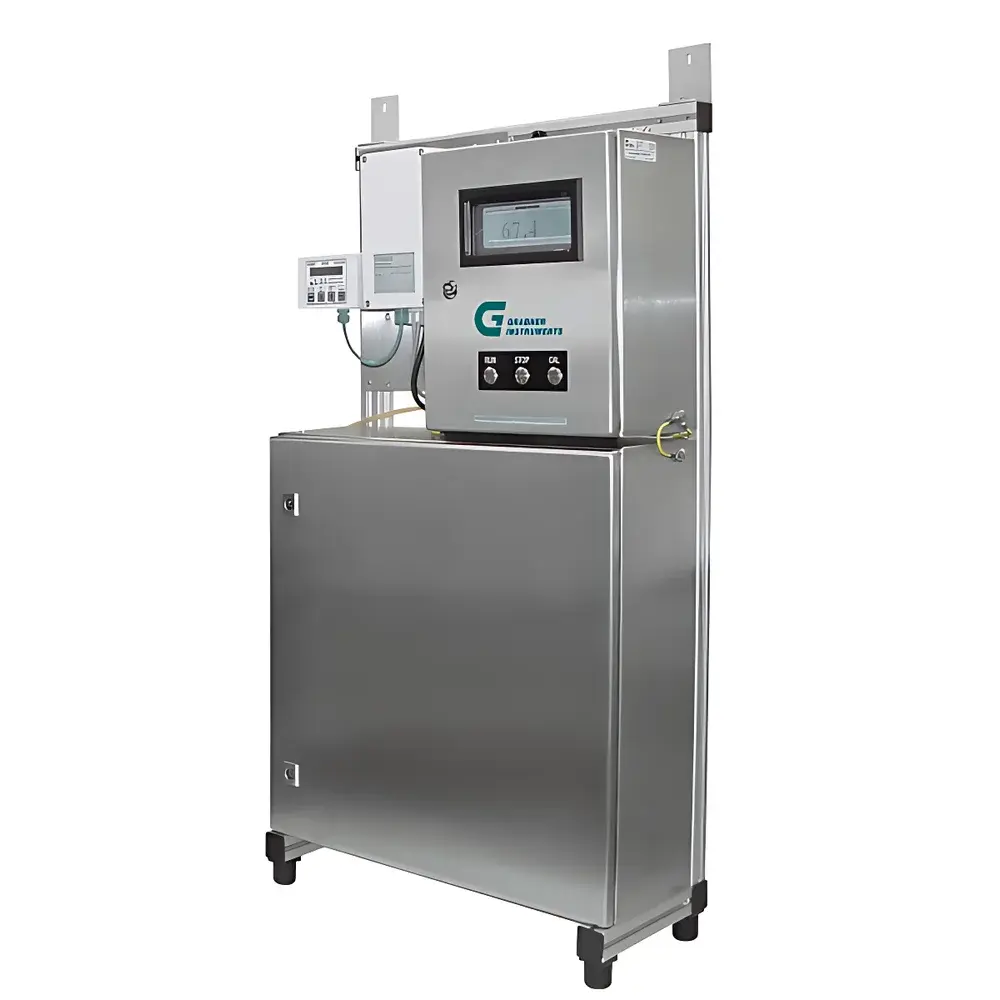
GRABNER MINIVAP Online Petroleum Product Vapor Pressure Analyzer
| Brand | GRABNER |
|---|---|
| Origin | Austria |
| Model | MINIVAP Online |
| Analysis Method | Three-stage Expansion Method |
| Pressure Range | 0–1000 kPa |
| Temperature Range | 20–60 °C |
| Power Supply | 100/120/230/240 V AC, 50/60 Hz, 65 W |
| Dimensions (W×H×D) | 650 × 1160 × 400 mm |
| Weight | 50 kg |
| Repeatability (r) | 0.30 kPa |
| Reproducibility (R) | 0.70 kPa |
| Explosion Protection | Class I, NEMA 496 (US) / EN 50016 (EU) |
| Cycle Time | 7 min |
| Vapor-to-Liquid Ratios | 4:1 (gasoline & crude), 1:2 (LPG/NPG), 20:1 (LVR temperature) |
Overview
The GRABNER MINIVAP Online Petroleum Product Vapor Pressure Analyzer is an industrial-grade, fully automated online vapor pressure measurement system engineered for continuous, real-time monitoring of volatile petroleum products—including gasoline, crude oil, liquefied petroleum gas (LPG), and natural petroleum gas (NPG)—directly within process streams. It operates on the internationally validated three-stage expansion thermodynamic principle, identical to that employed in the laboratory-standard GRABNER MINIVAP VPS series. This method precisely replicates the equilibrium conditions defined in ASTM D6378 (for gasoline), ASTM D6377 (for crude oil), and ASTM D6897 (for LPG), ensuring regulatory compliance without sample transfer or manual intervention. The instrument measures true vapor pressure (TVPR) by controlling thermal equilibration, sequential expansion, and pressure stabilization across multiple phases—delivering traceable, thermodynamically sound results under dynamic process conditions.
Key Features
- True dual-stream capability via single-channel architecture: simultaneous analysis of two independent sample lines with automatic valve sequencing and cross-contamination mitigation.
- Integrated temperature-controlled sample conditioning system maintains precise 20–60 °C thermal stability across inlet lines, expansion chambers, and pressure sensors—critical for minimizing phase segregation and adsorption artifacts.
- Automated zero-offset correction and pressure sensor calibration using internal reference checks at regular intervals, ensuring long-term metrological integrity without operator dependency.
- Multi-point apparent pressure profiling across expansion stages enables robust detection of non-ideal behavior, particularly relevant for heavy crudes and reformulated gasoline blends containing oxygenates.
- Explosion-proof enclosure certified to Class I, Division 1, NEMA 496 (US) and EN 50016 (EU), rated for hazardous area installation in refineries, terminals, and offshore platforms.
- 7-minute cycle time optimized for high-throughput process control while maintaining full ASTM-equivalent measurement fidelity.
- Support for multiple vapor-to-liquid (V/L) ratios: 4:1 for gasoline and crude oil; 1:2 for LPG/NPG; and 20:1 for LVR (vapor-to-liquid ratio) determination at specified temperature per ASTM D5188.
Sample Compatibility & Compliance
The MINIVAP Online is validated for direct integration into hydrocarbon process streams with viscosities up to 10 cSt and total sulfur content ≤500 ppm. It complies with all primary and supporting standards governing vapor pressure testing in petroleum refining and distribution: ASTM D6378 (gasoline VPx), D6377 (crude oil RVP), D6897 (LPG TVP), D5188 (LVR), D1267 (LPG), D323/D4953/D5191 (correction methodologies), EN 13016-1, and IP 394. Its design supports GLP-compliant operation through audit-trail-enabled firmware logging, user-access-level controls, and timestamped raw data capture—fully aligned with FDA 21 CFR Part 11 requirements when deployed in regulated manufacturing environments.
Software & Data Management
The analyzer interfaces via Modbus TCP/IP or 4–20 mA analog outputs to distributed control systems (DCS) or SCADA platforms. GRABNER’s proprietary MINIVAP Control Suite provides remote configuration, diagnostic trending, alarm management (e.g., pressure drift >0.5 kPa/h), and export of calibrated result sets in CSV or XML format. All measurements include embedded metadata: cycle ID, ambient temperature, sample line identifier, V/L ratio applied, and thermodynamic validation flags. Firmware updates are performed over secure HTTPS, with version rollback capability and SHA-256 integrity verification.
Applications
- Real-time blending control in gasoline pool optimization, enabling immediate adjustment of butane/naphtha ratios based on live RVP feedback.
- In-line quality assurance during crude desalting and stabilization—detecting early signs of light-end carryover or emulsion instability.
- LPG custody transfer verification at loading racks, reducing reliance on offline grab sampling and associated analytical delays.
- Process safety monitoring in fractionation units where excessive vapor pressure may indicate reflux failure or column flooding risk.
- Regulatory reporting support for EPA Tier II, EU REACH, and IMO MARPOL Annex VI compliance documentation.
FAQ
Does the MINIVAP Online require daily calibration with certified reference materials?
No. It performs automated internal pressure and temperature self-validation at every cycle; external calibration is recommended annually or after major maintenance per ISO/IEC 17025 guidelines.
Can it measure vapor pressure of ethanol-blended gasoline (E10/E15)?
Yes. Its thermodynamic model accounts for non-ideal mixing effects in oxygenated fuels, and it is explicitly referenced in ASTM D6378 Annex A4 for such applications.
Is sample pre-filtration required before entering the analyzer?
A 5-µm particulate filter is mandatory upstream to protect solenoid valves and expansion chambers; water removal is advised for crude streams with >50 ppm free water.
How does the instrument handle transient pressure surges from pump pulsation?
It incorporates a dual-stage dampening manifold and adaptive digital filtering to reject mechanical noise above 2 Hz while preserving true thermodynamic response.
What cybersecurity protocols are implemented in the Ethernet interface?
TLS 1.2 encryption, role-based access control (RBAC), disabled default credentials, and configurable firewall rules per IEC 62443-3-3 Level 2 requirements.




