
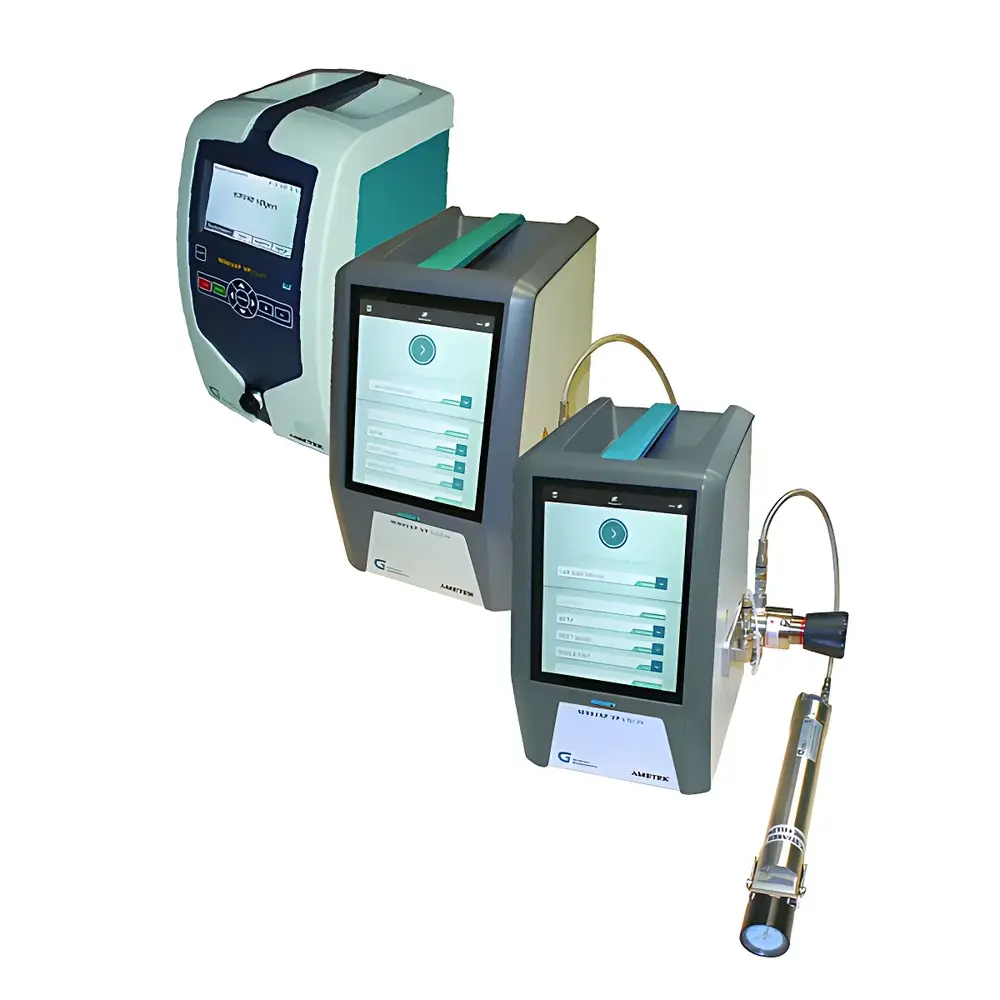
GRABNER MiniVAP VPVision Crude Oil Vapor Pressure Analyzer
| Brand | GRABNER |
|---|---|
| Origin | Austria |
| Model | MiniVAP VPVision Crude Oil |
| Analysis Method | Three-Stage Expansion |
| Pressure Range | 0–2000 kPa |
| Temperature Range | 0–120 °C |
Overview
The GRABNER MiniVAP VPVision Crude Oil Vapor Pressure Analyzer is a fully automated, micro-volume vapor pressure measurement system engineered for precision, regulatory compliance, and operational robustness in petroleum and chemical testing laboratories. It operates on the internationally validated three-stage expansion principle—defined in ASTM D6378 and D6377—and is formally recognized by the U.S. Environmental Protection Agency (EPA) under 40 CFR Part 79 and codified in the Federal Register (58 Fed. Reg. 14478, March 17, 1993). This thermodynamic equilibrium method enables direct determination of true vapor pressure (TVP), Reid vapor pressure (RVP), and vapor pressure of volatile crude oils, distillates, LPG, jet fuels, and hydrocarbon solvents without sample pre-conditioning or external vacuum systems. Its design satisfies critical regulatory frameworks including EU REACH Annex VII, GHS classification requirements (UN TDG, CLP), and China’s SH/T 0769–2005 and SH/T 0794 standards. The instrument delivers high reproducibility (< 0.2 kPa at 37.8 °C for pure reference substances) and long-term stability through proprietary piston-based fluid handling and thermal control architecture.
Key Features
- Three-stage expansion methodology compliant with ASTM D6378, D6377, D5191, D6897, EN 13016-1+2, and IP 394/409/481
- Patented 2D-Correction™ calibration technology (273-point matrix) ensuring accuracy across the full 0–2000 kPa pressure range
- Integrated oscillation module for rapid phase equilibration—essential for crude oil TVP and gas-oil ratio (GOR) measurements
- Sampling Pro™ valve system with wear-resistant piston sealing to eliminate carryover between samples
- Self-lubricating central lubrication system—no field maintenance or disassembly required
- 10-inch industrial-grade capacitive touchscreen with glove-compatible UI and application-style workflow navigation
- Fast Mode™ method combining ASTM D5191 and D5188 protocols for accelerated screening of gasoline and light distillates
- Ultra-low vapor-to-liquid ratio capability (0.02:1 to 100:1), enabling accurate TVP and bubble point determination for unstable crudes
- Reusable metal filter discs compatible with high-sulfur and asphaltenic feedstocks
- Onboard storage for >100,000 test records with timestamped pressure-temperature curves and statistical metadata
Sample Compatibility & Compliance
The MiniVAP VPVision is validated for use with undiluted, unfiltered crude oils—including sour, heavy, and emulsified grades—as well as gasoline, aviation turbine fuel (Jet A/A-1), liquefied petroleum gas (LPG), naphthas, and aromatic solvents. It meets all applicable safety and environmental directives: IEC 61010-1 (electrical safety), EN 60068-2 environmental stress testing (cold, dry heat, damp heat per EN 60068-2-1, -2-78, -2-14), and mechanical shock/vibration resistance per EN 60068-2-6 and EN 60068-2-27 (IEC 60721-3-2 Class 2M2). Regulatory alignment includes FDA 21 CFR Part 11-ready audit trails via Cockpit™ software, GLP-compliant electronic signatures, and full traceability of calibration history, method parameters, and operator credentials.
Software & Data Management
Cockpit™ PC software serves as the centralized laboratory management platform, supporting multi-instrument fleet monitoring, remote diagnostics, firmware updates, and configuration synchronization over secure VPN or LAN. It provides real-time status dashboards, customizable reporting (PDF with embedded trend charts, CSV export), and seamless LIMS integration via ASTM E1384-compliant data exchange. All user actions—including method edits, calibration events, and result approvals—are logged with ISO/IEC 17025-compliant audit trails. Role-based access control (RBAC) enforces SOP adherence through tiered user permissions (Operator, Supervisor, Administrator). Calibration backups include full parameter sets, correction matrices, and sensor drift logs—ensuring full metrological traceability.
Applications
- Determination of True Vapor Pressure (TVP) and bubble point for crude oil custody transfer and pipeline specification compliance
- RVP testing of gasoline blends per ASTM D323 and D5482 for refinery quality control
- Vapor pressure profiling of jet fuels during blending and certification (ASTM D1655 Annex A1)
- Hazard classification of flammable liquids under GHS Category 1–4 and UN transport regulations
- Stability assessment of emulsified or foaming crudes using dynamic pressure-temperature ramping
- Field-deployable verification of vapor pressure specifications at loading terminals, offshore platforms, and mobile labs
- Research applications involving vapor-liquid equilibrium (VLE) modeling and EOS validation
FAQ
Is the MiniVAP VPVision compliant with ASTM D6378 for crude oil TVP measurement?
Yes. Its three-stage expansion protocol, integrated oscillation, and low-ratio sampling are explicitly validated for TVP per ASTM D6378 Section 8.2 and Appendix X1.
Can the instrument operate in ambient temperatures below 0 °C?
The operating range is 0–50 °C; however, optional 12 V DC power conversion enables deployment in cold environments when paired with external thermal enclosures.
Does it support automatic calibration verification?
Yes—Cockpit™ software supports scheduled auto-verification using certified reference standards and generates ISO 17025-compliant calibration certificates.
What sample volume is required for crude oil analysis?
Only 1.0 mL of crude oil is needed per test; 2.2 mL is consumed during automated cleaning cycles.
How is data integrity ensured for regulated environments?
All measurements include digital signatures, immutable audit logs, and time-stamped raw sensor data—fully aligned with FDA 21 CFR Part 11 and EU Annex 11 requirements.




