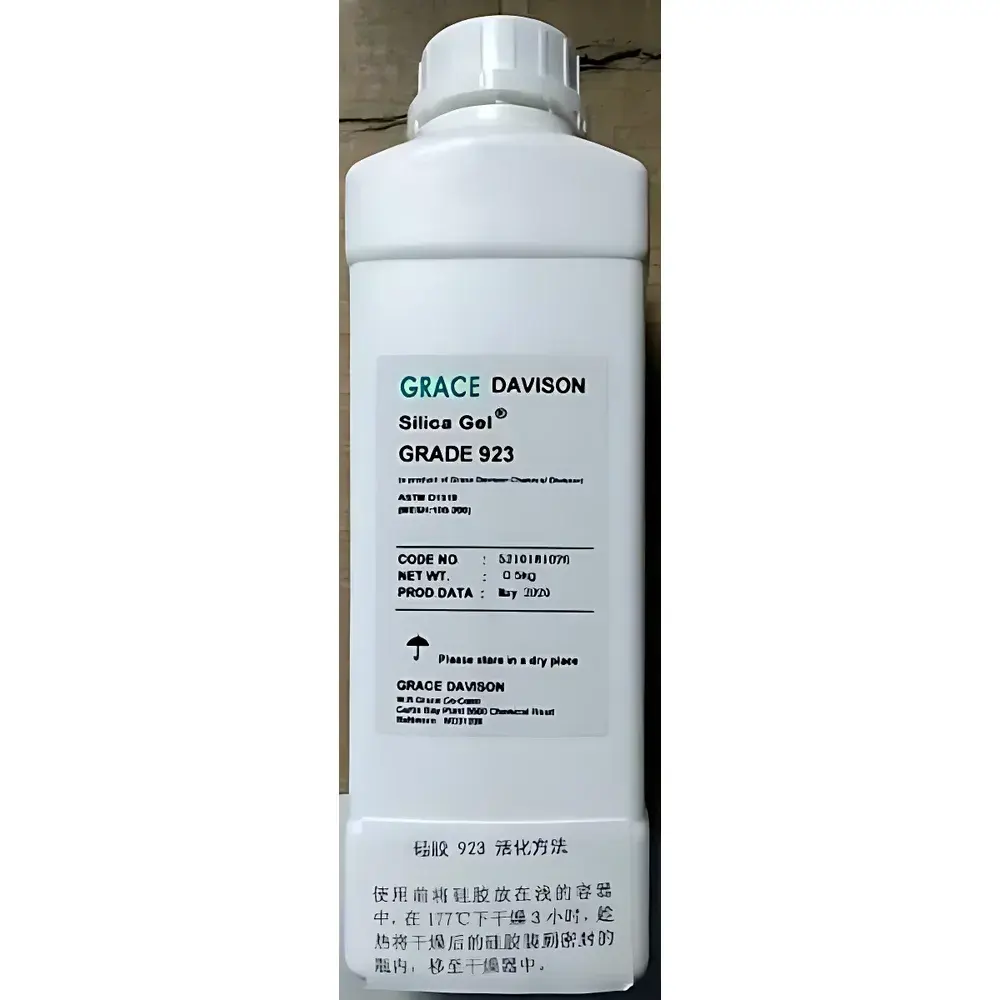
Grace GRACE 923 Chromatographic Silica Gel for Hydrocarbon Analysis
| Brand | Grace |
|---|---|
| Origin | USA |
| Manufacturer Type | Authorized Distributor |
| Origin Category | Imported |
| Model | GRACE 923 |
| Pricing | Available Upon Request |
| Certified Standard | Compliant with GB/T 11132 and ASTM D1319 |
| Average Pore Diameter | 32 Å |
| Pore Size Distribution | Narrow |
| Packaging | 500 g per bottle |
Overview
Grace GRACE 923 Chromatographic Silica Gel is a high-purity, surface-activated silica adsorbent engineered specifically for the quantitative separation and determination of hydrocarbon classes in petroleum distillates. It serves as the critical stationary phase in the Fluorescent Indicator Adsorption (FIA) method—a standardized analytical technique defined in both ASTM D1319 and its Chinese national equivalent, GB/T 11132. The method relies on differential adsorption affinities of aromatic, olefinic, and saturated hydrocarbons onto a silica gel column under controlled elution conditions, followed by UV-induced fluorescence visualization and zone quantification. GRACE 923’s precisely controlled surface chemistry and exceptionally narrow pore size distribution (centered at 32 Å) ensure reproducible band resolution, minimal tailing, and high inter-laboratory agreement—essential attributes for regulatory compliance and refinery quality control.
Key Features
- Ultra-narrow pore size distribution centered at 32 Å, optimized for selective retention of C5–C12 hydrocarbon fractions
- Consistent surface activity and moisture content (<5% w/w), pre-conditioned to meet ASTM D1319 specification requirements
- High batch-to-batch reproducibility validated via reference material testing (e.g., NIST SRM 1848)
- Free-flowing granular morphology (40–63 µm particle size range) ensuring uniform column packing and stable flow dynamics
- Trace metal impurities rigorously controlled to <1 ppm (Fe, Al, Na), minimizing catalytic side reactions during analysis
- Supplied in sealed, desiccated 500 g HDPE bottles with inert gas overlay to preserve adsorptive integrity
Sample Compatibility & Compliance
GRACE 923 silica gel is validated for use with liquid petroleum products including gasoline, naphtha, kerosene, and light diesel distillates having initial boiling points between 30 °C and 250 °C. It supports sample loadings up to 0.2 mL per 10 g of silica without compromising band separation fidelity. The material fully complies with the physical and chemical specifications outlined in Clause 5.1 of ASTM D1319, including specific surface area (≥750 m²/g), loss on ignition (≤5.0%), and acid-washed purity certification. Its performance has been verified across GLP-compliant laboratories participating in CCQM and ILAC proficiency testing schemes. Documentation includes full CoA (Certificate of Analysis) with BET surface area, pore volume, and pH slurry data traceable to NIST standards.
Software & Data Management
While GRACE 923 is a consumable—not an instrument—it integrates seamlessly into digital laboratory workflows governed by electronic record systems. When used with modern FIA instrumentation (e.g., automated fraction collectors coupled to UV/Vis imaging systems), raw band images and integrated area data are captured in vendor-neutral formats (TIFF, CSV). These outputs feed directly into LIMS platforms compliant with 21 CFR Part 11, supporting audit trails, user authentication, and electronic signatures. Grace provides technical documentation packages—including method transfer guides and validation templates—that align with ISO/IEC 17025:2017 clause 7.2.2 (validation of non-standard methods) and support internal SOP development for hydrocarbon class reporting.
Applications
- Regulatory reporting of aromatic and olefin content in reformulated gasoline (EPA Tier 3, EU Fuel Quality Directive 2009/30/EC)
- In-process monitoring of hydrotreater and catalytic cracker effluents
- Research-grade hydrocarbon speciation in alternative fuel blends (e.g., bio-naphtha, Fischer–Tropsch liquids)
- Method verification and reference material calibration in metrology institutes
- Training and accreditation exercises for ASTM D1319 operator certification programs
FAQ
Is GRACE 923 suitable for automated FIA instruments?
Yes—its consistent particle size and low fines generation ensure reliable performance in both manual and semi-automated column systems, including those with programmable solvent delivery and digital band imaging.
What is the shelf life under proper storage?
When stored unopened in original packaging at 15–25 °C and <40% RH, the certified performance remains valid for 24 months from date of manufacture.
Can it be reactivated after exposure to ambient humidity?
No—thermal reactivation alters surface silanol density and pore structure. GRACE 923 is supplied in ready-to-use condition; opening requires immediate column packing under dry nitrogen or low-humidity glovebox conditions.
Does Grace provide method validation support?
Yes—application notes, interlaboratory study summaries, and ASTM D1319 alignment checklists are available upon request to qualified laboratories engaged in petroleum product testing.