
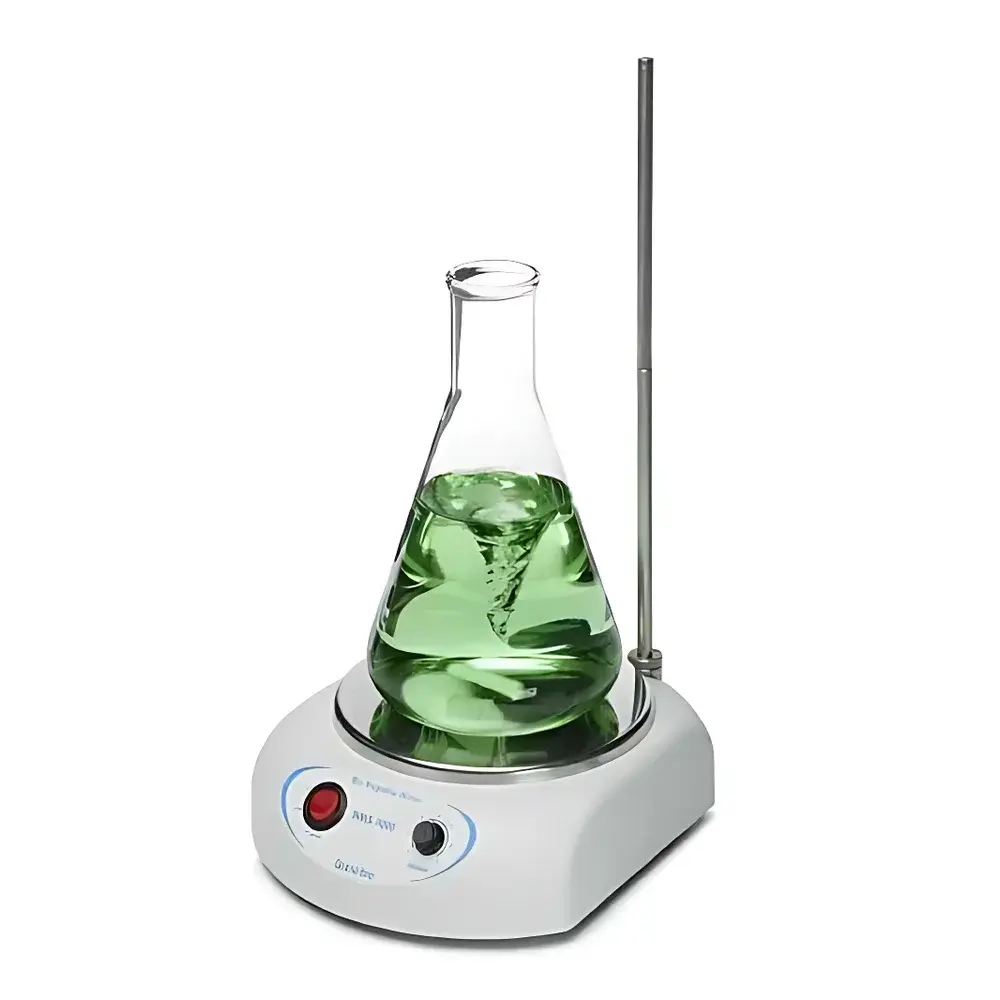
Grant MMS-3000 Compact Magnetic Stirrer
| Origin | UK |
|---|---|
| Manufacturer Type | Authorized Distributor |
| Origin Category | Imported |
| Model | MMS-3000 |
| Price | Upon Request |
Overview
The Grant MMS-3000 Compact Magnetic Stirrer is an engineered solution for precise, low-volume liquid agitation in research, quality control, and teaching laboratories. Utilizing permanent magnet coupling and rotating magnetic field induction, it drives standard cylindrical stir bars within vessels without mechanical contact—eliminating seal wear, contamination risk, or leakage concerns inherent in overhead stirrers. Designed for routine applications including pH calibration, aqueous/organic phase extraction, dialysis buffer equilibration, and reagent homogenization, the MMS-3000 delivers consistent rotational energy transfer across volumes up to 2 L. Its compact footprint (160 mm × 160 mm base) and silent brushless DC motor operation make it ideal for benchtop deployment in fume hoods, biosafety cabinets, or multi-instrument workstations where spatial efficiency and acoustic performance are critical.
Key Features
- Variable speed control from 0 to 3000 rpm via intuitive analog knob—enabling fine-tuned adjustment for viscous media, sensitive biological samples, or rapid mixing protocols
- Stainless steel platform (160 mm² active surface) with chemical-resistant finish—resistant to corrosion from acids, bases, and organic solvents commonly used in analytical workflows
- Detachable vertical support column—facilitates integration of temperature probes, pH electrodes, or conductivity sensors directly into stirred solutions without obstructing rotation or compromising stability
- Low-noise operation (<45 dB(A) at 1 m distance)—maintains ambient laboratory acoustics compatible with adjacent instrumentation and personnel concentration
- Integrated thermal protection circuitry—automatically suspends operation if internal temperature exceeds safe thresholds, ensuring long-term reliability under continuous use
- Supplied with one standard PTFE-coated cylindrical stir bar (6 mm × 25 mm), optimized for efficient torque transmission and inertness in diverse chemical environments
Sample Compatibility & Compliance
The MMS-3000 supports glass, polypropylene, polycarbonate, and borosilicate vessels ranging from 10 mL test tubes to 2 L beakers—provided vessel bottoms are flat and non-magnetic. It is compatible with common laboratory-grade stir bars (diameters 4–8 mm, lengths 15–40 mm). While not certified as intrinsically safe for explosive atmospheres (ATEX/IECEx), its design conforms to IEC 61010-1:2010 safety requirements for electrical equipment used in laboratory settings. The unit meets CE marking directives for electromagnetic compatibility (EMC Directive 2014/30/EU) and low-voltage safety (LVD Directive 2014/35/EU). No regulatory certification for GLP/GMP audit trails is provided, as the device lacks digital logging capability; however, its mechanical simplicity ensures reproducibility suitable for SOP-driven procedures under ISO/IEC 17025-accredited testing environments.
Software & Data Management
The MMS-3000 operates as a standalone analog instrument with no embedded firmware, network interface, or data output ports. Speed setting is manually recorded by users during protocol execution. For traceable documentation in regulated workflows (e.g., pharmaceutical QC per USP or ISO 15189), laboratories may integrate external digital tachometers or time-stamped video capture systems. Grant Instruments provides full technical documentation—including electrical schematics, mechanical drawings, and RoHS/REACH compliance statements—in English upon request, supporting equipment qualification (IQ/OQ) activities required by FDA 21 CFR Part 11–aligned quality systems.
Applications
- pH meter calibration and electrode conditioning in standardized buffer solutions
- Liquid–liquid extraction of analytes (e.g., pesticide residues in food matrices per AOAC 2007.01)
- Dialysis membrane equilibration with physiological saline or Tris-HCl buffers
- Preparation of homogeneous stock solutions for HPLC mobile phases or cell culture media
- Accelerated dissolution testing of solid dosage forms in USP Apparatus II–compatible vessels
- Small-scale enzymatic reaction mixing under controlled thermal conditions when paired with Grant’s circulating water baths
FAQ
What is the maximum recommended viscosity for stable operation at 3000 rpm?
For optimal torque transmission and stir bar centering, the MMS-3000 is validated for aqueous solutions ≤ 50 mPa·s (e.g., 1% w/v CMC or 5% glycerol/water) at full speed. Higher viscosities require reduced rpm to prevent vortex instability or bar ejection.
Can the MMS-3000 be used inside a cold room or incubator?
Yes—its operating temperature range is 5 °C to 40 °C, and relative humidity tolerance is up to 80% non-condensing. Ensure adequate ventilation around the unit to prevent condensation on electronics.
Is the stainless steel platform autoclavable?
No—the platform is not designed for steam sterilization. Surface decontamination should be performed using 70% ethanol, isopropanol, or diluted sodium hypochlorite (≤0.5%), followed by thorough drying.
Does Grant offer calibration services for the MMS-3000?
Grant provides factory verification of speed accuracy (±3% of setpoint at 25 °C ambient) with each unit. NIST-traceable recalibration is available through authorized service centers upon request.
Are replacement stir bars available in different geometries?
Yes—Grant supplies elliptical, cross-shaped, and micro stir bars (down to 2 mm × 8 mm) for specialized applications such as microcentrifuge tube agitation or high-shear dispersion. All are PTFE- or PTFE/glass-coated for chemical inertness.



