
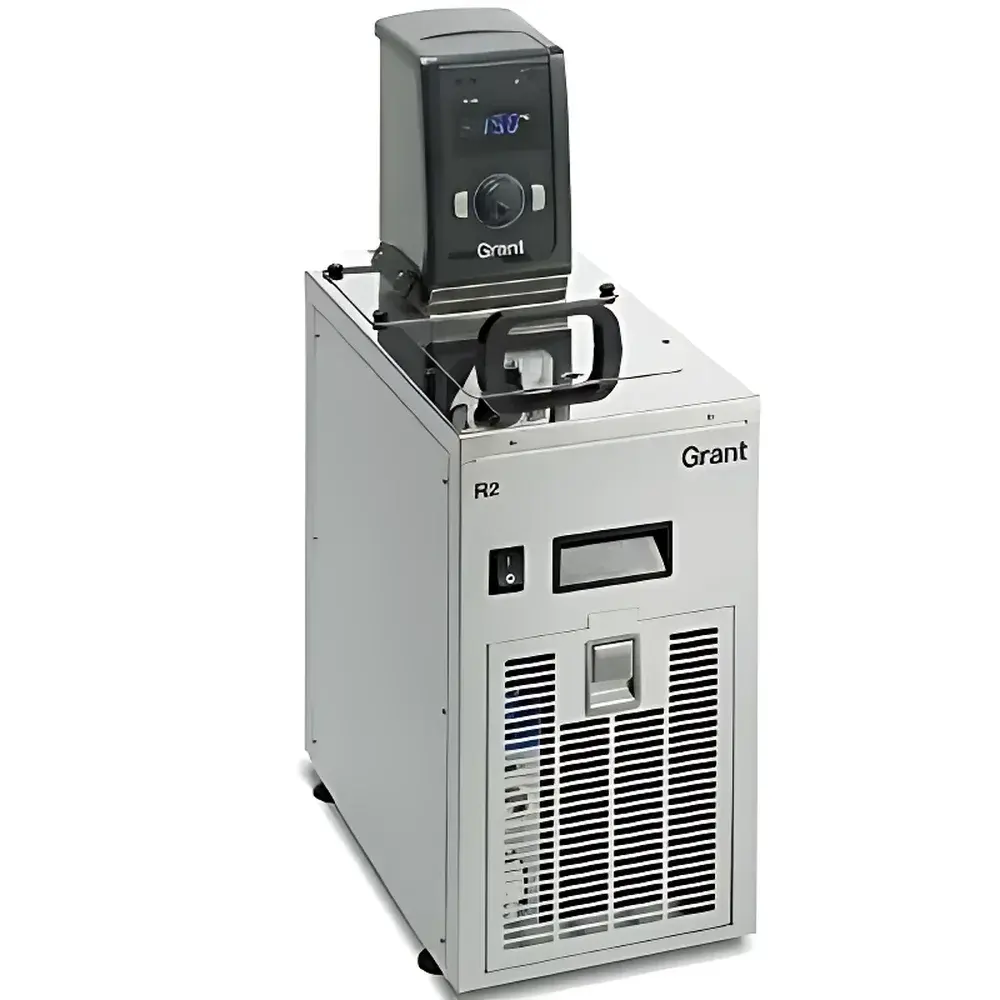
Grant Optima TC120 R Series Refrigerated Circulating Bath
| Brand | Grant |
|---|---|
| Origin | UK |
| Model | TC120 R |
| Temperature Range | −20 °C to +100 °C |
| Stability | ±0.1 °C (DIN 12876, water @ 10 °C) |
| Pump Flow Rate | up to 16 L/min |
| Display | 4-digit LED |
| Control | Adaptive Smart PID with Intelligent Control Optimization (ICO™) |
| Calibration | User-accessible two-point self-calibration |
| Safety Features | Adjustable overtemperature cutoff, low-level float switch, audible alarm |
| Communication | RS232 & USB (with Labwise™ software support) |
| Compliance | DIN 12876 Class I, CE, RoHS |
Overview
The Grant Optima TC120 R Series is a precision-engineered refrigerated circulating bath system designed for laboratory applications requiring stable, bidirectional temperature control across a wide operational range (−20 °C to +100 °C). Unlike passive water baths or basic heating-only units, the TC120 R integrates a high-efficiency vapor-compression refrigeration circuit—using environmentally compliant R134a refrigerant—with a digitally regulated immersion or external circulation architecture. Its core thermal management relies on adaptive Smart PID control enhanced by Grant’s proprietary Intelligent Control Optimization (ICO™) algorithm, which dynamically adjusts heating/cooling power output based on bath fluid composition (e.g., water, 50% ethylene glycol/water), load mass, and ambient conditions. This ensures rapid equilibration, minimal overshoot, and long-term stability of ±0.1 °C (per DIN 12876 in water at 10 °C)—a performance benchmark essential for kinetic studies, enzymatic assays, calorimetric calibration, and material testing where thermal drift directly impacts data reproducibility.
Key Features
- Wide dual-mode temperature control: −20 °C to +100 °C with automatic fluid-type compensation (water or glycol-based mixtures)
- Integrated high-capacity circulation pump delivering up to 16 L/min flow rate and 210 mbar pressure (TC120 R base model); optional R-series chillers extend cooling capacity down to −47 °C
- Intuitive single-knob + two-button interface with 4-digit LED display—optimized for glove-compatible operation and remote readability
- User-accessible two-point temperature calibration system enabling traceable field adjustment without service intervention
- Programmable timer (1 min to 99 h 59 min) with audible alert and configurable setpoint deviation alarm
- Dual safety architecture: adjustable overtemperature cutoff (user-defined threshold), mechanical low-level float switch, and refrigerant high-pressure cutout (R4/R5 models)
- Compliant with DIN 12876 Class I specifications for temperature uniformity (±0.1 °C) and stability in aqueous and mixed-fluid media
Sample Compatibility & Compliance
The TC120 R accommodates diverse sample configurations—including immersed vessels (e.g., reaction flasks, cuvettes, viscometer spindles), jacketed reactors, and externally connected analytical instruments (e.g., HPLC column ovens, spectrophotometer thermostats). Its sealed, corrosion-resistant stainless-steel reservoir and chemically inert fluid pathways support compatibility with water, ethanol, silicone oils, and 50/50 ethylene glycol–water solutions. All models meet CE marking requirements under the EU Machinery Directive 2006/42/EC and Electromagnetic Compatibility Directive 2014/30/EU (Class B emission limits). For regulated environments, the TC120 R supports audit-ready operation when paired with Labwise™ software: full electronic log of setpoints, actual temperatures, alarms, and user actions—enabling compliance with FDA 21 CFR Part 11 (when configured with electronic signature and audit trail), ISO/IEC 17025, and GLP/GMP documentation standards.
Software & Data Management
Grant’s Labwise™ PC software (included with TC120 TXF200/TX150 controllers and optionally available for TC120 R via USB/RS232 interface) enables remote monitoring, multi-step temperature programming (up to 100 segments), real-time graphing, and export of timestamped CSV data logs. The software implements secure user authentication, role-based access control, and immutable audit trails—including operator ID, parameter changes, alarm events, and calibration records. When used with optional external PT100 probes (TXPEP/TXSEP), Labwise™ supports cascade control modes for chamber-in-bath or reactor-jacket applications, ensuring precise thermal coupling between primary and secondary zones. All firmware updates are delivered via signed binary packages to maintain system integrity and cybersecurity posture.
Applications
- Temperature-controlled enzymatic and microbial incubations requiring sub-zero stabilization
- Calibration of thermistors, RTDs, and infrared sensors against NIST-traceable references
- Viscosity measurements using rotational rheometers or capillary viscometers with external coolant loops
- Stability testing of pharmaceutical formulations per ICH Q1A(R2) guidelines
- Thermal cycling of polymer samples during DSC or TMA method development
- Chill-heating of chromatography columns and detectors to optimize retention time reproducibility
- Material science testing of elastomers, adhesives, and composites under controlled thermal stress
FAQ
What is the maximum operating temperature when using a refrigerated chiller unit?
All R-series chillers (R1–R5) are rated for a maximum bath temperature of 100 °C. Operation above this limit may compromise refrigerant system integrity and void warranty coverage.
Can the TC120 R operate without an external chiller?
Yes—the TC120 R controller includes integrated heating and limited self-contained cooling; however, full −20 °C capability requires connection to an R-series chiller (R1–R5).
Is the pump flow rate adjustable?
The base TC120 R pump delivers fixed flow up to 16 L/min; higher-end R-series chillers (R3–R5) feature continuously variable speed control for fine-tuned pressure and flow regulation.
Does the system support external temperature feedback for closed-loop control?
Yes—optional TXPEP (probe-in-bath) or TXSEP (external probe) sensors enable dynamic setpoint correction based on actual sample or process temperature, improving thermal accuracy in non-ideal heat-transfer scenarios.
How is traceability maintained during calibration?
The built-in two-point self-calibration function logs date, time, reference values, and user ID; calibration events are archived in Labwise™ audit trails and can be exported as PDF reports with digital signatures.



