
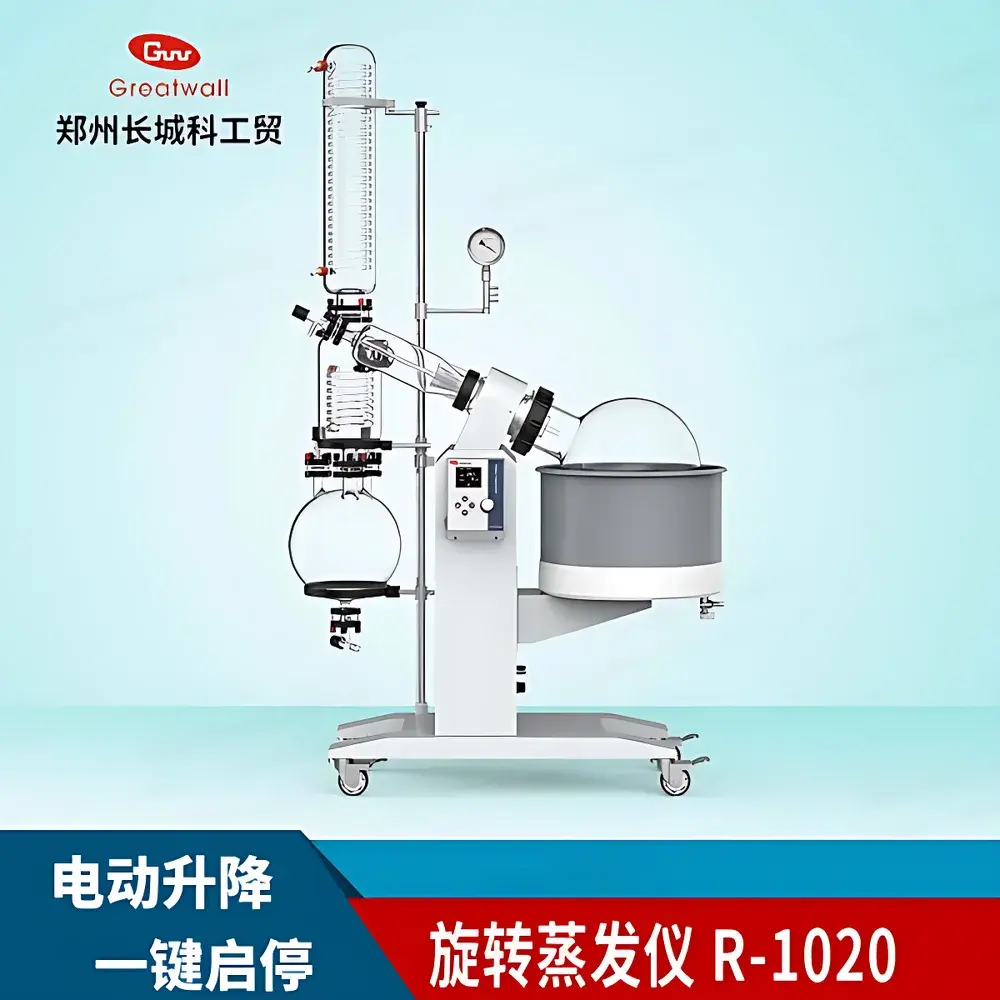
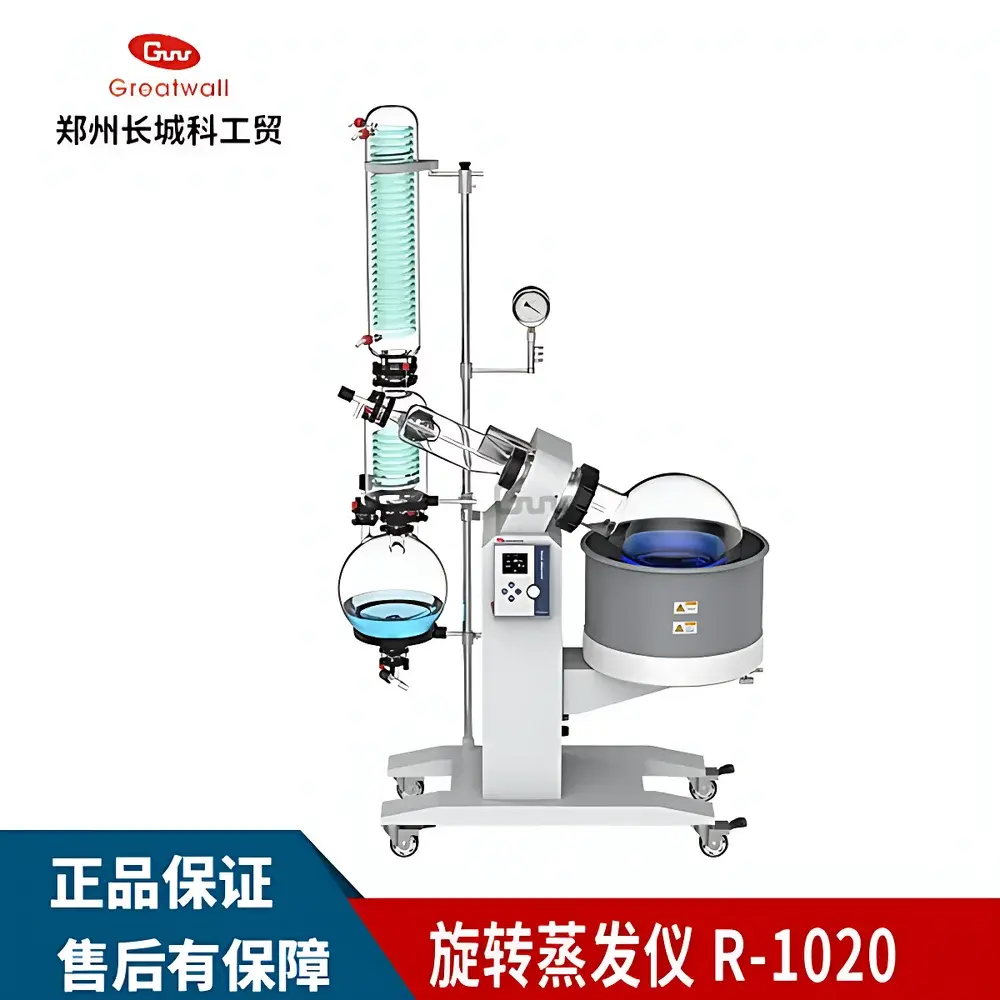
The Great Wall R-1020L 20-Liter Rotary Evaporator
| Brand | The Great Wall |
|---|---|
| Origin | Henan, China |
| Manufacturer Type | Direct Manufacturer |
| Origin Category | Domestic (China) |
| Model | R-1020L |
| Capacity | 20 L |
| Temperature Control Range | Ambient +5°C to 95°C |
| Temperature Control Accuracy | ±1.5°C |
| Construction Material | Borosilicate Glass 3.3 |
| Condenser Type | Dual-Cooling (Main + Auxiliary) Triple-Return Condenser |
| Sealing System | PTFE + Fluoroelastomer Dual-Seal Ring |
| Bath Lift Mechanism | Motorized Vertical Adjustment |
| Safety Features | Over-Temperature Protection |
| Flask Interface | Quick-Connect Flange Coupling |
| Drain Valve | PTFE Ball Valve |
| Mobility | Braked Casters with Position Lock |
Overview
The Great Wall R-1020L is a high-capacity, laboratory-grade rotary evaporator engineered for efficient, scalable solvent removal and compound concentration in research, quality control, and pilot-scale purification workflows. Designed around the fundamental principle of reduced-pressure distillation—where lowering the system pressure decreases the boiling point of solvents—the R-1020L enables gentle thermal processing of heat-sensitive compounds while maintaining high recovery yields. Its 20-liter rotating evaporation flask provides expanded batch capacity compared to standard benchtop units, making it suitable for applications requiring larger-volume processing without compromising vacuum integrity or thermal stability. The instrument operates within a precisely regulated temperature range of ambient +5°C to 95°C, with an accuracy of ±1.5°C, ensuring reproducible evaporation kinetics across diverse solvent systems including ethanol, acetone, dichloromethane, ethyl acetate, and aqueous mixtures.
Key Features
- Borosilicate glass 3.3 construction throughout all critical components—including the rotating flask, condenser, receiving flasks, and three-way buffer bottle—ensures exceptional resistance to thermal shock, chemical corrosion, and mechanical stress under prolonged vacuum operation.
- Dual-cooling triple-return condenser architecture significantly increases effective condensing surface area, enhancing vapor capture efficiency and minimizing solvent loss during high-throughput evaporation cycles.
- Motorized vertical bath lift mechanism allows precise, repeatable positioning of the heating bath relative to the rotating flask, facilitating safe and ergonomic operation—especially during flask loading/unloading or process optimization.
- PTFE-fluoroelastomer dual-seal ring system delivers superior vacuum integrity at pressures down to ≤10 mbar, eliminating leakage risks associated with single-material gaskets under extended thermal cycling.
- Quick-connect flange interfaces enable tool-free assembly and disassembly of glassware, reducing setup time and minimizing risk of breakage during routine maintenance or configuration changes.
- Integrated over-temperature protection circuitry automatically deactivates heating if bath temperature exceeds preset limits, preventing dry-run conditions and safeguarding both sample integrity and equipment longevity.
- Ergonomic PTFE ball valve drain port permits controlled, contamination-free discharge of collected distillate without interrupting ongoing evaporation—critical for multi-step fractionation protocols.
Sample Compatibility & Compliance
The R-1020L accommodates a broad spectrum of organic, inorganic, and aqueous solutions, including but not limited to pharmaceutical intermediates, natural product extracts, polymer solutions, and synthetic reaction mixtures. Its inert borosilicate glass path and PTFE-wetted surfaces ensure compatibility with aggressive solvents (e.g., chlorinated hydrocarbons, strong acids/bases at moderate concentrations) and eliminate metal ion leaching concerns. While not certified to specific ISO/IEC 17025 or GLP validation frameworks out-of-the-box, the system’s design supports traceable operation when integrated into compliant laboratory environments—particularly when paired with calibrated external temperature sensors, validated vacuum gauges, and documented SOPs aligned with ASTM E2654 (Standard Guide for Validation of Analytical Methods for Volatile Organic Compounds) and USP (Validation of Compendial Procedures).
Software & Data Management
The R-1020L features a dedicated digital controller with LCD interface supporting real-time display of bath temperature and rotation speed. Parameter inputs are executed via intuitive rotary encoder (“one-touch flywheel”), enabling rapid, tactile adjustment without menu navigation. Though the base model does not include PC connectivity or data logging firmware, its analog-compatible output signals (0–10 V or 4–20 mA optional) allow integration with third-party SCADA systems or programmable logic controllers (PLCs) for centralized monitoring in GMP-aligned facilities. Audit trail functionality may be implemented externally using compliant data acquisition hardware adhering to FDA 21 CFR Part 11 requirements for electronic records and signatures.
Applications
- Concentration of large-volume botanical extracts in nutraceutical and cosmeceutical development labs.
- Removal of reaction solvents following multi-gram scale synthesis in medicinal chemistry and process R&D.
- Recovery and recycling of high-purity solvents in sustainable manufacturing settings.
- Pretreatment of environmental water samples prior to GC-MS or HPLC analysis.
- Dehydration of heat-labile biopolymers and enzyme formulations under controlled low-temperature vacuum conditions.
FAQ
What is the maximum recommended operating vacuum level for the R-1020L?
The system is designed for stable operation at pressures between 5 and 50 mbar; optimal performance is achieved at ≤15 mbar when paired with a compatible vacuum pump (e.g., diaphragm or oil-sealed rotary vane).
Can the R-1020L be used with corrosive solvents such as concentrated HCl or HF?
No—while borosilicate glass 3.3 resists many acids, hydrofluoric acid (HF) and hot concentrated phosphoric or sulfuric acids are incompatible and will etch or degrade the glass. Always consult chemical compatibility charts before use.
Is the heating bath filled with water or oil by default?
The bath is designed for either water or silicone oil, depending on required temperature range; water is sufficient up to ~95°C, while oil extends upper limits to 180°C (requires optional high-temp bath module).
Does the R-1020L support automatic distillation endpoint detection?
Not natively—the unit lacks integrated weight or conductivity-based endpoint sensing. Endpoint determination must be performed manually or via external balance integration.
What maintenance intervals are recommended for long-term reliability?
Inspect PTFE seals and vacuum tubing every 3 months; clean condenser coils after each solvent class change; verify bath heater calibration annually using a traceable NIST-certified thermometer.



