
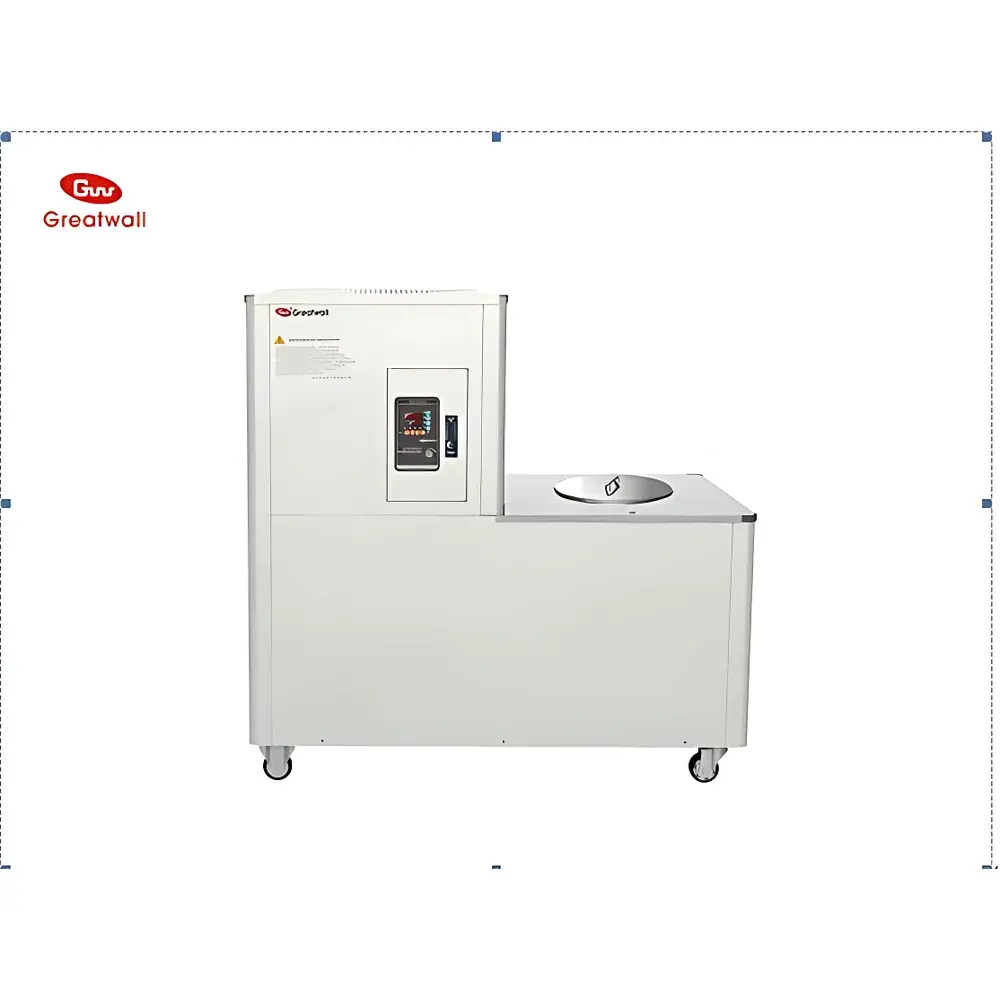
Great Wall DHJF-120 Series Ultra-Low-Temperature Circulating Bath with Integrated Stirring Function
| Brand | The Great Wall |
|---|---|
| Origin | Henan, China |
| Manufacturer Type | OEM/ODM Producer |
| Model | DHJF-1220 |
| Cooling Capacity | 600 W at −60 °C, 480 W at −80 °C, 180 W at −100 °C, 40 W at −120 °C |
| Temperature Range | −120 °C to −60 °C |
| Temperature Stability | ±2 °C |
| Bath Volume | 20 L |
| Circulation Flow Rate | 20 L/min |
| Max. Pressure | 0.4 bar |
| Pump Power | 100 W |
| Total Power Consumption | 4000 W |
| Reservoir Material | 304 Stainless Steel |
| Reservoir Dimensions (Ø×H) | 300 mm × 300 mm |
| Max. Flask Capacity | 5000 mL |
| Display | Digital LCD with Keypad Interface |
| Safety Protections | Delayed Start, Overcurrent, Overtemperature, Phase Sequence Monitoring |
| Refrigerant | Mixed Cryogenic Refrigerant |
| Ambient Operating Conditions | 5–35 °C, ≤70% RH |
| Power Supply | 3-phase, 380 V, 50 Hz |
| External Port Size | 1/2″ NPT |
| Footprint (W×D×H) | 810 × 1160 × 1310 mm |
| Net Weight | 190 kg |
| Critical Operational Constraint | External circulation must be disabled when bath temperature < −90 °C |
Overview
The Great Wall DHJF-1220 is an ultra-low-temperature circulating bath engineered for precision thermal control in cryogenic synthetic chemistry, low-temperature catalysis, and material science applications requiring sustained operation between −120 °C and −60 °C. Unlike conventional single-stage refrigeration systems, it implements a proprietary single-compressor, multi-stage cascade condensation architecture—achieved via a fully welded, all-copper serial heat exchanger array. This design eliminates intermediate refrigerant staging valves and reduces weld joints by over 60% compared to parallel cascade systems, significantly enhancing long-term hermetic integrity and serviceability. The core refrigeration loop integrates a Panasonic hermetically sealed scroll compressor with built-in thermal overload protection, an oxygen-free copper finned air-cooled condenser utilizing proprietary tube-expansion bonding technology, and a high-efficiency coil-type evaporator immersed directly within the 304 stainless steel reservoir. Thermal energy transfer occurs via a non-toxic, low-viscosity cryogenic heat transfer fluid compatible with extended operation below −100 °C. The system’s structural architecture prioritizes mechanical robustness, corrosion resistance, and operational safety—critical for unattended overnight runs in regulated laboratory environments.
Key Features
- Single-compressor, serial-stage sub-zero refrigeration capable of stable −120 °C operation without liquid nitrogen or external cryogens
- Immersion-type coil evaporator fully enclosed within the 20 L 304 stainless steel reservoir—designed to withstand thermal shock from localized freezing of heat transfer medium
- Low-noise, corrosion-resistant stainless steel magnetic drive circulation pump (100 W, 20 L/min, 0.4 bar max pressure) with dry-run protection
- Digital LCD controller with intuitive Chinese-language interface (configurable firmware supports English localization), real-time temperature logging, and programmable ramp-hold profiles
- Comprehensive electrical and thermal safety suite: phase sequence monitoring, delayed startup, overcurrent cutoff, dual-stage overtemperature shutdown, and compressor thermal limiter
- Modular mechanical layout with front-access service panels, standardized 1/2″ NPT external ports, and footprint-optimized chassis (810 × 1160 × 1310 mm)
Sample Compatibility & Compliance
The DHJF-1220 accommodates standard laboratory glassware up to 5 L capacity (e.g., jacketed reactors, Schlenk tubes, cryo-condensers) via its Ø280 mm open-top reservoir. All wetted components—including circulation tubing, pump housing, and reservoir—are fabricated from ASTM A240 304 stainless steel, ensuring compatibility with common organic solvents (THF, toluene, diethyl ether), halogenated media, and low-temperature reaction mixtures. The unit complies with IEC 61010-1:2010 for electrical safety in laboratory equipment and meets CE marking requirements for electromagnetic compatibility (EMC Directive 2014/30/EU). While not certified to ISO/IEC 17025 or GLP Annexes per se, its digital control system supports audit-ready temperature traceability when integrated with external data acquisition hardware compliant with FDA 21 CFR Part 11 (electronic records/signatures) via optional RS485 or analog 4–20 mA output modules.
Software & Data Management
The embedded controller provides local setpoint programming, real-time display of bath temperature, compressor status, and fault codes. Though no proprietary PC software is bundled, the unit supports passive data logging through its analog voltage output (0–5 V DC proportional to temperature) or digital Modbus RTU over RS485—enabling seamless integration into LabVIEW, MATLAB, or enterprise LIMS platforms. All temperature readings are referenced to a calibrated Pt100 sensor mounted adjacent to the evaporator coil, with factory calibration traceable to NIM (National Institute of Metrology, China). Firmware updates are performed via USB port; configuration backups and event logs (including timestamped alarm history) can be exported for internal QA documentation.
Applications
- Cryogenic Grignard and organolithium reagent synthesis requiring precise −100 °C to −70 °C thermal control
- Low-temperature polymerization studies (e.g., anionic ring-opening of epoxides or lactones)
- Superconductivity precursor preparation and metal–organic framework (MOF) crystallization under deep-cryo conditions
- Calibration of infrared detectors and bolometric sensors in metrology labs
- Thermal stress testing of aerospace composites and cryo-electronics packaging
- Condensation trapping in high-vacuum distillation or solvent recovery systems
FAQ
Can the DHJF-1220 operate continuously at −120 °C with external circulation enabled?
No. External circulation must be disabled whenever the bath temperature falls below −90 °C to prevent pump cavitation, impeller fracture, and thermal shock-induced seal failure.
Is the refrigerant mixture ozone-depleting or subject to F-Gas Regulation restrictions?
The blended refrigerant contains zero ODP (Ozone Depletion Potential) components and complies with EU F-Gas Regulation (EU) No 517/2014 Tier II thresholds for GWP-weighted charge limits.
What maintenance intervals are recommended for the scroll compressor and heat exchanger?
Compressor oil inspection every 2000 operating hours; full refrigerant circuit leak check and filter-drier replacement every 36 months or after any refrigerant recharge.
Does the unit support remote start/stop or setpoint adjustment via network protocol?
Not natively—but Modbus RTU over RS485 enables full read/write access to all operational parameters when connected to a Modbus master controller or industrial PLC.
Is the reservoir geometry compatible with custom-fit insulation jackets or vacuum shrouds?
Yes. The cylindrical 300 mm × 300 mm reservoir features uniform wall thickness and external mounting flanges, permitting third-party cryo-insulation retrofitting without compromising structural integrity or thermal stability.



