
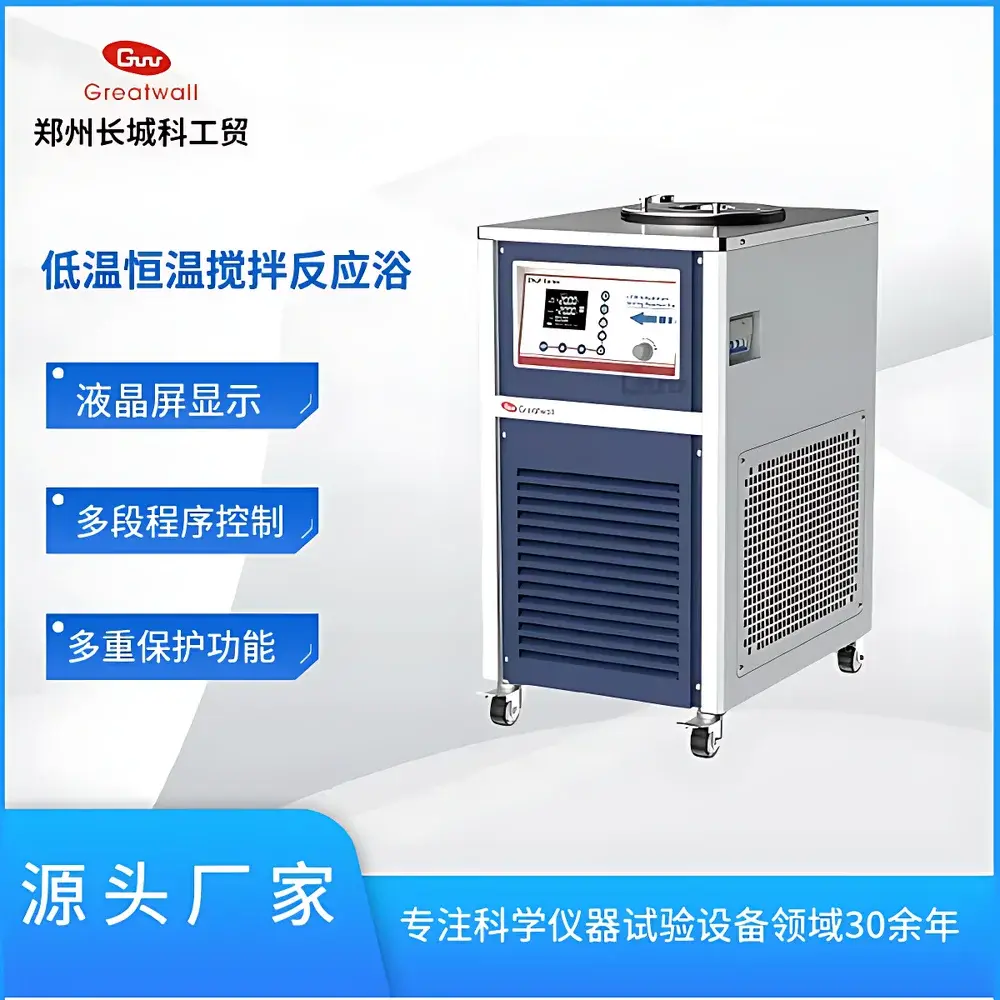
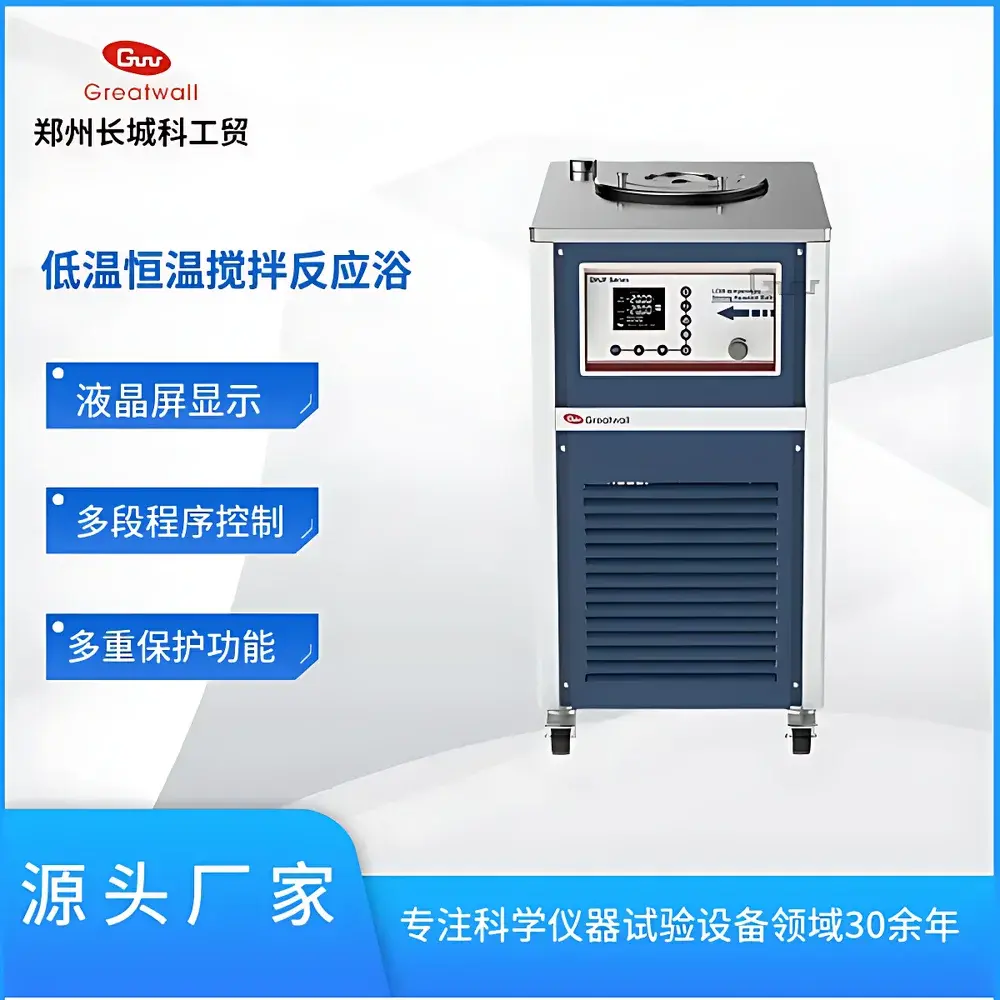
The Great Wall DHJF-2005 Low-Temperature Constant-Temperature Stirred Reaction Bath
| Brand | The Great Wall |
|---|---|
| Origin | Henan, China |
| Manufacturer Type | Direct Manufacturer |
| Equipment Type | Vertical |
| Temperature Stability | ±0.2 °C |
| Operating Temperature Range | −20 °C to 99 °C |
| Bath Opening Diameter | Ø210 mm |
| Heating Power | 1500 W |
| Bath Volume | 5 L |
| External Dimensions (W×D×H) | 385 mm × 560 mm × 735 mm |
| Net Weight | 55 kg |
| Refrigerant | R404A |
| Refrigeration Capacity | 570 W at 10 °C, 470 W at 0 °C, 385 W at −10 °C, 230 W at −20 °C |
| Circulation Pump Flow Rate | 20 L/min |
| Max. Pressure | 0.4 bar |
| Magnetic Stirring Power | 50 W |
| Stirring Speed Range | 100–1000 rpm |
| Input Power Supply | 220 V~, 50 Hz |
| Protection Functions | Dry-run prevention (heating), overtemperature, overcurrent, leakage current, thermal delay, and overheat safeguards |
| Ambient Operating Conditions | 5–35 °C, ≤70% RH |
| Bath Material | 304 Stainless Steel |
| Max. Flask Capacity Supported | 2000 mL |
| External Circulation Port | Rc1/2 |
Overview
The Great Wall DHJF-2005 Low-Temperature Constant-Temperature Stirred Reaction Bath is a vertically oriented, dual-mode thermal management system engineered for precision temperature control in laboratory-scale chemical synthesis, kinetic studies, and physical property measurements. It functions both as a self-contained thermostatic bath—capable of maintaining stable temperatures across a wide operational range—and as an external cold or hot source for auxiliary equipment via its integrated circulation pump. Its core architecture combines a hermetic refrigeration circuit using R404A refrigerant with resistive heating elements and a high-torque magnetic stirrer, enabling simultaneous temperature regulation, fluid mixing, and heat transfer to reaction vessels such as round-bottom flasks, jacketed reactors, or sensor housings. Unlike passive cooling baths, the DHJF-2005 actively circulates thermal fluid through closed-loop external connections (Rc1/2 port), supporting applications requiring remote temperature control or integration into larger experimental setups—for instance, coupling with spectroscopic cells, calorimeters, or chromatographic columns.
Key Features
- PID-based digital temperature control delivering ±0.2 °C stability across the full −20 °C to 99 °C range, validated under standard ambient conditions (25 °C, ≤70% RH).
- Integrated magnetic stirring system (50 W, 100–1000 rpm) capable of driving both internal bath stirrers and submerged stir bars within reaction vessels—ensuring homogeneous thermal distribution and minimizing thermal stratification.
- Adjustable telescopic cover with Ø210 mm aperture, designed to minimize evaporative loss of heat-transfer fluid (e.g., ethanol/water or silicone oil blends) and reduce parasitic heat exchange with ambient air.
- Dual-purpose stainless steel bath vessel (304 grade, Ø250 mm × 130 mm depth, 5 L capacity) compatible with vessels up to 2000 mL; includes standardized mounting rail and accessory bracket for titration burettes, PT100 probes, or pH electrodes.
- Comprehensive safety architecture: dry-burn protection on heating elements, real-time monitoring of refrigerant discharge temperature, current-sensing circuit breakers, ground-fault interruption, and redundant overtemperature cutoffs aligned with IEC 61010-1 Class II requirements.
Sample Compatibility & Compliance
The DHJF-2005 accommodates standard laboratory glassware—including borosilicate flasks (up to 2 L), immersion-cooled condensers, and externally jacketed reactors—without requiring custom adapters. Its 304 stainless steel bath interior resists corrosion from common cryogenic and high-temperature heat-transfer media (e.g., ethylene glycol/water mixtures, silicone oils). While not certified to ISO/IEC 17025 or GLP-specific validation protocols out-of-the-box, the unit’s deterministic PID response, traceable temperature calibration points, and audit-ready protection logs support qualification per internal SOPs or regulatory frameworks such as FDA 21 CFR Part 11 when paired with compliant data acquisition software. It meets CE marking requirements for electrical safety (EN 61010-1) and electromagnetic compatibility (EN 61326-1), and complies with RoHS Directive 2011/65/EU regarding hazardous substances.
Software & Data Management
The DHJF-2005 operates via an embedded microcontroller interface with dual-line LCD display and tactile membrane keys—designed for glove-compatible operation in controlled environments. Real-time parameters (setpoint, actual bath temperature, stirring speed, error codes) are continuously visible. Though no proprietary PC software is bundled, the device supports analog voltage output (0–5 V) proportional to bath temperature for integration with third-party DAQ systems (e.g., LabVIEW, MATLAB, or SCADA platforms). All safety-triggered events—including overtemperature lockout, pump stall detection, and refrigerant pressure anomalies—are timestamped and retained in non-volatile memory for post-event diagnostics. For laboratories implementing electronic recordkeeping, this log data can be manually exported via serial interface (RS-232 optional upgrade) and archived in accordance with ALCOA+ principles (Attributable, Legible, Contemporaneous, Original, Accurate, Complete, Consistent, Enduring, Available).
Applications
- Controlled-rate crystallization and polymorph screening in pharmaceutical development.
- Exothermic reaction quenching during Grignard or lithium-aluminum hydride reductions.
- Calibration of thermocouples, RTDs, and infrared pyrometers against NIST-traceable references.
- Thermal preconditioning of polymer samples prior to DSC or DMA analysis.
- Stabilization of laser diodes, photomultiplier tubes, or CCD detectors in optical instrumentation.
- Supporting multi-step organic syntheses requiring sequential heating/cooling cycles with in-situ agitation.
FAQ
What heat-transfer fluids are recommended for operation below 0 °C?
Ethanol/water (30/70 v/v) or commercial low-temperature silicone oils (e.g., DC-200 series) are suitable down to −20 °C. Avoid aqueous glycols below −10 °C due to increased viscosity and reduced pump efficiency.
Can the DHJF-2005 be used for external cooling only—without internal stirring?
Yes. Stirring function is independently controllable via front-panel toggle; the unit maintains temperature stability and circulation flow even with stirring disabled.
Is the refrigeration system serviceable in the field?
Refrigerant circuit components (compressor, condenser, expansion valve) are sealed and warrantied for 24 months; servicing requires authorized technician certification per EPA Section 608 (U.S.) or F-Gas Regulation (EU).
How does the dry-burn protection engage during heating mode?
A dedicated PTC thermistor mounted beneath the heater plate detects absence of thermal mass contact; if surface temperature exceeds 120 °C without corresponding bath temperature rise, power is cut within 2 seconds.
What is the maximum allowable backpressure for external circulation?
The built-in centrifugal pump is rated for continuous operation at ≤0.4 bar static pressure; exceeding this may reduce flow rate, impair temperature uniformity, and accelerate seal wear.



