
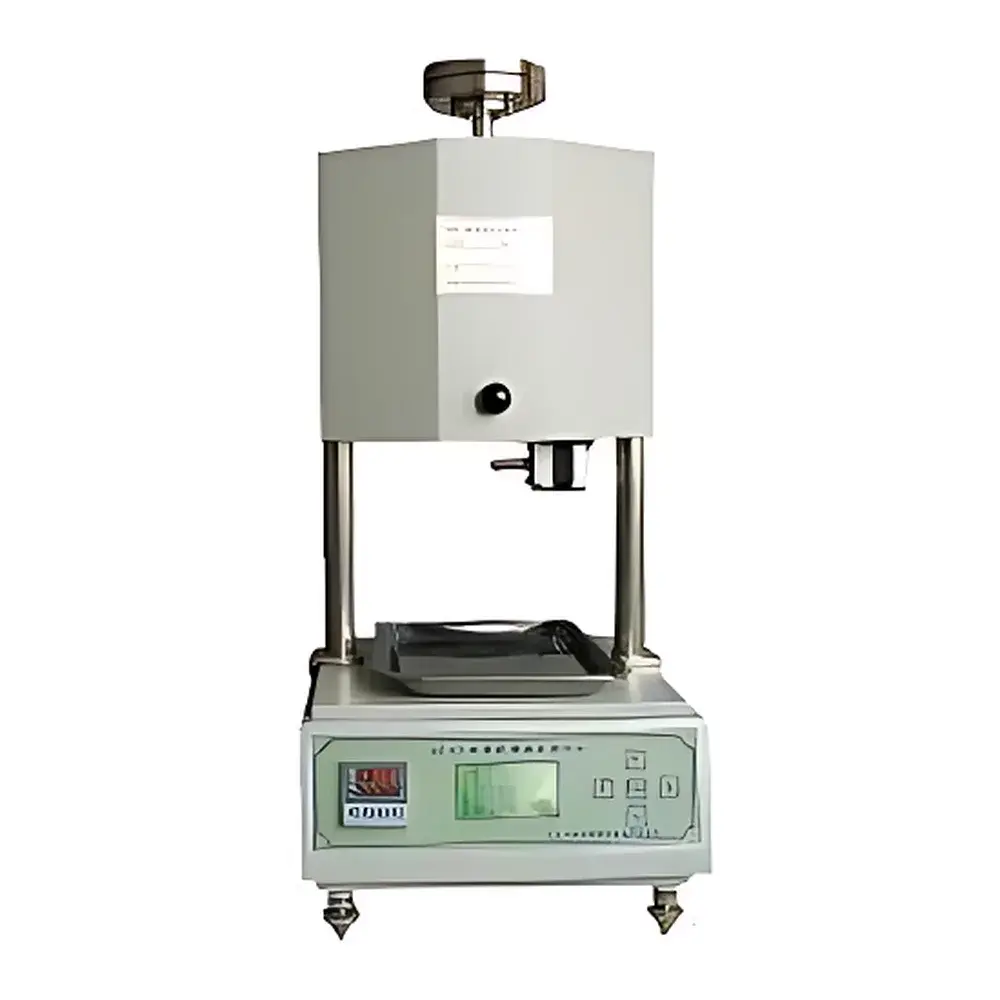
Jiubin GB/T3682-2000 Melt Flow Rate Tester
| Brand | Jiubin |
|---|---|
| Origin | Shanghai, China |
| Model | GB/T3682-2000 |
| Temperature Control Range | 50–400 °C |
| Temperature Accuracy | ±0.2 °C |
| Temperature Resolution | 0.1 °C |
| Power Consumption | 500 W |
| Temperature Recovery Time | 4 min |
| Piston Travel Distance | 30 mm |
| Displacement Resolution | 0.1 mm |
| Barrel Inner Diameter Tolerance | ±0.025 mm |
| Piston Head Diameter Tolerance | ±0.01 mm |
| Piston Head Length Tolerance | ±0.1 mm |
| Die Capillary Inner Diameter Tolerance | ±0.005 mm |
| Standard Weights | 0.325 kg (including piston rod), 0.875 kg, 0.96 kg, 1.2 kg, 1.64 kg |
| Compliance | GB/T 3682–2000, ISO 1133:1997, ASTM D1238 |
Overview
The Jiubin GB/T3682-2000 Melt Flow Rate Tester is a precision gravimetric and volumetric instrument engineered for the standardized determination of melt mass flow rate (MFR) and melt volume flow rate (MVR) of thermoplastic polymers under controlled temperature and load conditions. Based on the fundamental principle of extrusion rheometry—where molten polymer is forced through a standardized capillary die under defined thermal and mechanical stress—the instrument delivers repeatable, traceable flow data essential for quality control, material specification verification, and process development in polymer compounding, injection molding, and extrusion facilities. Its architecture adheres strictly to the operational requirements of GB/T 3682–2000, while maintaining full technical alignment with international standards including ISO 1133:1997 and ASTM D1238, ensuring cross-laboratory comparability and regulatory acceptability in global supply chains.
Key Features
- High-stability PID temperature control system with 50–400 °C operating range, ±0.2 °C accuracy, and 0.1 °C digital resolution—enabling precise thermal conditioning across polyolefins, engineering plastics, and high-temperature resins.
- Rapid thermal recovery (<4 minutes after load change) minimizes cycle time without compromising thermal equilibrium at the barrel wall and die entrance.
- Optical piston displacement detection over a calibrated 30 mm stroke length, with 0.1 mm positional resolution, supporting both timed-cut MFR and automated volumetric MVR calculations.
- Interchangeable standard die capillaries (inner diameter tolerance ±0.005 mm) and precision-machined piston assemblies (head diameter tolerance ±0.01 mm; barrel ID tolerance ±0.025 mm) ensure dimensional conformity to ISO/ASTM geometric specifications.
- Integrated micro-printer enables real-time hardcopy output of test parameters, cut timestamps, mass measurements, and calculated MFR/MVR values—supporting GLP documentation workflows.
- Five certified reference weights (0.325 kg inclusive of piston rod, 0.875 kg, 0.96 kg, 1.2 kg, and 1.64 kg) cover standard test conditions for common materials such as PP, PE, ABS, PS, PA6/66, PC, POM, and fluoropolymers.
Sample Compatibility & Compliance
The tester accommodates granular, pelletized, or flaked thermoplastic specimens—including but not limited to polyethylene (HDPE, LDPE, LLDPE), polypropylene (homopolymer, copolymer), acrylonitrile-butadiene-styrene (ABS), polystyrene (GPPS, HIPS), polyamides (PA6, PA66), polyacrylates, polyoxymethylene (POM), polycarbonate (PC), and polytetrafluoroethylene (PTFE)-based compounds. All mechanical and thermal subsystems are validated per GB/T 3682–2000 Annex A and ISO 1133 Clause 6 for dimensional integrity, temperature uniformity, and load application fidelity. The system supports audit-ready operation in environments governed by ISO/IEC 17025, FDA 21 CFR Part 11 (when paired with compliant data logging software), and GMP/GLP quality systems—particularly where raw material release, batch consistency, or supplier qualification requires documented MFR traceability.
Software & Data Management
While the base configuration operates via embedded firmware with LCD interface and autonomous print output, optional USB- or RS232-enabled data acquisition modules allow direct transfer of timestamped cut intervals, mass readings, ambient temperature logs, and operator IDs to laboratory information management systems (LIMS). Exported datasets conform to CSV and TXT formats compatible with statistical process control (SPC) platforms. Audit trails—including parameter changes, calibration events, and weight selection history—can be enabled to satisfy FDA 21 CFR Part 11 electronic record requirements when deployed with validated third-party software. Firmware updates maintain backward compatibility with legacy test protocols and support future alignment with revised editions of ISO 1133 (e.g., ISO 1133-1:2011 and ISO 1133-2:2011).
Applications
- Quality assurance of incoming polymer resin lots against supplier MFR specifications (e.g., PE 0.3–40 g/10 min @ 190 °C/2.16 kg).
- Batch-to-batch consistency monitoring during polymer synthesis or compounding—detecting molecular weight shifts due to degradation or chain scission.
- Correlation of MFR with mechanical properties (tensile strength, impact resistance) and processing behavior (mold fill time, weld line formation).
- Validation of thermal stability during multiple extrusion passes or regrind incorporation studies.
- Supporting regulatory submissions for medical-grade polymers (ISO 10993-1) and automotive interior materials (SAE J2527, FMVSS 302) where melt rheology influences fire performance and part integrity.
FAQ
What standards does this instrument fully comply with?
It meets the mechanical, thermal, and procedural requirements of GB/T 3682–2000, ISO 1133:1997, and ASTM D1238. Dimensional tolerances for barrel, piston, and die are verified per ISO 1133 Annex B.
Can it measure both MFR and MVR simultaneously?
Yes—by combining timed extrudate cuts with calibrated piston displacement tracking and melt density input, the system calculates both MFR (g/10 min) and MVR (cm³/10 min) within a single test run.
Is calibration certification included with shipment?
A factory-issued calibration report covering temperature uniformity, load verification, and dimensional inspection is provided. Optional UKAS-accredited calibration services are available upon request.
What maintenance is required for long-term accuracy?
Routine cleaning of the barrel, die, and piston with brass brushes and specified solvents is recommended after each test series. Annual verification of temperature sensor drift and weight calibration is advised for ISO/IEC 17025 compliance.
Does the system support custom test protocols beyond standard loads?
Yes—user-defined temperature setpoints, dwell times, cut intervals, and weight combinations can be stored in memory, enabling method development for specialty polymers or multi-step thermal ramping procedures.



