
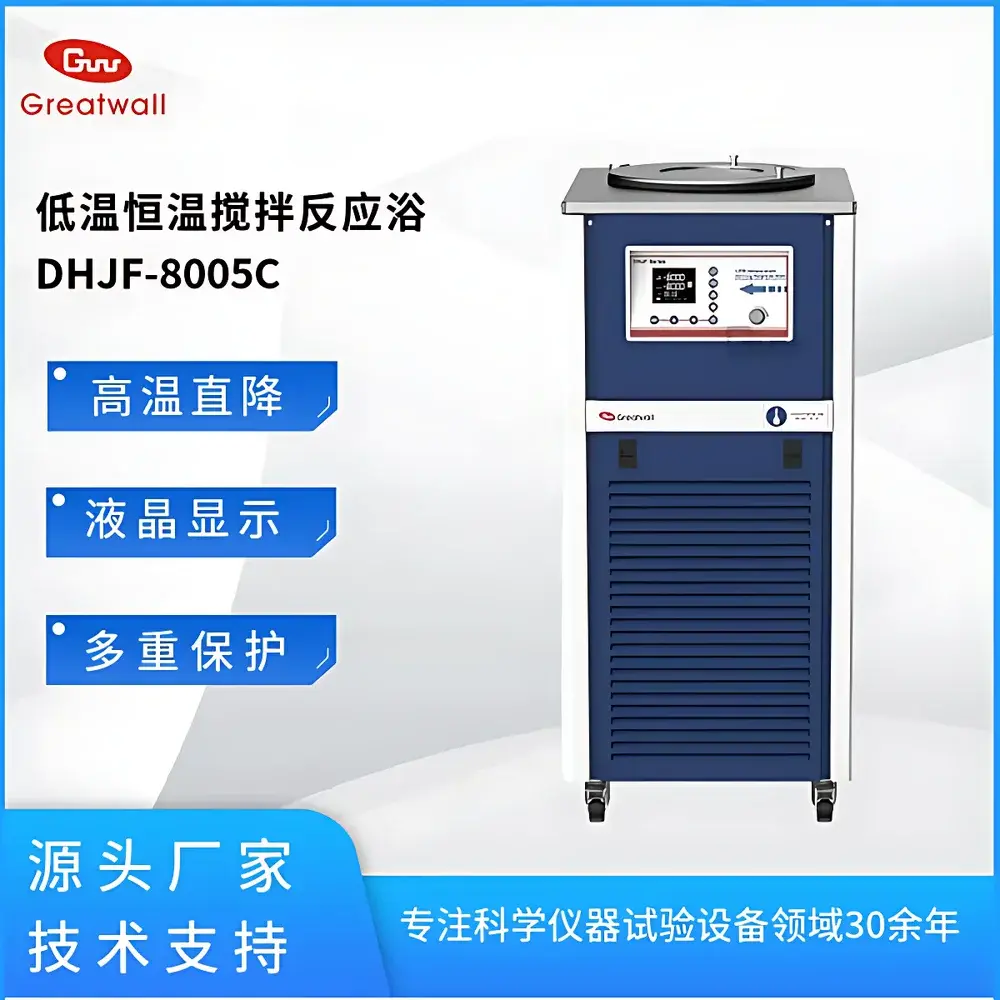
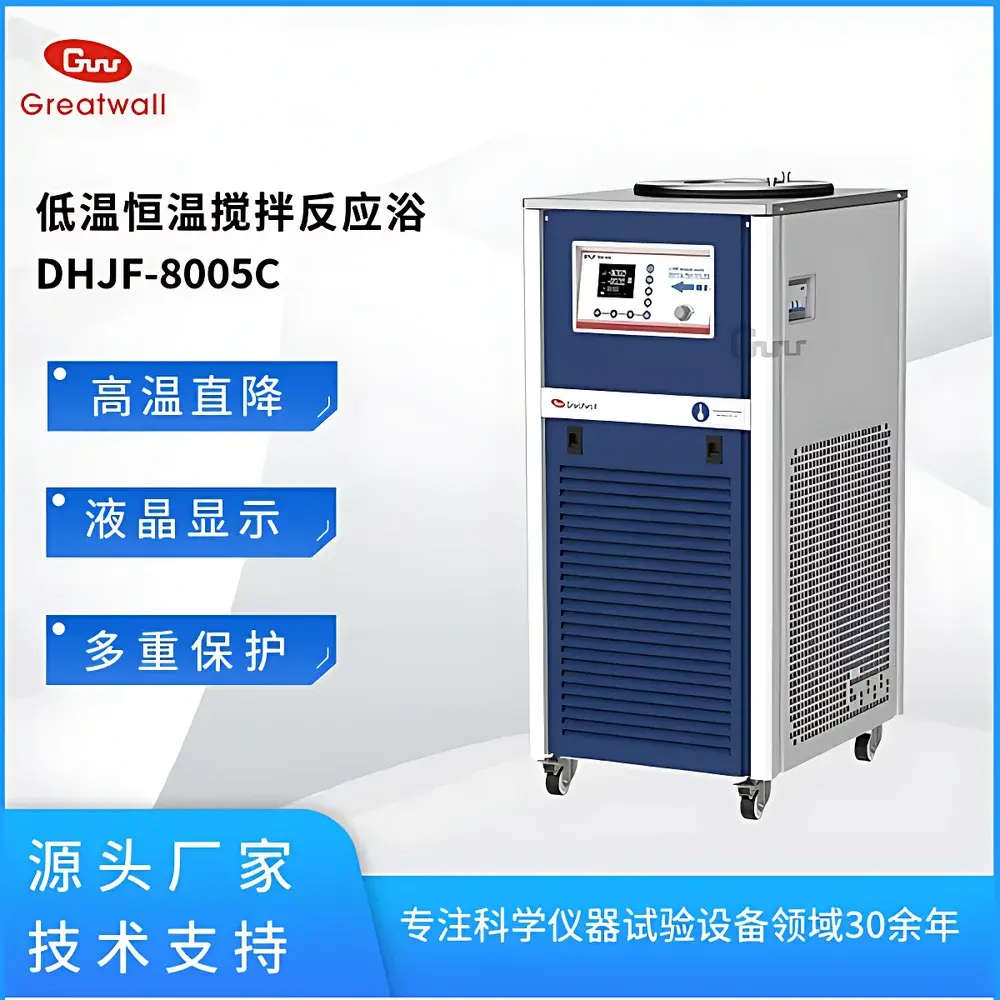
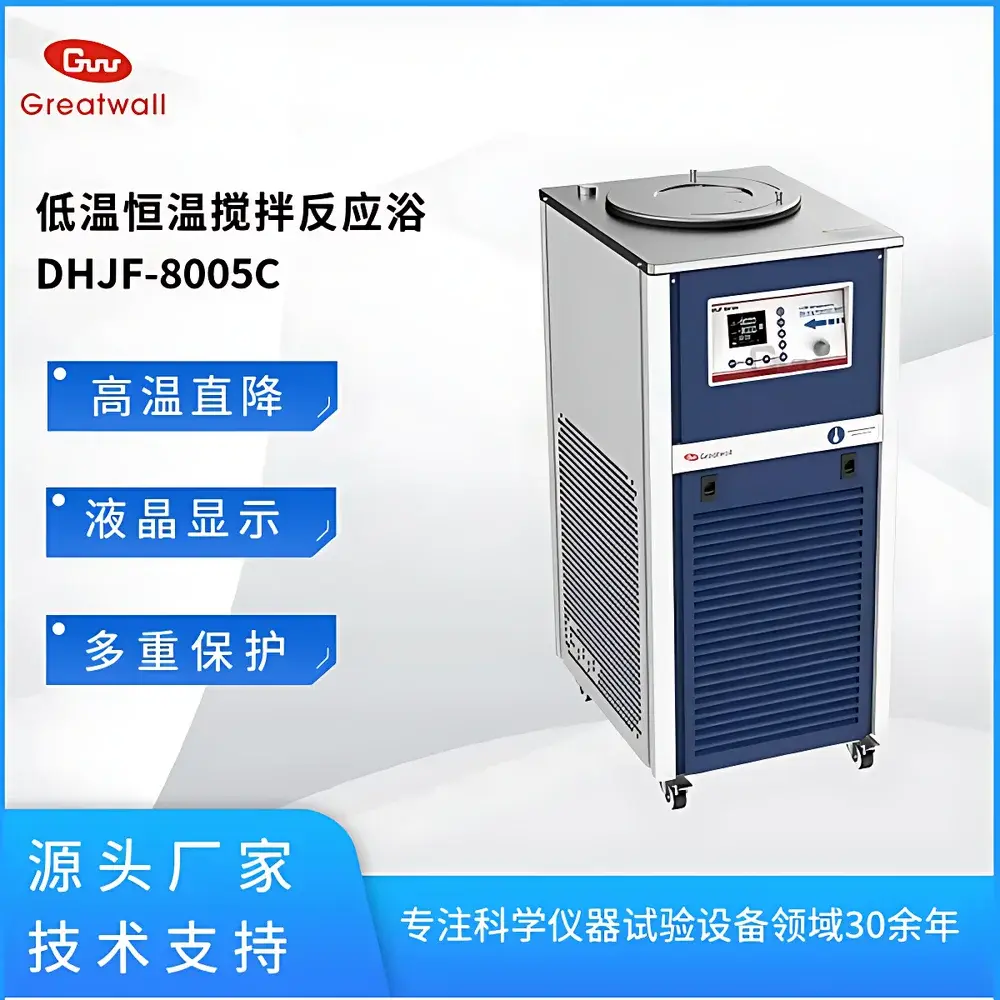
The Great Wall DHJF-8005C Cryogenic Circulating Thermostatic Bath with Magnetic Stirring
| Brand | The Great Wall |
|---|---|
| Model | DHJF-8005C |
| Type | Vertical |
| Temperature Range | −80 °C to +99 °C |
| Temperature Stability | ±0.2 °C |
| Display Resolution | 0.01 °C |
| Bath Volume | 5 L |
| Bath Opening Diameter | Ø210 mm |
| Heating Power | 1500 W |
| Cooling Capacity | 860 W at 90 °C, 410 W at 0 °C, 350 W at −40 °C, 260 W at −60 °C, 80 W at −80 °C |
| Refrigerants | R404A / R23 |
| Circulation Pump Power | 100 W |
| Flow Rate | 20 L/min |
| Max. Pressure | 0.4 bar |
| Magnetic Stirring Power | 50 W |
| Stirring Speed | 100–1000 rpm |
| External Dimensions (W×D×H) | 455×585×1025 mm |
| Net Weight | 100 kg |
| Power Supply | 220 V~, 50 Hz |
| Protection | Over-temperature, over-current, leakage, delay-start, thermal cutoff |
| Communication Interface | RS485 (MODBUS RTU) |
| Compliance | JB/T 4088 (heater), ISO/IEC 17025-aligned manufacturing environment |
Overview
The Great Wall DHJF-8005C Cryogenic Circulating Thermostatic Bath with Magnetic Stirring is an integrated precision temperature control system engineered for demanding laboratory applications requiring simultaneous cooling, heating, circulation, and agitation of reaction media. It operates on a dual-stage cascade refrigeration principle—combining high- and low-temperature refrigerant circuits (R404A and R23)—to achieve stable operation across an extended range from −80 °C to +99 °C. This architecture enables reliable thermal management in exothermic or endothermic reactions, low-temperature crystallization studies, solvent reflux control, and cryogenic sample conditioning. Unlike single-stage chillers, the cascade design maintains consistent cooling capacity even near the −80 °C limit, where conventional systems exhibit rapid performance decay. The unit integrates a PID-based digital temperature controller with five-segment programmable ramp-soak profiles, supporting reproducible thermal protocols essential for method validation under GLP or GMP frameworks.
Key Features
- Robust cascade refrigeration system with Embraco hermetic piston compressors and copper-alloy finned air-cooled condensers for high heat-transfer efficiency and long-term reliability.
- 304 stainless steel bath tank (Ø250 × 160 mm depth) and internal coil evaporator—designed to withstand repeated freeze-thaw cycles without mechanical fatigue or corrosion.
- External 304 stainless steel tubular heater compliant with JB/T 4088, featuring independent mechanical over-temperature cut-off for fail-safe thermal protection.
- Low-temperature-rated shielded circulation pump (100 W) delivering up to 20 L/min flow at 0.4 bar pressure, compatible with external jacketed reactors and condenser coils.
- Integrated magnetic stirrer (50 W, 100–1000 rpm) with adjustable torque, enabling homogeneous mixing without introducing mechanical seals or shaft penetrations into the bath.
- LCD interface with real-time display of setpoint, actual temperature, stirring speed, and system status; supports RS485 MODBUS RTU communication for integration into centralized lab automation platforms.
Sample Compatibility & Compliance
The DHJF-8005C accommodates standard laboratory glassware up to 2000 mL via its Ø210 mm open bath aperture. Its 304 stainless steel fluid path—including tank, circulation lines, and pump housing—ensures chemical compatibility with water, ethanol, methanol, ethylene glycol/water mixtures, and other common heat-transfer fluids used below −40 °C. All electrical components meet IEC 61010-1 safety requirements for laboratory equipment. The system’s thermal stability (±0.2 °C) and resolution (0.01 °C) align with ASTM E74 and ISO 17025 calibration traceability expectations. While not certified to FDA 21 CFR Part 11 out-of-the-box, audit-ready data logging (via optional software) and full parameter traceability support qualification for regulated environments when deployed with documented SOPs.
Software & Data Management
The embedded controller stores up to five user-defined multi-step temperature programs, each with ramp rate, soak time, and target temperature parameters. Real-time temperature and stirring data are accessible via MODBUS RTU over RS485, allowing seamless integration with SCADA systems, LIMS, or custom Python/Node-RED scripts. Optional PC software (sold separately) provides graphical trend analysis, CSV export, alarm history, and electronic signature-capable audit trails—facilitating compliance with ALCOA+ data integrity principles. All firmware updates are delivered via USB port with version-controlled release notes and change logs.
Applications
- Controlled-rate cooling for polymer crystallization kinetics and phase transition analysis.
- Low-temperature Grignard, organolithium, or hydride reduction reactions requiring precise thermal management below −60 °C.
- Calibration of thermocouples, RTDs, and infrared sensors across wide temperature spans.
- Stabilization of spectrophotometer cuvette compartments or CCD detector housings during extended acquisition.
- Pre-conditioning of samples prior to XRD, DSC, or rheological testing to eliminate thermal history effects.
- Supporting continuous-flow chemistry setups with external jacketed microreactors or PTFE coil reactors.
FAQ
What refrigerants does the DHJF-8005C use, and are they compliant with current environmental regulations?
The system employs R404A (high-stage) and R23 (low-stage), both classified as HFCs under the Kigali Amendment. While not ozone-depleting, their GWP values require proper handling per EPA Section 608 and EU F-Gas Regulation 517/2014. Recovery and reclamation by certified technicians are mandatory during servicing.
Can this unit maintain −80 °C while circulating fluid externally?
Yes—the specified cooling capacity of 80 W at −80 °C applies under closed-loop circulation conditions with recommended heat-transfer fluids (e.g., 30% ethylene glycol/water). External load must remain within this thermal budget; jacketed reactor surface area and insulation quality significantly affect achievable stability.
Is the magnetic stirrer suitable for viscous reaction mixtures?
The 50 W motor delivers sufficient torque for aqueous or moderately viscous organic solutions (< 500 mPa·s at operating temperature); for higher-viscosity media, external overhead stirring is recommended.
Does the system support remote monitoring via Ethernet or Wi-Fi?
No native Ethernet or Wi-Fi interface is included; connectivity is limited to RS485 MODBUS RTU. Third-party protocol gateways (e.g., Moxa NPort) may be used to bridge to TCP/IP networks.
What maintenance intervals are recommended for optimal long-term performance?
Compressor oil inspection every 24 months; condenser coil cleaning quarterly in dusty environments; refrigerant leak check annually; calibration verification against NIST-traceable reference thermometer every 6–12 months depending on usage intensity.



