
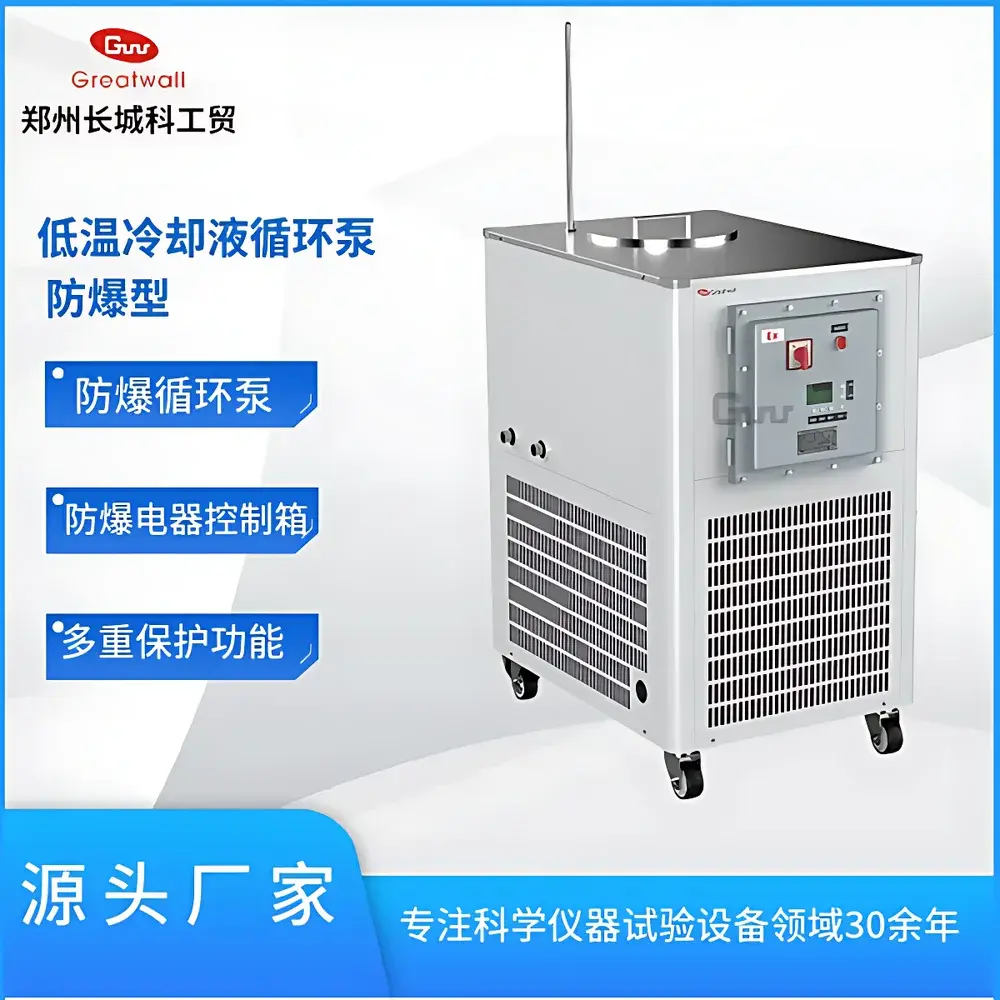
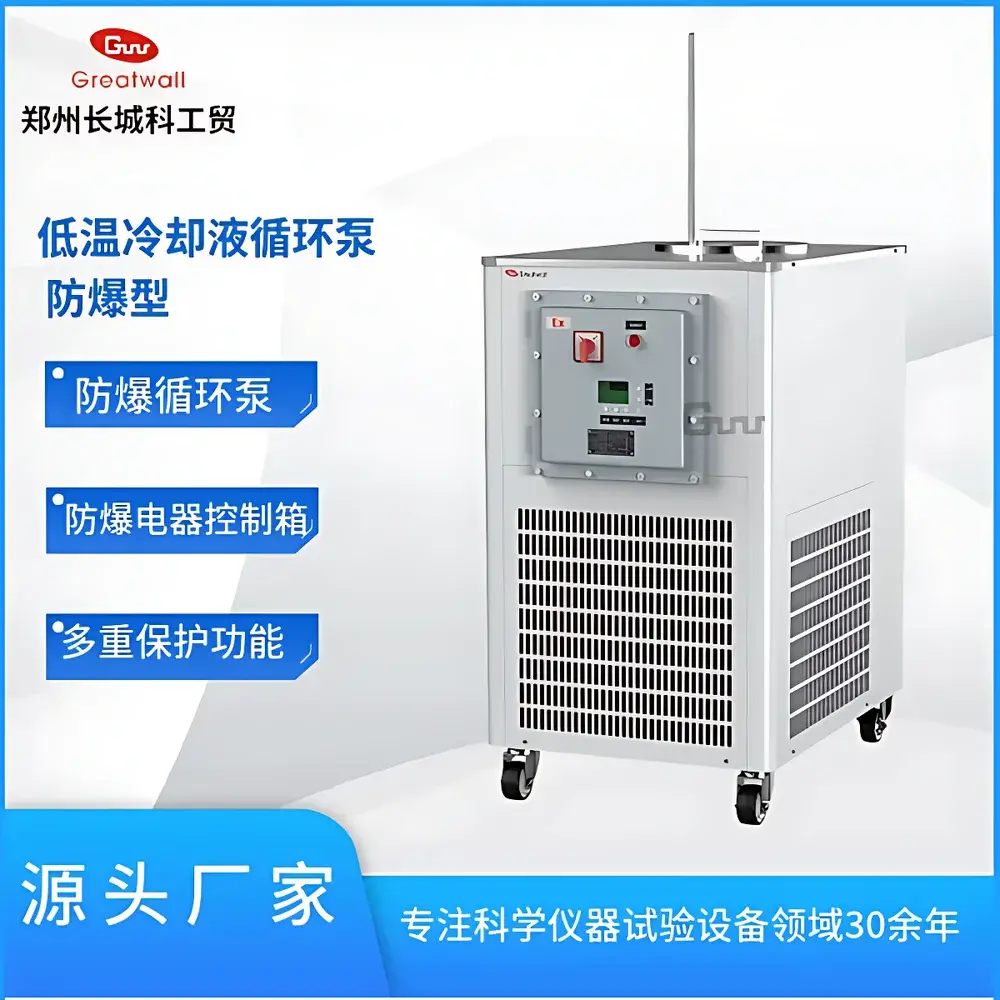
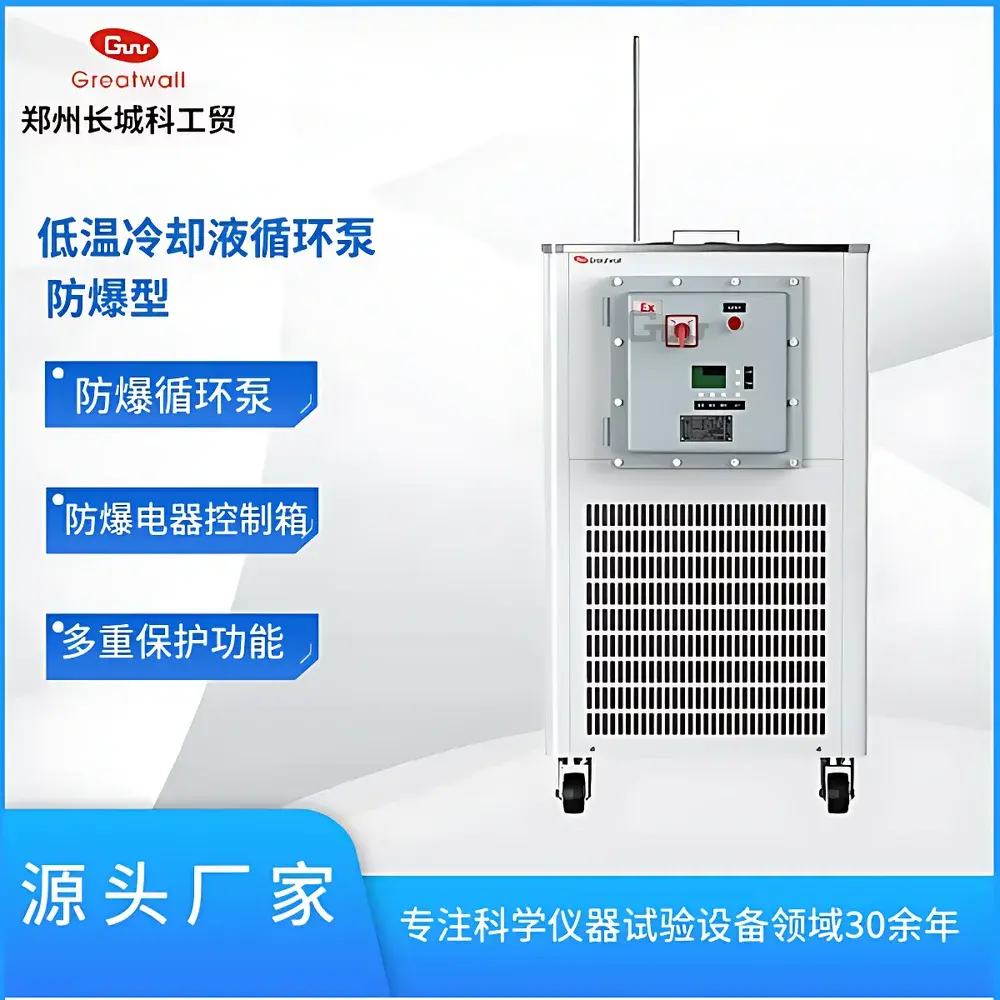
The Great Wall DLSB-20/30Ex Explosion-Proof Low-Temperature Circulating Chiller
| Brand | The Great Wall |
|---|---|
| Origin | Henan, China |
| Manufacturer Type | Direct Manufacturer |
| Equipment Type | Integrated Circulating Chiller |
| Cooling Method | Air-Cooled |
| Temperature Range | −30 °C to +25 °C |
| Temperature Stability | ±2 °C |
| Max. Pump Pressure | 2.0 bar |
| Max. Pump Flow Rate | 25 L/min |
| Reservoir Volume | 20 L |
| Operating Mode | Continuous |
| Explosion Protection Mark | Ex db IIB T4 Gb |
| Refrigerant | R410A |
| Power Supply | 3-phase, 380 V, 50 Hz |
| Total Power Consumption | 1680 W |
| Refrigeration Capacity | 2550 W (at 10 °C), 1750 W (at 0 °C), 1070 W (at −10 °C), 720 W (at −20 °C), 300 W (at −30 °C) |
| Reservoir Material | 304 Stainless Steel |
| External Port Size | 1/2″ BSP |
| Dimensions (W×D×H) | 602 × 876 × 1070 mm |
| Net Weight | 135 kg |
Overview
The Great Wall DLSB-20/30Ex is an integrated, air-cooled explosion-proof circulating chiller engineered for safe, stable thermal management in hazardous laboratory and pilot-scale process environments. Designed in accordance with IEC 60079-0 and IEC 60079-1 standards for explosive atmospheres, it features intrinsic safety architecture across all critical subsystems—including the circulation pump, electrical control cabinet, and internal wiring—certified to Ex db IIB T4 Gb (Gas Group IIB, Temperature Class T4, Equipment Protection Level Gb). Its refrigeration system employs a hermetically sealed rotary compressor, copper-aluminum finned condenser, high-efficiency evaporator, and capillary tube expansion device, enabling precise temperature control from −30 °C to +25 °C using environmentally compliant R410A refrigerant. The unit operates continuously under load, delivering consistent thermal output while maintaining ±2 °C temperature stability—critical for exothermic reaction cooling, low-temperature condensation, cryogenic sample conditioning, and controlled crystallization processes in chemical synthesis, pharmaceutical development, and materials science.
Key Features
- Explosion-proof certified circulation pump and control cabinet (Ex db IIB T4 Gb), suitable for Zone 1/2 hazardous areas handling flammable solvents such as acetone, ethanol, diethyl ether, or hydrocarbon-based reagents.
- Robust 304 stainless steel reservoir and fluid pathways—resistant to corrosion, embrittlement at sub-zero temperatures, and chemical degradation from common organic and aqueous coolants (e.g., ethylene glycol/water, ethanol/water, or silicone oil mixtures).
- High-flow, low-pulsation circulation system delivering up to 25 L/min at 2.0 bar maximum pressure—optimized for integration with jacketed reactors, distillation columns, rotary evaporators, and analytical instrumentation requiring stable external coolant supply.
- Multi-layer safety architecture including phase sequence protection, delayed startup, overcurrent cutoff, compressor overheat shutdown, and real-time thermal monitoring of both reservoir and discharge lines.
- Air-cooled design eliminates dependency on facility water infrastructure; compact footprint (602 × 876 × 1070 mm) supports placement in fume hoods, gloveboxes, or confined utility spaces without ventilation ducting requirements.
Sample Compatibility & Compliance
The DLSB-20/30Ex is compatible with a broad range of heat transfer fluids—including aqueous glycol solutions (up to 50% v/v), ethanol–water blends, and low-viscosity silicone oils—within its operational temperature window. All wetted components meet ASTM A240 and EN 10088-2 specifications for 304 stainless steel. The unit complies with CE marking requirements under the ATEX Directive 2014/34/EU and carries full conformity documentation for installation in laboratories governed by EU Directive 1999/92/EC (ATEX 137) and NFPA 496 (US). It supports GLP-compliant operation through configurable alarm logging and manual calibration traceability, and may be integrated into facilities adhering to ISO/IEC 17025 or FDA 21 CFR Part 11 frameworks when paired with validated data acquisition systems.
Software & Data Management
This model operates via a dedicated microprocessor-based controller with dual LED display (setpoint/actual temperature), intuitive push-button interface, and non-volatile memory for parameter retention during power interruption. While the base configuration does not include Ethernet or USB connectivity, optional RS-485 Modbus RTU interface enables integration with centralized building management systems (BMS) or SCADA platforms for remote monitoring of reservoir temperature, compressor status, fault codes, and runtime hours. All safety events—including overtemperature, phase loss, or pump failure—are timestamped and stored in internal event logs accessible via front-panel navigation. Calibration offsets can be applied per user-defined procedures, supporting audit readiness for quality assurance protocols in regulated environments.
Applications
- Cooling of jacketed glass reactors during Grignard, lithiation, or nitration reactions where solvent vapors present ignition risks.
- Temperature stabilization of NMR probe preamplifiers and mass spectrometer ion sources requiring sub-ambient, vibration-free thermal environments.
- Condenser cooling in vacuum distillation setups involving low-boiling, flammable fractions (e.g., THF, dichloromethane, pentane).
- Thermal conditioning of catalyst screening modules in combinatorial chemistry platforms operating under inert or reducing atmospheres.
- Support of cryogenic sample preparation workflows in polymer characterization labs—particularly for DSC calibration, rheology testing, or DMA specimen equilibration.
FAQ
What hazardous area classifications does the DLSB-20/30Ex support?
It is certified for use in Zone 1 and Zone 2 gas environments (Group IIB, T4 temperature class) per IEC 60079-0 and IEC 60079-1, making it suitable for laboratories handling propane, ethylene, acetone, or ethanol vapors.
Can the unit operate continuously at −30 °C ambient intake temperature?
No—the specified ambient operating range is +5 °C to +35 °C. Operation below +5 °C may impair condenser efficiency and trigger low-ambient safety shutdowns.
Is the reservoir volume adjustable or modular?
The 20 L 304 stainless steel reservoir is fixed-integral; however, external secondary reservoirs may be connected via the 1/2″ BSP ports using approved explosion-proof flexible couplings.
Does the chiller support external temperature feedback control?
Yes—via optional PT100 input terminals, enabling cascade control using a remote sensor placed at the process load (e.g., reactor jacket outlet) rather than relying solely on reservoir temperature.
What maintenance intervals are recommended for long-term reliability?
Compressor oil inspection every 2000 operating hours; annual replacement of air filter and desiccant cartridge; biannual verification of pressure switch calibration and explosion-proof enclosure integrity per IEC 60079-17.



