
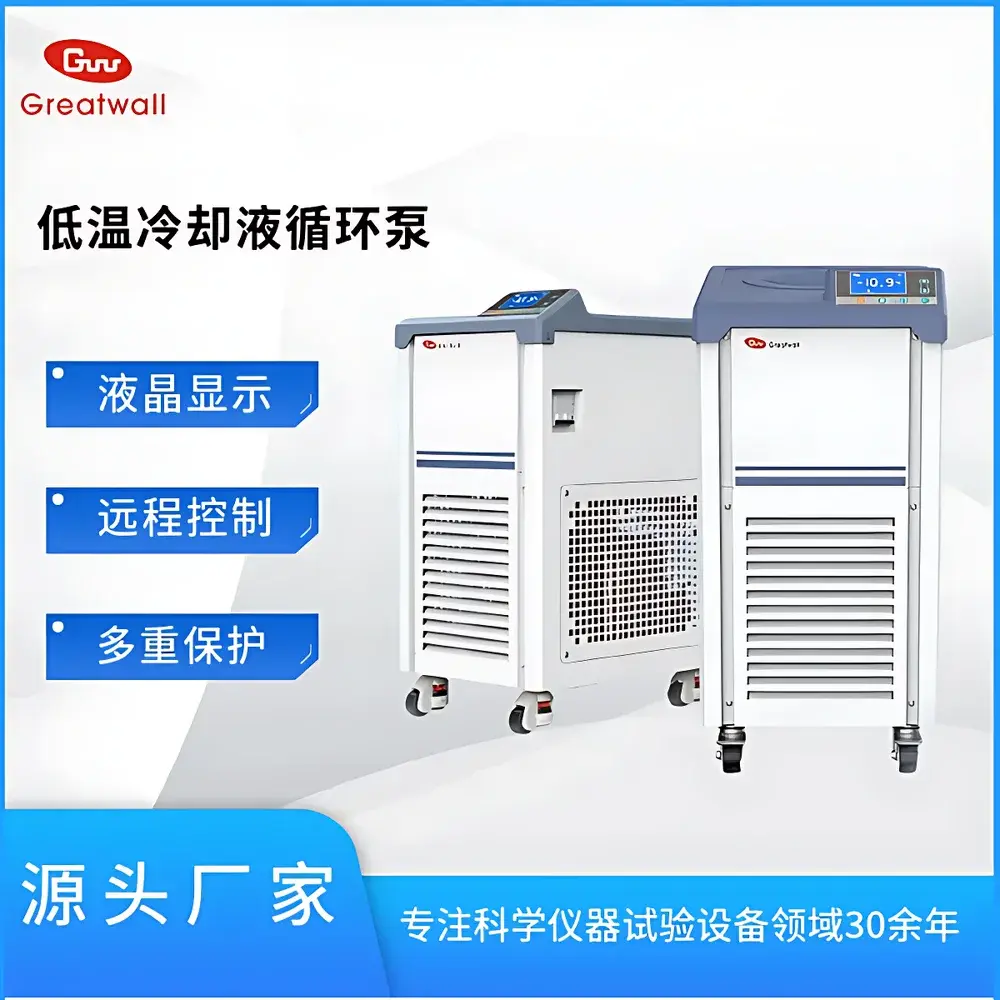
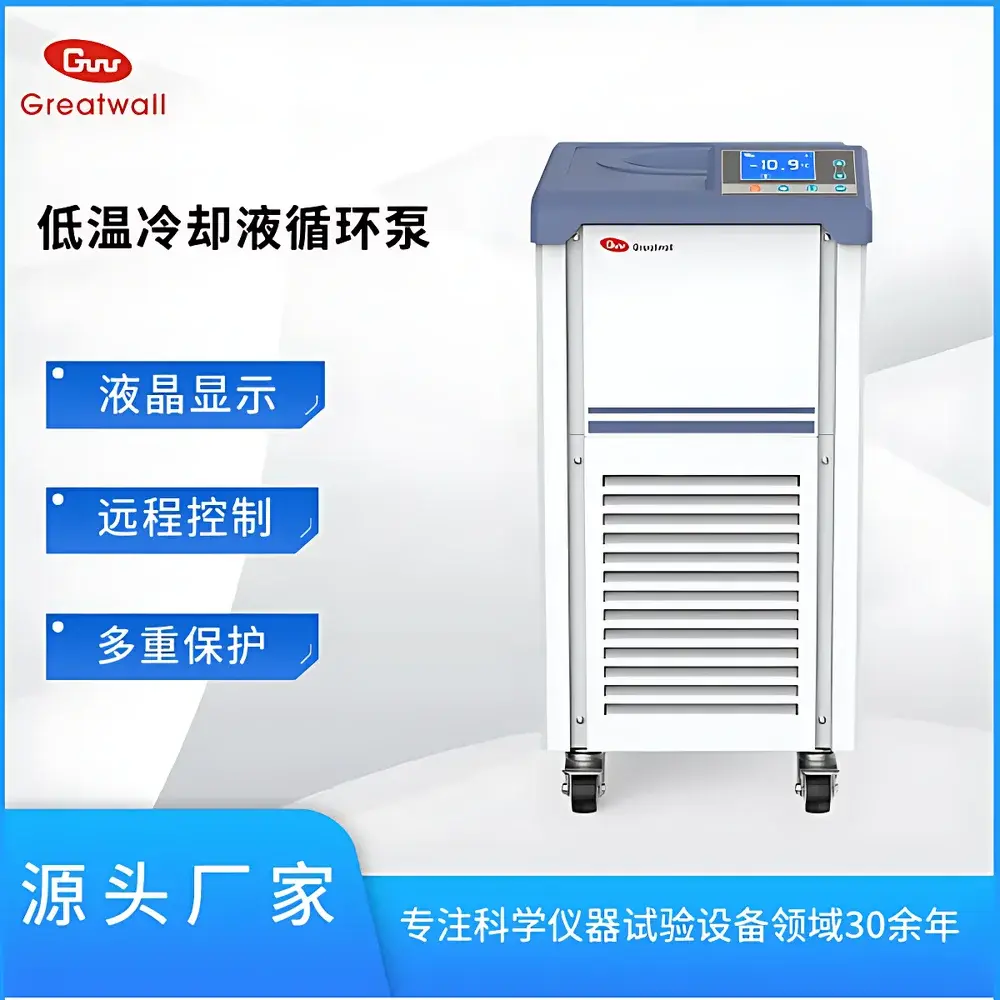
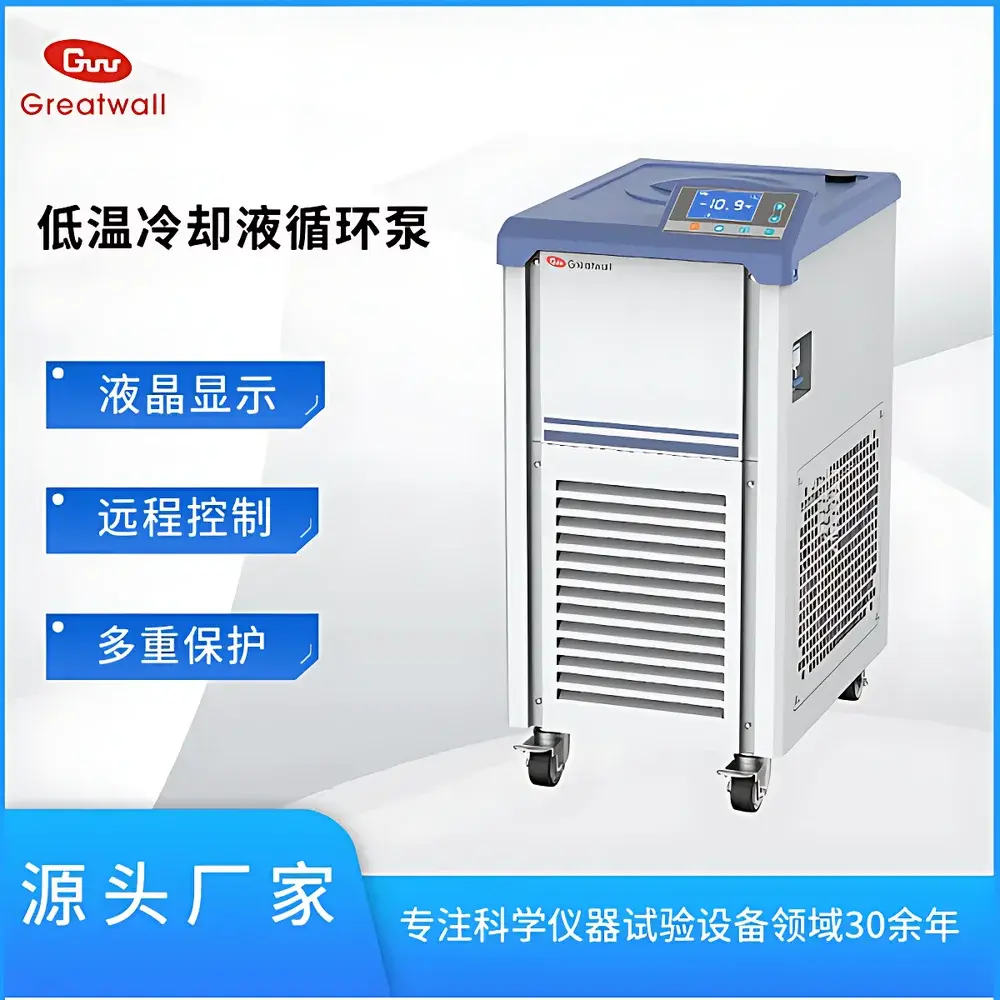
The Great Wall DLSB-5/20D Low-Temperature Circulating Chiller
| Brand | The Great Wall |
|---|---|
| Origin | Henan, China |
| Manufacturer Type | Direct Manufacturer |
| Equipment Type | Integrated Circulating Chiller |
| Cooling Method | Air-Cooled |
| Temperature Range | −20 °C to 25 °C |
| Temperature Stability | ±2 °C |
| Refrigeration Capacity | 600 W at 0 °C |
| Max. Pump Pressure | 1.1 bar |
| Max. Pump Flow Rate | 22 L/min |
| Reservoir Volume | 5 L |
| Operating Mode | Continuous |
| Display Resolution | 0.1 °C (LCD) |
| Communication Interface | RS485 with Standard Modbus Protocol |
| Refrigerant | R404A |
| Power Input | 220 V~, 50 Hz |
| IP Rating | IP20 |
| Ambient Operating Conditions | 5–35 °C, ≤70% RH |
| Reservoir Material | 304 Stainless Steel |
| Dimensions (W×D×H) | 335 × 473 × 684 mm |
| Net Weight | 40 kg |
Overview
The Great Wall DLSB-5/20D Low-Temperature Circulating Chiller is an integrated, air-cooled thermal management system engineered for precision temperature control in laboratory and pilot-scale applications. It operates on a vapor-compression refrigeration cycle using R404A refrigerant, delivering stable cooling capacity across a wide operational range from −20 °C to +25 °C. Designed for continuous-duty operation, the unit supplies chilled heat-transfer fluid—typically aqueous glycol mixtures—to external equipment via a closed-loop circulation system. Its primary function is to maintain consistent thermal conditions for exothermic or endothermic processes, enabling reproducible experimental outcomes in environments where ambient cooling is insufficient or thermally unstable. Typical integration points include condenser jackets of rotary evaporators, temperature-controlled reaction vessels, semiconductor thermal test fixtures, laser diode cooling manifolds, and material characterization systems requiring controlled thermal ramping or isothermal hold.
Key Features
- Integrated architecture with compact footprint (335 × 473 × 684 mm) and 40 kg net weight—optimized for benchtop or under-bench installation in space-constrained labs.
- High-reliability air-cooled condensing system with compressor delay-start protection, preventing mechanical stress during power cycling.
- Stainless steel (304) reservoir with 5 L capacity, corrosion-resistant and compatible with common heat-transfer fluids including 30% ethylene glycol/water solutions.
- LCD controller with 0.1 °C display resolution and Pt100 sensor input for accurate real-time temperature monitoring and setpoint adjustment.
- RS485 serial interface compliant with Modbus RTU protocol, supporting integration into centralized lab automation systems or SCADA platforms for remote parameter setting, status reporting, and alarm logging.
- Comprehensive safety architecture: dual-stage overcurrent protection, high-pressure cut-off, overtemperature shutdown, ground-fault detection, and automatic restart inhibition after fault clearance.
- CE-marked per applicable EN 61000-6-3 (EMC) and EN 61000-6-2 (immunity) standards; TÜV-certified models meet essential health and safety requirements for EU market deployment.
Sample Compatibility & Compliance
The DLSB-5/20D is compatible with standard laboratory tubing (1/2″ BSP inlet/outlet ports) and accommodates silicone or fluoropolymer-lined hoses rated for low-temperature service down to −20 °C. Its fluid-handling components are chemically inert toward common organic solvents, acids, and bases when used with appropriate carrier fluids. While not classified as GMP-grade equipment, the chiller’s design supports GLP-aligned workflows through deterministic temperature stability (±2 °C), auditable operating parameters, and traceable communication logs when interfaced with validated software systems. It complies with IEC 61010-1:2010 for electrical safety in laboratory equipment and meets RoHS Directive 2011/65/EU restrictions on hazardous substances.
Software & Data Management
As a standalone hardware platform, the DLSB-5/20D does not include embedded data logging or proprietary software. However, its RS485/Modbus interface enables seamless interoperability with third-party data acquisition systems (e.g., LabVIEW, MATLAB, Ignition SCADA) for time-stamped recording of setpoint, actual temperature, pump status, and fault codes. Users may configure automated start/stop sequences, temperature ramps, and alarm thresholds externally. For regulated environments requiring audit trails (e.g., pharmaceutical QC labs), integration with 21 CFR Part 11-compliant electronic record systems is achievable via middleware that enforces user authentication, electronic signatures, and immutable log archiving.
Applications
- Cooling of rotary evaporator condensers in solvent recovery and concentration workflows (e.g., ethanol, acetone, dichloromethane).
- Thermal conditioning of jacketed reactors during kinetic studies, polymerization, or crystallization experiments.
- Stabilization of laser sources (e.g., DPSS, fiber lasers) requiring precise thermal management to minimize wavelength drift and mode instability.
- Environmental simulation in materials testing—e.g., tensile strength evaluation of polymers at sub-zero temperatures.
- Support of cryogenic sample preparation for TEM grid vitrification or low-temperature XRD measurements.
- Process validation support in biopharmaceutical development, where controlled cooling rates impact protein aggregation behavior.
FAQ
What is the minimum achievable temperature at full load?
The DLSB-5/20D achieves −20 °C under no-load conditions. At rated refrigeration capacity (600 W at 0 °C), sustained operation below −10 °C requires reduced thermal load and optimized fluid flow; consult the performance curve for duty-point derating.
Can this chiller be used with flammable solvents?
The unit itself is not explosion-proof. When circulating flammable carrier fluids (e.g., pure acetone), ensure secondary containment, ventilation compliance per NFPA 30, and elimination of ignition sources near fluid pathways.
Is the reservoir drainable without disassembly?
Yes—a bottom-mounted drain valve allows complete fluid evacuation without removing the reservoir cover or internal components.
Does it support external temperature feedback control?
No. The built-in Pt100 sensor measures reservoir temperature only. For process-jacket feedback, users must implement external PID controllers with separate sensor inputs.
What maintenance intervals are recommended?
Inspect air filter monthly; clean condenser coils quarterly; verify refrigerant charge and compressor oil level annually by qualified service personnel. Record all interventions in a maintenance log per ISO/IEC 17025 clause 6.4.9.



