
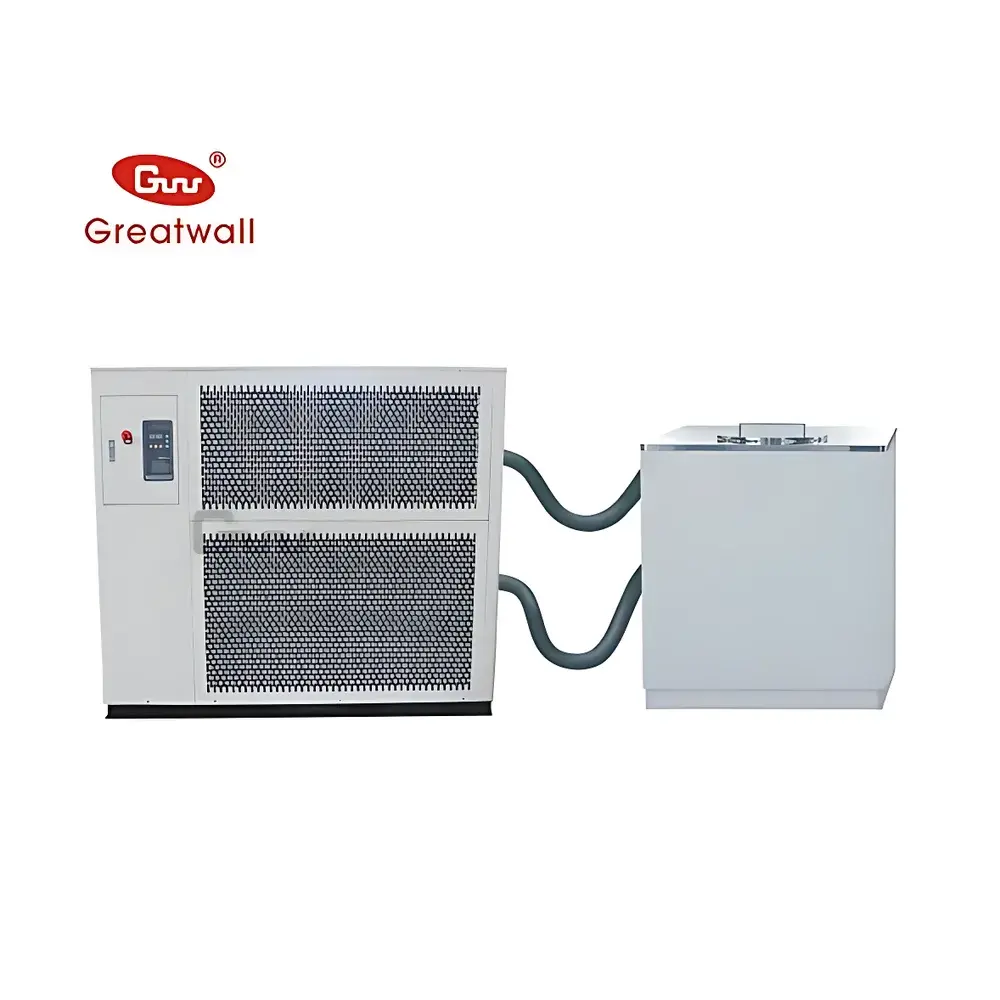
The Great Wall DLSB-200/30 Industrial-Scale Low-Temperature Circulating Chiller
| Brand | The Great Wall |
|---|---|
| Origin | Henan, China |
| Manufacturer Type | Direct Manufacturer |
| Product Category | Domestic |
| Model | DLSB-200/30 |
| Instrument Type | Split-System |
| Cooling Method | Air-Cooled |
| Temperature Control Range | −30 °C to +10 °C |
| Temperature Stability | ±2 °C |
| Circulating Pump Pressure | 2.2 bar |
| Circulating Pump Flow Rate | 67 L/min |
| Reservoir Capacity | 200 L |
| Operating Mode | Continuous |
Overview
The Great Wall DLSB-200/30 is an industrial-scale, split-system low-temperature circulating chiller engineered for stable, continuous thermal management in pilot-plant and mid-scale laboratory environments. It operates on a vapor-compression refrigeration cycle using R404A refrigerant—azeotropic blend selected for its favorable thermodynamic properties in sub-zero applications—and delivers precisely regulated coolant (typically aqueous glycol or ethanol/water mixtures) to external process equipment. Unlike benchtop chillers, the DLSB-200/30 is purpose-built for integration with multiple parallel loads—including jacketed reactors (50–500 L), rotary evaporators, condensers, and crystallization units—common in pharmaceutical process development, fine chemical synthesis, and bioprocess scale-up. Its air-cooled design eliminates dependency on facility water infrastructure, while the split architecture (separate reservoir and compressor-condenser unit) enables flexible installation in constrained production spaces and simplifies coolant filling, maintenance access, and thermal isolation of sensitive instrumentation.
Key Features
- Split-System Architecture: Independent reservoir (1100 × 820 × 950 mm) and refrigeration unit (1440 × 945 × 1430 mm) allow optimal spatial deployment—reservoir positioned near process equipment, compressor unit placed in ventilated utility areas.
- High-Capacity Thermal Management: 200 L insulated stainless steel (304) reservoir with polyurethane foam insulation minimizes ambient heat ingress; rated for continuous operation at −30 °C (3.5 kW cooling capacity) up to +10 °C (28 kW), enabling multi-stage reaction control.
- Robust Safety & Protection Suite: Comprehensive safeguards include high/low pressure cutouts, phase-loss and overcurrent protection, compressor discharge temperature monitoring, flow switch interlock, and programmable delay start (prevents compressor cycling during power fluctuations).
- Industrial-Grade Circulation System: 750 W magnetic-drive centrifugal pump delivers 67 L/min at 2.2 bar maximum head—sufficient to overcome pressure drops across extended tubing runs, multiple parallel reactors, or packed-column condensers.
- Environmental Adaptability: Designed for ambient operation between 5 °C and 35 °C at ≤70% RH; optional water-cooled condenser configuration available for high-ambient or heat-sensitive facilities.
Sample Compatibility & Compliance
The DLSB-200/30 circulates non-corrosive, low-viscosity heat-transfer fluids compatible with common process chemistries—including 30–50% ethylene glycol/water, propylene glycol solutions, and ethanol/water mixtures. Its 304 stainless steel reservoir and fluid-contact components resist oxidation and chloride-induced pitting under standard operating conditions. While not certified to ISO 13485 or FDA 21 CFR Part 11 out-of-the-box, the system supports GLP/GMP-aligned operation through documented maintenance logs, calibration traceability (Pt100 sensor, Class B tolerance), and configurable alarm history export. It meets IEC 61000-6-2 (immunity) and IEC 61000-6-4 (emission) standards for industrial environments and complies with Chinese GB/T 10826.1-2018 for circulating chillers.
Software & Data Management
The chiller features an integrated microprocessor-based controller with dual Pt100 temperature sensors (reservoir inlet/outlet) and real-time display of setpoint, actual temperature, pump status, and fault codes. While it does not include Ethernet or USB data logging as standard, analog 4–20 mA output signals (temperature and fault status) enable integration into distributed control systems (DCS) or SCADA platforms. Optional RS485 Modbus RTU interface supports remote parameter adjustment and event logging via third-party supervisory software. All safety-critical alarms—including low-flow, high discharge temperature, and refrigerant leak detection—are latched and require manual reset, ensuring auditable operational integrity.
Applications
- Pilot-scale exothermic reaction control in API synthesis (e.g., Grignard additions, nitration, hydrogenations)
- Temperature stabilization of multi-vessel parallel screening reactors in formulation development
- Coolant supply for large-capacity rotary evaporation (≥50 L flasks) under vacuum
- Condenser jacket cooling in fractional distillation or solvent recovery trains
- Crystallization process control requiring precise ramp-and-hold profiles from −25 °C to +5 °C
- Support for analytical instrumentation requiring stable cold baths (e.g., NMR sample pre-chilling, HPLC column ovens)
FAQ
What is the minimum achievable temperature with a full 200 L load?
Under standard test conditions (25 °C ambient, 30% ethylene glycol/water), the system achieves −30 °C at the reservoir outlet when operating at no external flow. With full 67 L/min circulation through typical reactor jackets (ΔT ≈ 3–5 °C), sustained delivery below −25 °C is typical.
Can this chiller be integrated with PLC-based process automation?
Yes—via optional RS485 Modbus RTU or standard 4–20 mA analog outputs for temperature and alarm status, enabling bidirectional communication with Allen-Bradley, Siemens, or Beckhoff PLCs.
Is R404A refrigerant being phased out? What are the alternatives?
R404A is subject to EU F-Gas Regulation phase-down; however, it remains widely permitted in China and many export markets. The DLSB platform supports field retrofitting to R449A or R452A with compressor and expansion valve recalibration—contact technical support for retrofit documentation.
What maintenance intervals are recommended for continuous 24/7 operation?
Compressor oil and filter-drier replacement every 6,000 operating hours; annual inspection of condenser coil cleanliness and refrigerant charge verification; quarterly verification of Pt100 sensor calibration against NIST-traceable reference.



