
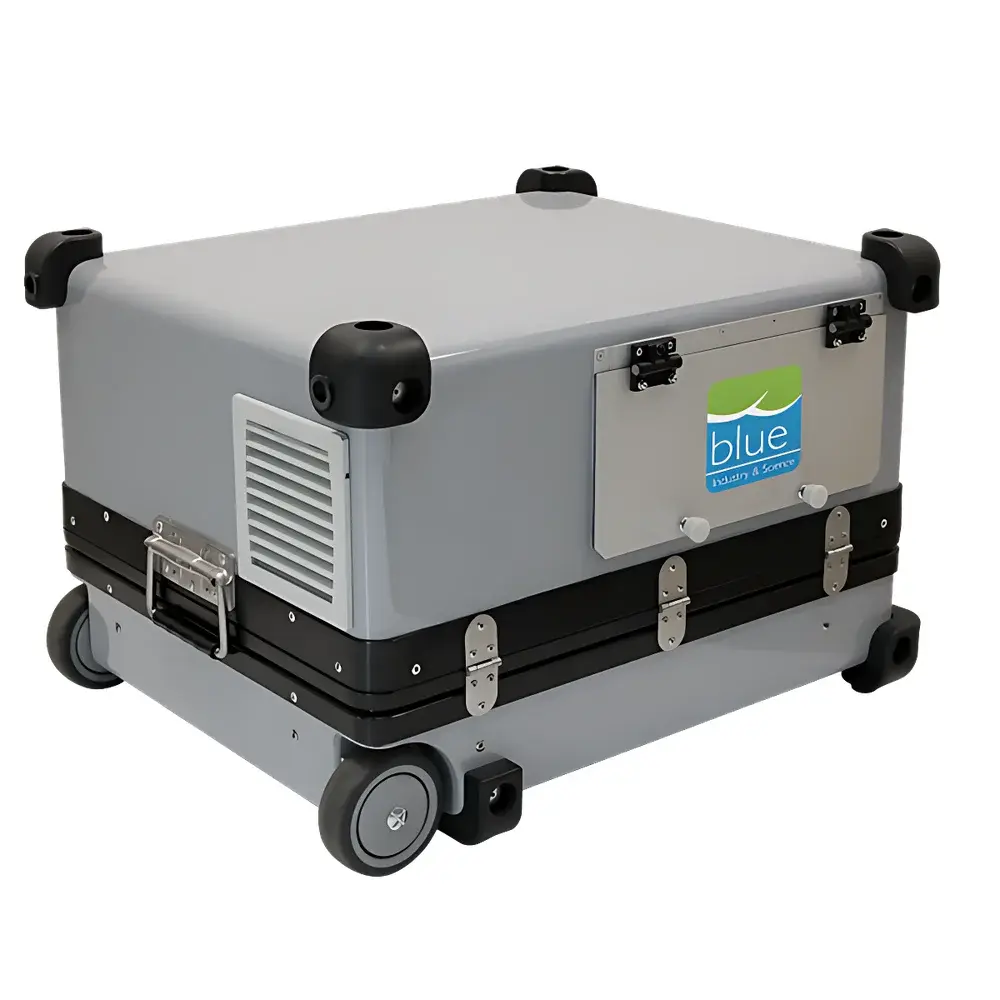
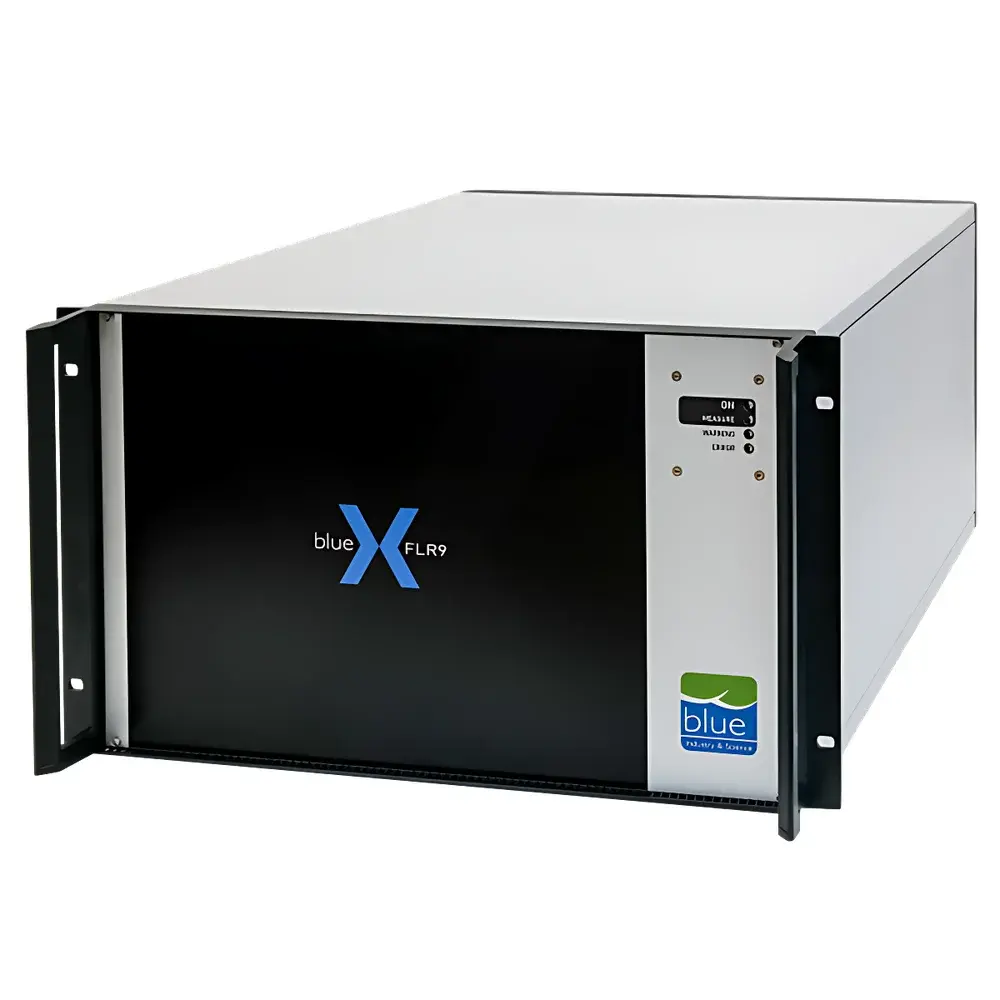
Plutonium FLR9 Broad-Tunable Laser Spectroscopy Gas Analyzer
| Brand | ONUEE |
|---|---|
| Origin | France |
| Manufacturer Type | Authorized Distributor |
| Origin Category | Imported |
| Model | FLR9 |
| Portability | Portable |
| Response Time | <10 s |
| Repeatability | ±1% of span |
| Detection Capability | >500 organic and inorganic compounds (VOCs and inorganics) |
| Measurement Principle | Tunable Diode Laser Absorption Spectroscopy (TDLAS) coupled with Photoacoustic Detection (PAD) |
| Detection Range | ppb to % (gas-phase) |
| LOD | 1 ppb (direct measurement, no pre-concentration required) |
| Linearity | R² > 0.99 |
| Measurement Frequency | Up to 1 Hz |
| Operating Temperature | 10–35 °C |
| Max Sample Temperature | 50 °C |
| Humidity | ≤95% RH (non-condensing) |
| Enclosure Rating | Cabinet: IP20 |
| Carry Case | IP54 |
| Power Supply | 24 V DC / 3.5 A |
| Typical Power Consumption | 40 W |
| Mounting Options | 6-U rack cabinet, wheeled transport case, optional ATEX/IECEx-certified explosion-proof housing |
| Dimensions (Cabinet) | 524 × 448 × 260 mm |
| Dimensions (Carry Case) | 621 × 520 × 422 mm |
| Weight (Cabinet) | 17–19 kg |
| Weight (Carry Case) | 29–31 kg |
| Sampling Method | Extractive (process or ambient air) |
Overview
The Plutonium FLR9 Broad-Tunable Laser Spectroscopy Gas Analyzer is an advanced, field-deployable instrument engineered for real-time, multi-component gas analysis in environmental monitoring and industrial safety applications. It integrates patented Broad-Tunable Laser (BTL) technology—developed by Plutonium Industrie Scientifique (France)—with a high-sensitivity photoacoustic detection (PAD) module. Unlike conventional gas analyzers relying on electrochemical sensors or non-selective FID/PID detectors, the FLR9 operates on the physical principle of tunable diode laser absorption spectroscopy (TDLAS), enabling species-specific quantification through high-resolution spectral scanning across near- and mid-infrared absorption bands. This architecture delivers direct, interference-free measurement of over 500 volatile organic compounds (VOCs) and inorganic gases—including aldehydes, BTEX, terpenes, alcohols, halogenated hydrocarbons, esters, amines, chlorides, and thiols—without chromatographic separation or chemical derivatization. Its ppb-level limit of detection (LOD), sub-10-second response time, and robust calibration stability make it suitable for regulatory-grade ambient air quality surveys, fugitive emission detection, and emergency response scenarios under variable field conditions.
Key Features
- Patented BTL laser source providing continuous, wide-wavelength tuning across multiple absorption lines for simultaneous multi-gas quantification
- Photoacoustic detection cell with ultra-low noise electronics, eliminating optical alignment drift and enabling stable long-term operation
- True portable form factor: available in ruggedized wheeled transport case (IP54) or 6-U rack-mount configuration (IP20), both certified for use in standard and hazardous areas (ATEX/IECEx optional)
- No consumables or reagents required; zero routine calibration drift due to internal reference gas cell and real-time baseline correction
- Integrated embedded controller with intuitive tablet-based HMI for local operation; full remote access via secure TLS-encrypted Ethernet or LTE interface
- Onboard data logging with encrypted storage (≥32 GB SSD), supporting timestamped spectra, concentration time-series, and diagnostic logs compliant with GLP audit trails
Sample Compatibility & Compliance
The FLR9 is designed for extractive sampling of ambient air, stack emissions, soil vapor, and industrial process streams. It accommodates sample temperatures up to 50 °C and relative humidity up to 95% RH (non-condensing), with integrated heated sampling line options available for dew-point control. All gas-handling components are chemically inert (electropolished stainless steel, PFA-lined tubing) to prevent adsorption or catalytic decomposition of reactive species such as formaldehyde or hydrogen sulfide. The analyzer meets IEC 61000-6-2/6-4 for electromagnetic compatibility and complies with ISO 16000-18 for VOC measurement methodology validation. Optional ATEX II 2G Ex db IIB T4 Gb and IECEx Ex db IIB T4 Gb certifications enable deployment in Zone 1 hazardous locations. Data integrity features—including electronic signatures, audit logs, and 21 CFR Part 11–compliant user access controls—are available via optional software license.
Software & Data Management
The FLR9 runs on a Linux-based real-time OS with Plutonium’s proprietary Analytical Engine firmware. The web-accessible software suite supports method configuration, spectral library management (customizable per application), alarm threshold definition, and automated report generation (PDF/CSV). Raw interferograms and calibrated concentration outputs are stored with full metadata (GPS coordinates, atmospheric pressure, temperature, flow rate). Data export conforms to EPA Method TO-15/TO-17 metadata standards and can be ingested into enterprise LIMS or SCADA platforms via Modbus TCP, OPC UA, or MQTT protocols. Firmware updates are delivered over-the-air with cryptographic signature verification. Remote diagnostics include live spectral view, signal-to-noise ratio monitoring, and detector health metrics.
Applications
- Regulatory environmental inspection: real-time mapping of VOC plumes during site audits, landfill monitoring, and urban air quality campaigns
- Fugitive emission detection (FED) in petrochemical, pharmaceutical, and semiconductor facilities—supporting LDAR compliance per EPA 40 CFR Part 60 and ISO 55000
- Emergency response: rapid identification and quantification of toxic or flammable gases during chemical spills, fire investigations, or confined-space entry assessments
- Industrial hygiene: personal exposure assessment and workplace air monitoring for OSHA PEL and ACGIH TLV validation
- Research-grade atmospheric chemistry studies requiring speciated, time-resolved VOC profiles at urban, rural, or forested sites
FAQ
Does the FLR9 require daily calibration or zero/span gas cylinders?
No. The system employs an internal sealed reference cell and continuous background normalization, eliminating the need for external calibration gases under normal operation. Annual verification using traceable standards is recommended for regulatory reporting.
Can the FLR9 measure gases in humid or particulate-laden samples?
Yes—when equipped with optional heated sample conditioning (filter + Nafion dryer + temperature-controlled line), it maintains accuracy in high-humidity environments and resists fouling from aerosols up to PM10.
Is spectral library customization supported for proprietary compounds?
Yes. Users may import high-resolution absorption cross-section data (HITRAN/NIST format) and define custom quantification methods via the SDK.
What cybersecurity measures are implemented for remote data transmission?
All network interfaces enforce TLS 1.2+ encryption, role-based authentication, and configurable firewall rules. No default credentials; SSH access requires key-pair authentication.
How is measurement uncertainty quantified and documented?
Each measurement includes propagated uncertainty estimation based on SNR, path-length stability, and spectral fitting residuals—exportable alongside concentration values in standardized QA/QC reports.
Related Products







