
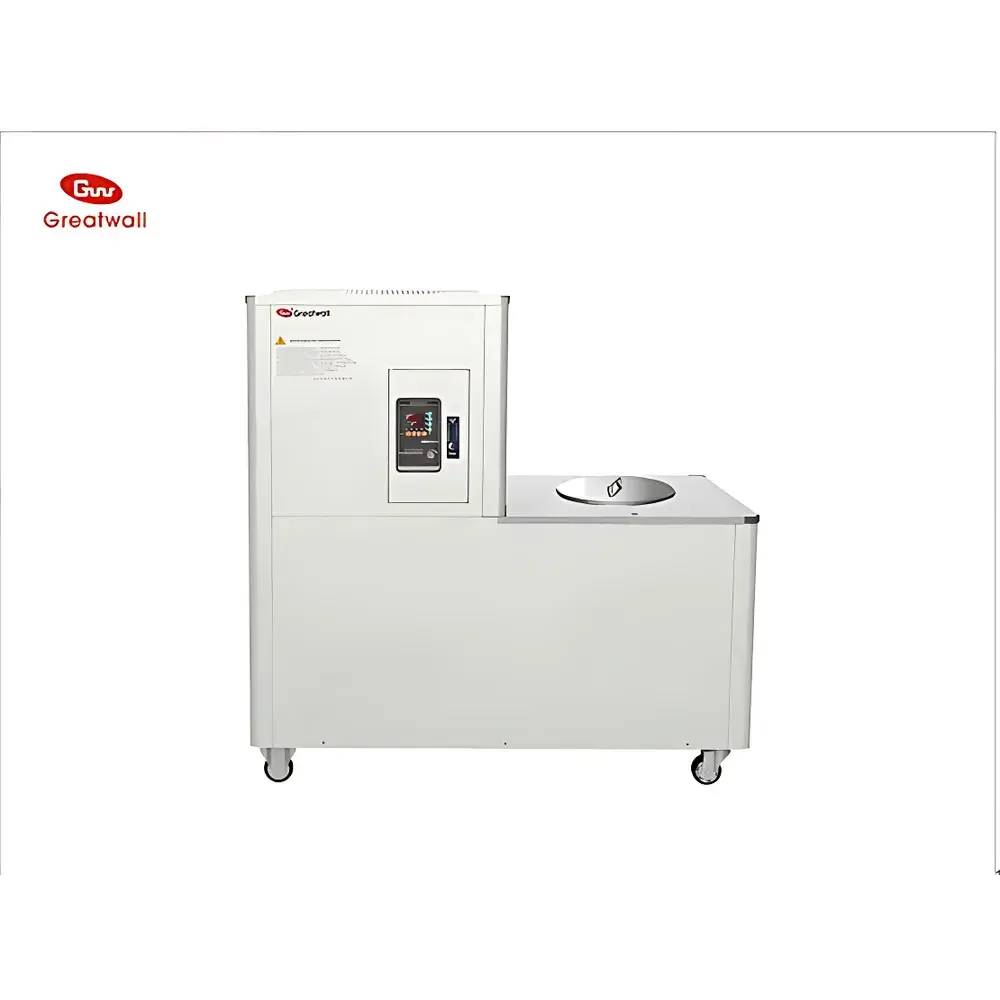
Great Wall DHJF-1050 Ultra-Low Temperature Circulating Reaction Bath
| Brand | The Great Wall |
|---|---|
| Origin | Henan, China |
| Manufacturer Type | Direct Manufacturer |
| Country of Origin | China |
| Model | DHJF-1050 |
| Quotation | Upon Request |
| Cooling Capacity | 700 W at −60 °C, 580 W at −80 °C, 420 W at −100 °C |
| Temperature Range | −100 °C to −60 °C |
| Temperature Stability | ±2 °C |
| Bath Volume | 50 L |
| Pump Flow Rate | 20 L/min |
| Max. Circulation Pressure | 0.4 bar |
| Pump Power | 100 W |
| Total Power Consumption | 4.876 kW |
| Display | LCD with 0.1 °C resolution |
| Bath Material | 304 Stainless Steel |
| External Port | 1/2″ BSP |
| Bath Opening Diameter | 400 mm |
| Bath Internal Dimensions | Ø450 × 320 mm |
| Max. Flask Capacity | 20,000 mL |
| Ambient Operating Conditions | 5–35 °C, ≤70% RH |
| Power Supply | 3-phase, 380 V, 50 Hz |
| Unit Dimensions (W×D×H) | 1340 × 820 × 1310 mm |
| Net Weight | 265 kg |
| Safety Protections | Phase sequence, overcurrent, overheating, and startup delay protection |
| Refrigerant | Mixed refrigerant blend |
| Note | External circulation must be disabled when bath temperature < −90 °C |
Overview
The Great Wall DHJF-1050 Ultra-Low Temperature Circulating Reaction Bath is an engineered solution for sustained, stable cryogenic operation in laboratory-scale chemical synthesis, low-temperature catalysis, and material characterization workflows. Designed around a single-stage compression cascade architecture with serial heat exchangers, the system achieves continuous thermal control from −100 °C to −60 °C—without requiring liquid nitrogen or multi-compressor configurations. Its core refrigeration circuit integrates a hermetic Panasonic scroll compressor, air-cooled finned-tube condenser with oxygen-free copper tubing, capillary tube expansion device, and a submerged coil-type evaporator housed directly within the 304 stainless steel reservoir. This fully welded, low-joint-count design minimizes leak risk and enhances long-term operational integrity under deep-cryogenic stress. The bath’s structural configuration isolates the evaporator from mechanical strain during cryogen-induced contraction of the heat transfer fluid, ensuring reliability even when the coolant approaches its freezing threshold.
Key Features
- Hermetically sealed Panasonic scroll compressor with integrated thermal overload protection and flexible mounting for vibration damping
- Air-cooled condenser featuring high-efficiency oxygen-free copper spiral tubing and proprietary tube-to-fin expansion bonding for optimal heat rejection
- Serial-stage subcooling heat exchanger assembly enabling single-compressor operation down to −100 °C via controlled phase separation and staged evaporation
- Submerged helical evaporator fabricated from corrosion-resistant 304 stainless steel, mechanically decoupled from the bath vessel to withstand thermal cycling-induced stress
- Low-temperature-rated shielded centrifugal circulation pump (100 W, 20 L/min, 0.4 bar max) with 304 stainless steel wetted parts and non-ferrous impeller
- Digital PID controller with backlit LCD interface, 0.1 °C temperature resolution, and programmable ramp/soak profiles
- Comprehensive safety suite including phase-sequence monitoring, overcurrent cutoff, thermal cutout, and delayed startup logic to prevent compressor short-cycling
Sample Compatibility & Compliance
The DHJF-1050 accommodates standard laboratory glassware up to 20 L volume through its 400 mm-diameter opening and 450 mm × 320 mm cylindrical bath chamber. All fluid-contact surfaces—including reservoir, internal piping, and pump head—are constructed from ASTM A240 304 stainless steel, ensuring compatibility with common organic solvents, halogenated coolants, and low-temperature reaction mixtures. The unit complies with IEC 61000-6-2 (immunity) and IEC 61000-6-4 (emissions) for industrial environments. While not certified to UL/CSA or CE for medical or explosive atmospheres, its electrical architecture adheres to GB/T 19001 (ISO 9001) manufacturing controls, and documentation supports GLP-compliant validation protocols—including IQ/OQ documentation templates, calibration traceability records, and alarm log export capability.
Software & Data Management
The embedded controller provides local data logging with timestamped temperature, setpoint, and alarm status history stored internally for ≥30 days. Optional RS485 Modbus RTU interface enables integration into centralized lab management systems (e.g., LabVantage, STARLIMS) for automated data capture and audit trail generation. When configured with external SCADA or custom Python-based acquisition tools, the bath supports FDA 21 CFR Part 11–aligned electronic record practices—including user authentication, change tracking, and electronic signature readiness. All parameter adjustments are logged with operator ID, timestamp, and pre-/post-change values—enabling full retrospective review for quality audits.
Applications
- Low-temperature Grignard and organolithium reactions requiring precise thermal hold between −80 °C and −100 °C
- Cryogenic crystallization studies for pharmaceutical polymorph screening under controlled sub-zero nucleation conditions
- Thermal aging tests of elastomers and composites per ASTM D746 and ISO 22088-2
- Calibration of cryogenic thermocouples and resistance temperature detectors (RTDs) across the −100 °C to −60 °C range
- Condensation trapping in vacuum distillation setups using chilled glycol–ethanol mixtures
- Stabilization of superconducting magnet test fixtures during quench characterization
FAQ
Can the DHJF-1050 operate with external recirculation below −90 °C?
No. External circulation must be disabled when the bath temperature falls below −90 °C to prevent pump cavitation, seal embrittlement, and flow instability. Internal bath homogeneity is maintained via passive convection and internal agitation.
What coolant fluids are recommended for operation at −100 °C?
A mixture of ethylene glycol and ethanol (typically 30:70 v/v) or specialized low-temperature silicone oils meeting ASTM D4692 specifications are validated for use. Water-based solutions are strictly prohibited.
Is the unit suitable for GMP-regulated pharmaceutical development?
Yes—when deployed with documented IQ/OQ protocols, calibrated reference thermometers, and configured for electronic audit trails via Modbus integration, it meets foundational requirements for Category B equipment per EU Annex 15 and USP <1058>.
How is temperature uniformity verified across the 50 L bath volume?
Uniformity is characterized per ASTM E742 using nine-point sensor mapping (center + eight radial positions at mid-depth). Typical deviation is ≤±1.2 °C at −80 °C steady state, confirmed in factory acceptance testing reports.
Does the system include remote monitoring capability out-of-the-box?
Standard configuration includes local LCD and keypad only. Remote access requires optional RS485 interface module and third-party SCADA or custom script integration. No built-in Wi-Fi or Ethernet port is provided.
Related Products



