
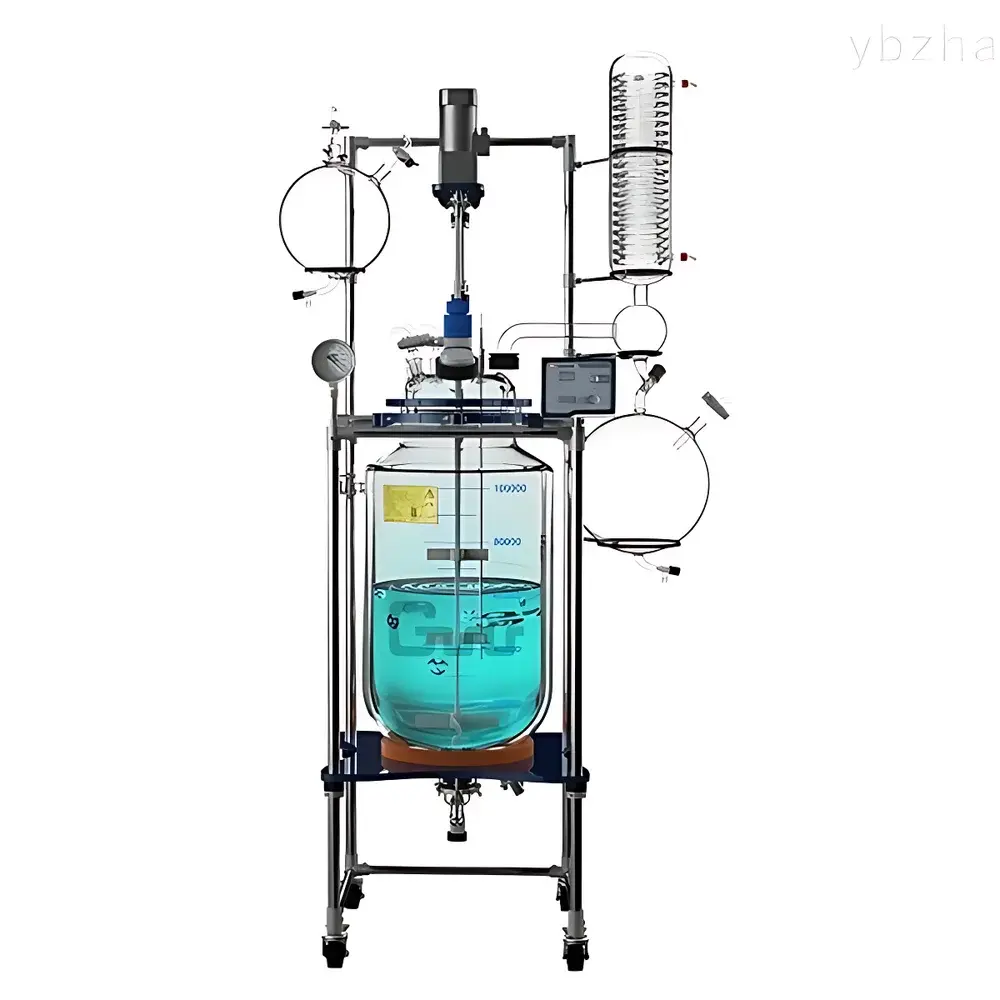
The Great Wall GR-150EX Explosion-Proof Double-Jacketed Glass Reactor
| Brand | The Great Wall |
|---|---|
| Origin | Henan, China |
| Manufacturer Type | Direct Manufacturer |
| Origin Category | Domestic |
| Model | GR-150EX |
| Price Range | USD 7,000–14,000 (FOB) |
| Usable Volume | 150 L (Large-Scale Lab Use) |
| Construction Material | Borosilicate Glass 3.3 |
| Operating Pressure Range | −0.1 MPa to 0.0 MPa (Vacuum to Atmospheric) |
| Jacket Capacity | ~45 L |
| Vacuum Performance | ≤ 2 kPa/h pressure rise rate |
| Condenser Heat Exchange Area | ~1.32 m² |
| Stirring Power | 370 W |
| Speed Range | 50–300 rpm (Variable-Frequency Drive) |
| Temperature Range | −80 °C to +200 °C |
| Temperature Sensor | Pt100 (±0.1 °C display accuracy) |
| Sealing Material | PTFE |
| Stirrer Type | Paddle-type with PTFE-coated blades |
| Shaft Material | SUS304 stainless steel with PTFE cladding |
| Jacket Inlet/Outlet | 3/4″ NPT female threads |
| Overall Dimensions (W×D×H) | ~1250 × 1100 × 2700 mm |
| Ambient Operating Conditions | 5–35 °C, ≤65% RH |
Overview
The Great Wall GR-150EX Explosion-Proof Double-Jacketed Glass Reactor is an engineered solution for controlled, scalable synthesis under vacuum or inert conditions in research laboratories and pilot-scale development facilities. Designed around the Couette flow principle and thermal equilibrium dynamics of double-jacketed glass vessels, this reactor enables precise temperature regulation—via external circulatory fluid (e.g., silicone oil, ethylene glycol, or dry ice/acetone mixtures)—across a wide operational envelope from −80 °C to +200 °C. Its fully enclosed, ground-glass jointed architecture—constructed exclusively from ASTM F3239-compliant borosilicate glass 3.3—ensures optical clarity for real-time reaction monitoring while maintaining chemical inertness against strong acids, alkalis, and organic solvents. The integrated explosion-proof motor assembly (certified per IEC 60079-0 and IEC 60079-1 for Zone 1/2 hazardous locations) eliminates ignition risk during exothermic or solvent-based reactions involving flammable vapors. Unlike standard reactors, the GR-150EX incorporates structural stress mitigation features—including PTFE-sealed, non-rotating flange interfaces and stainless steel insulated flex hoses at jacket ports—to prevent thermal fatigue and microfracture propagation under cyclic pressure/vacuum duty.
Key Features
- Explosion-proof 370 W variable-frequency drive motor with digital speed display (50–300 rpm), enabling reproducible shear control across viscosity ranges up to 50,000 mPa·s.
- Borosilicate glass 3.3 vessel body and condenser (per DIN ISO 3585), rated for ≤80 °C differential between inner and outer jacket surfaces—critical for cryogenic reflux or high-temperature distillation stability.
- Integrated Pt100 temperature sensor (SUS304 sheath + PTFE insulation) mounted via 35# ground-glass port; supports external PID controller integration for closed-loop thermal management.
- Zero-dead-volume side discharge valve with PTFE-lined ceramic core and 370 mm floor clearance—designed for complete, residue-free transfer of viscous or crystalline products without disassembly.
- Modular port configuration: six standardized joints (60#, 35#, 50#, 34#, 40#, 95#) accommodate interchangeable accessories including dropping funnels, gas inlets, thermowells, and Dean-Stark traps.
- Locking casters with load-rated polyurethane wheels (≥150 kg capacity) allow safe repositioning within fume hoods or Class I/II biosafety cabinets without compromising leveling or vacuum integrity.
Sample Compatibility & Compliance
The GR-150EX accommodates heterogeneous, multiphase, and air/moisture-sensitive reaction systems—including Grignard formations, lithium-aluminum hydride reductions, and palladium-catalyzed cross-couplings—under sustained vacuum (≤−0.098 MPa absolute) or nitrogen/argon blanket. All wetted surfaces comply with USP extractables limits for pharmaceutical process equipment. The reactor meets CE Machinery Directive 2006/42/EC requirements for mechanical safety and EN 61000-6-3 EMC emission standards. For GLP-regulated environments, optional audit-trail-capable temperature/stirring data logging (via RS485 Modbus RTU) supports 21 CFR Part 11 compliance when paired with validated third-party software. Pressure containment design adheres to PED 2014/68/EU Annex I essential safety requirements for Group 2 fluid category (non-hazardous gases/liquids).
Software & Data Management
While the base unit operates via standalone analog controls, the GR-150EX supports digital integration through its 4–20 mA temperature output and 0–10 V speed reference input. When connected to a programmable logic controller (PLC) or SCADA system, users can implement multi-step temperature ramping profiles, interlock logic (e.g., stirrer stop on vacuum loss), and automated batch reporting. Optional USB-to-RS485 adapters enable direct acquisition of real-time RPM, temperature, and vacuum readings into MATLAB, LabVIEW, or custom Python scripts using open Modbus registers. All firmware updates are delivered via signed .bin files with SHA-256 checksum verification to ensure traceability and cybersecurity integrity.
Applications
- Solvent-mediated crystallization studies requiring precise supersaturation control via simultaneous cooling and antisolvent addition.
- Catalytic hydrogenation screening under controlled H₂ partial pressure (with optional mass-flow controller integration).
- Distillative workup of reaction mixtures using the built-in 1.32 m² condenser surface—capable of handling reflux ratios ≥3:1 at 80 °C with water-cooled circulation.
- Photochemical synthesis using UV-transparent glass components and optional quartz irradiation ports.
- Process analytical technology (PAT) development: inline Raman or FTIR probe compatibility via dedicated 35# sensor port.
- Educational demonstration of thermodynamic phase behavior, reaction kinetics, and heat transfer coefficients in chemical engineering curricula.
FAQ
Is the GR-150EX certified for use in Class I, Division 1 hazardous locations?
No—it carries IECEx and ATEX certification for Zone 1 (gas) and Zone 21 (dust) per EN 60079-0:2018 and EN 60079-1:2014, which align with NEC Article 505 for Class I, Zone 1 equivalency—not Division 1.
Can the reactor be operated continuously at −80 °C using liquid nitrogen in the jacket?
Direct liquid nitrogen injection is prohibited due to thermal shock risk. Use pre-chilled cryogenic circulators (e.g., Julabo FP50-HL) with methanol/ethanol mixtures to achieve stable subzero operation.
What maintenance intervals are recommended for the PTFE stirring seal?
Inspect visually every 200 operating hours; replace if radial play exceeds 0.15 mm or leakage exceeds 1 drop/minute under full vacuum.
Does the system include vacuum pump and chiller?
No—these are specified as auxiliary components per user-defined thermal/vacuum duty cycles and must be selected separately based on required pumping speed (≥12 m³/h for rapid evacuation) and cooling capacity (≥3 kW @ −40 °C).
Are replacement glass parts available with serialized traceability?
Yes—each borosilicate component ships with laser-etched batch ID, hydrostatic test certificate (per ISO 7806), and CoA referencing raw material melt lot and annealing cycle parameters.



