
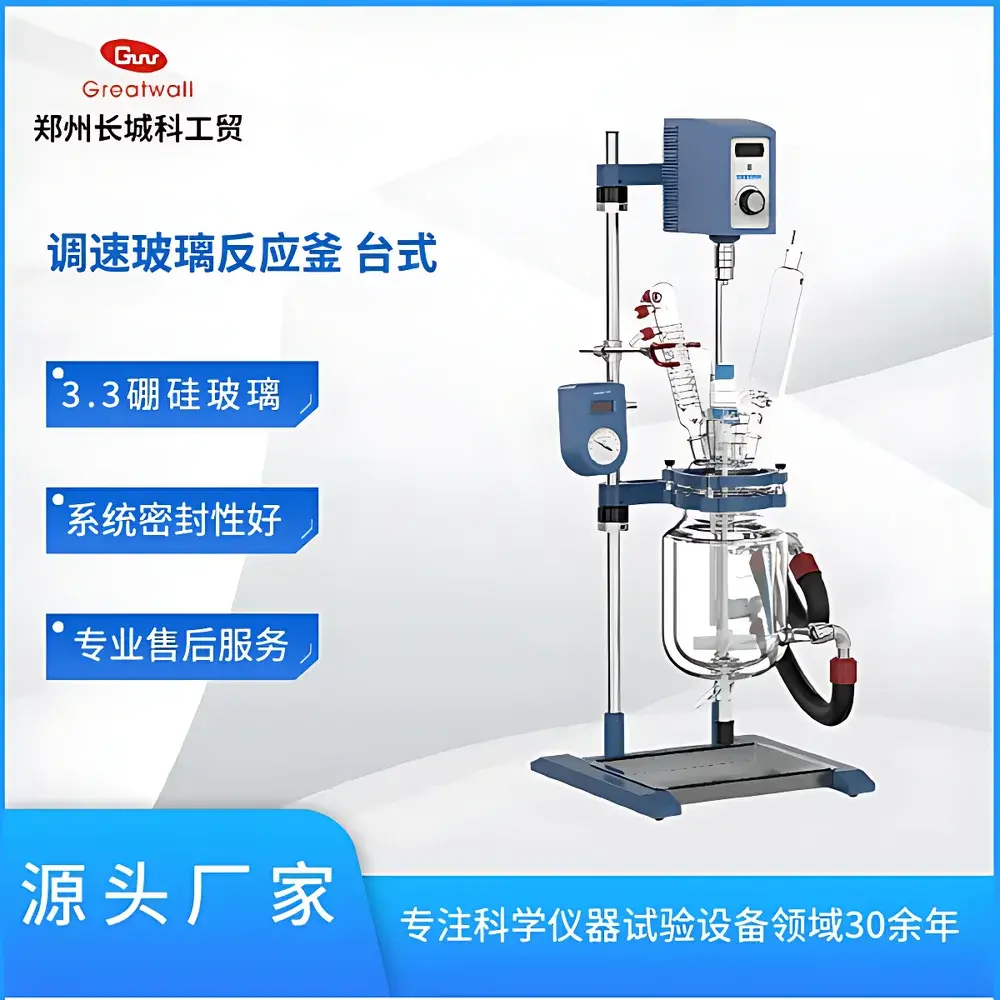
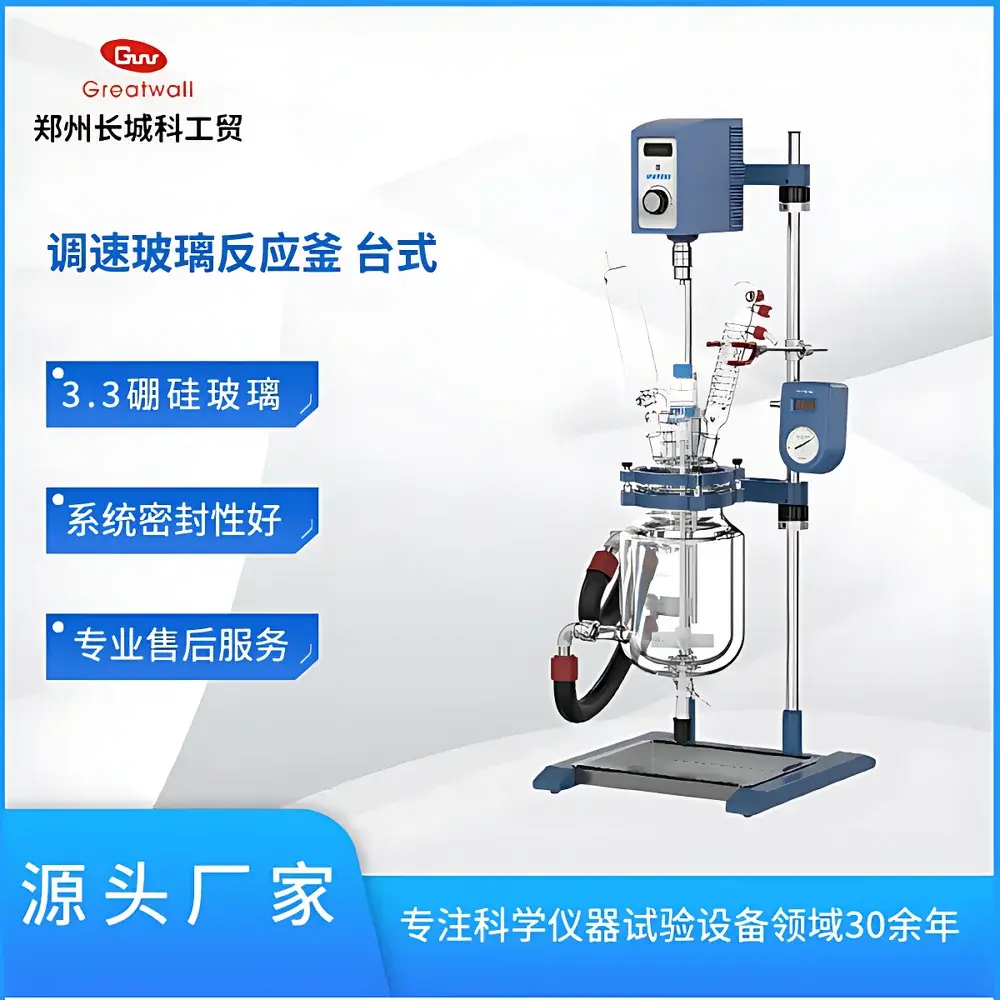
Great Wall GR-2 Benchtop Glass Reactor
| Brand | The Great Wall |
|---|---|
| Origin | Henan, China |
| Manufacturer Type | Direct Manufacturer |
| Equipment Category | Domestic |
| Model | GR-2 |
| Reactor Type | Benchtop Glass Reactor |
| Vessel Capacity | 2 L |
| Vessel Material | Borosilicate Glass 3.3 |
| Operating Pressure Range | –0.1 MPa to 0 MPa (vacuum to ambient) |
| Temperature Range | –80 °C to +200 °C |
| Jacket Volume | 1.7 L |
| Jacket Pressure Rating | ≤ 0.03 MPa |
| Stirring Speed Range | 40–500 rpm |
| Speed Accuracy | ±1 rpm |
| Motor Type | Brushless DC |
| Motor Power | 50 W |
| Stirrer Shaft Material | 06Cr19Ni10 (AISI 304) with PTFE cladding |
| Impeller Material | PTFE-coated 06Cr19Ni10 |
| Sealing | Vacuum-rated mechanical seal |
| Stirrer Configuration | Single-layer four-blade inclined turbine |
| Temperature Sensor | PT100, ±0.1 °C accuracy |
| Display | Digital LED for speed and temperature |
| Power Supply | Stirrer: 100–240 V AC, 50/60 Hz |
| Control Box | 220–240 V AC, 50/60 Hz |
| Dimensions (W×D×H) | ~480 × 420 × 1100 mm |
| Weight | ~20 kg |
| Compliance | Designed for GLP-compliant laboratory environments |
| Accessories | Standard condenser (326 mm length, 0.025 m² cooling area), 200 mL constant-pressure dropping funnel (24/29 joint), 24/40 and 19/26 standard taper ports, φ20 discharge valve, Rc 3/4 & Rc 1/2 jacket inlet/outlet threads |
Overview
The Great Wall GR-2 Benchtop Glass Reactor is an engineered solution for controlled small-scale chemical synthesis, distillation, concentration, and reaction monitoring under vacuum or inert atmosphere. It operates on the principle of jacketed thermal regulation—where a circulating fluid (e.g., coolant or heating oil) flows through the double-walled borosilicate glass vessel to precisely maintain process temperature—combined with magnetically coupled or mechanically sealed agitation to ensure homogeneity and reproducibility. Its design adheres to fundamental reactor engineering requirements: transparent observation of reaction progress, chemically inert wetted surfaces, compatibility with vacuum and mild positive pressure, and modular integration with ancillary equipment such as condensers, reflux traps, and feed systems. The GR-2 is intended for use in academic research laboratories, pharmaceutical development labs, and fine chemical pilot studies where batch fidelity, material compatibility, and operational safety are prioritized over high-throughput automation.
Key Features
- High-purity borosilicate glass 3.3 vessel and lid (ASTM E438 Type I, Class A), offering exceptional thermal shock resistance (ΔT ≤ 80 °C), low coefficient of thermal expansion (3.3 × 10⁻⁶ /K), and broad chemical resistance to acids, alkalis, and organic solvents.
- Double-jacket construction with 1.7 L jacket volume and rated pressure ≤ 0.03 MPa, enabling stable thermal control via external circulators across the full operating range (–80 °C to +200 °C).
- Vacuum-rated mechanical seal assembly using imported bearings and PTFE/PEEK composite support components, ensuring long-term leak-tight operation at pressures down to –0.1 MPa without lubricant contamination.
- Brushless DC stirring motor (50 W) with true 40–500 rpm continuous variable speed control, digital LED display, and ±1 rpm repeatability—critical for kinetic studies requiring precise shear rate definition.
- Modular port configuration: five standardized ground-glass joints (three × 24/40, one × 19/26, one central 24/40), facilitating flexible setup of reflux, gas inlet, thermometer, addition funnel, and vacuum line.
- Corrosion-resistant frame fabricated from hybrid materials—06Cr19Ni10 stainless steel base, powder-coated carbon steel structural members, and anodized aluminum uprights—designed for durability, cleanability, and compliance with ISO 14644-1 Class 8 lab environment standards.
Sample Compatibility & Compliance
The GR-2 accommodates liquid-phase reactions, heterogeneous catalysis, crystallization, solvent removal, and low-boiling-point distillations. Its all-glass fluid path eliminates metal ion leaching, making it suitable for organometallic synthesis, catalyst screening, and API intermediate development where trace metal contamination must be avoided. The system supports ASTM E2877-22 (Standard Guide for Laboratory Reactor Selection) and aligns with USP analytical instrument qualification principles. While not inherently 21 CFR Part 11 compliant, its analog/digital instrumentation architecture allows integration with validated electronic lab notebooks (ELNs) and LIMS platforms when paired with audit-trail-capable data loggers. All electrical components meet IEC 61010-1 safety standards for laboratory equipment.
Software & Data Management
The GR-2 operates as a stand-alone unit with local digital readouts for speed and temperature. For enhanced traceability, optional RS485 or USB interfaces enable connection to third-party data acquisition systems (e.g., LabVIEW, MATLAB, or custom Python-based logging tools). When deployed in regulated environments, users may configure external controllers to record timestamps, setpoint deviations, and alarm events—supporting GLP/GMP documentation requirements including raw data archiving, operator identification, and change history. No proprietary firmware or cloud dependency is involved; all control logic remains transparent and user-verifiable.
Applications
- Synthesis of heterocyclic compounds under reflux or reduced pressure
- Kinetic profiling of esterification and transesterification reactions
- Controlled crystallization trials with real-time visual monitoring
- Removal of volatile solvents via rotary evaporation-compatible setups
- Photochemical reactions using UV-transparent glass and optional lamp housings
- Small-batch polymerization (e.g., polycondensation, ring-opening) with viscosity tracking
- Extraction and phase-separation studies with immiscible solvent systems
FAQ
What is the maximum allowable thermal gradient across the glass vessel during rapid cooling?
The borosilicate 3.3 construction tolerates a maximum instantaneous thermal gradient of 80 °C—exceeding typical cryogenic quenching protocols when using dry ice/acetone or liquid nitrogen-cooled jackets.
Can the GR-2 be used under positive pressure?
No—it is rated for vacuum to ambient pressure only (–0.1 MPa to 0 MPa); positive pressure operation requires alternative reactor designs with reinforced sealing and pressure-certified vessels.
Is the stirring system compatible with abrasive slurries?
The PTFE-coated impeller and shaft provide excellent resistance to corrosion but are not recommended for highly abrasive solid suspensions; for such applications, optional Hastelloy or ceramic-coated agitators may be sourced separately.
How is calibration verified for temperature and speed readings?
PT100 sensor output can be field-verified against a NIST-traceable reference thermometer; speed calibration is confirmed using a non-contact tachometer aligned with the motor shaft marker.
Does the unit include validation documentation for GxP environments?
Factory-supplied IQ/OQ documentation templates are available upon request; final PQ must be performed by the end user per their internal SOPs and regulatory jurisdiction.



