
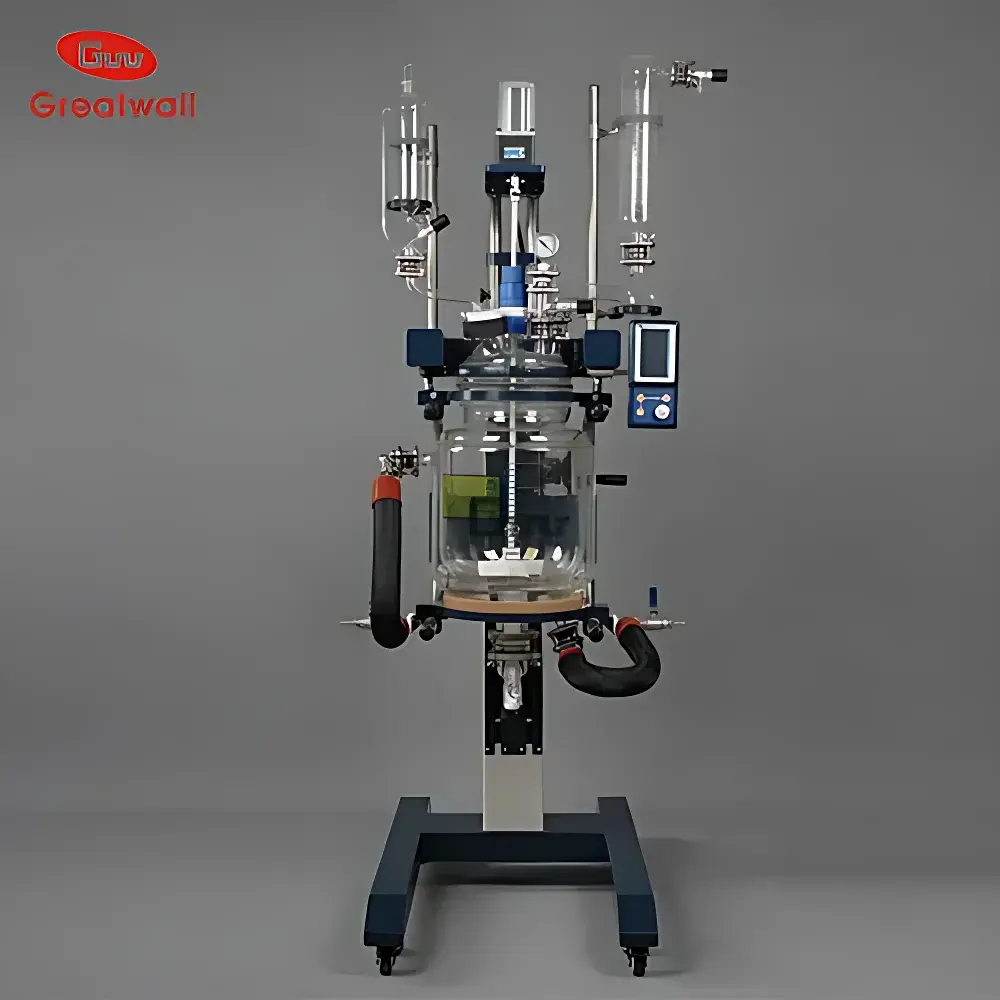
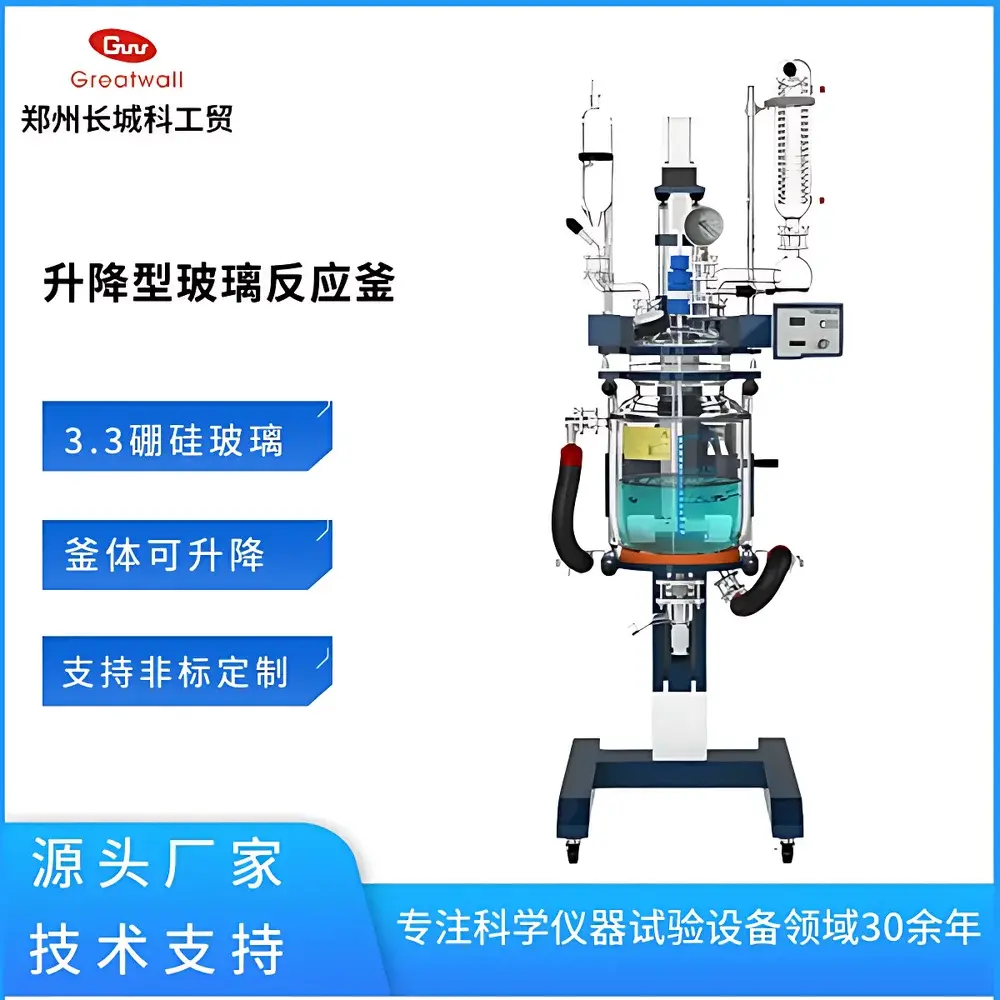
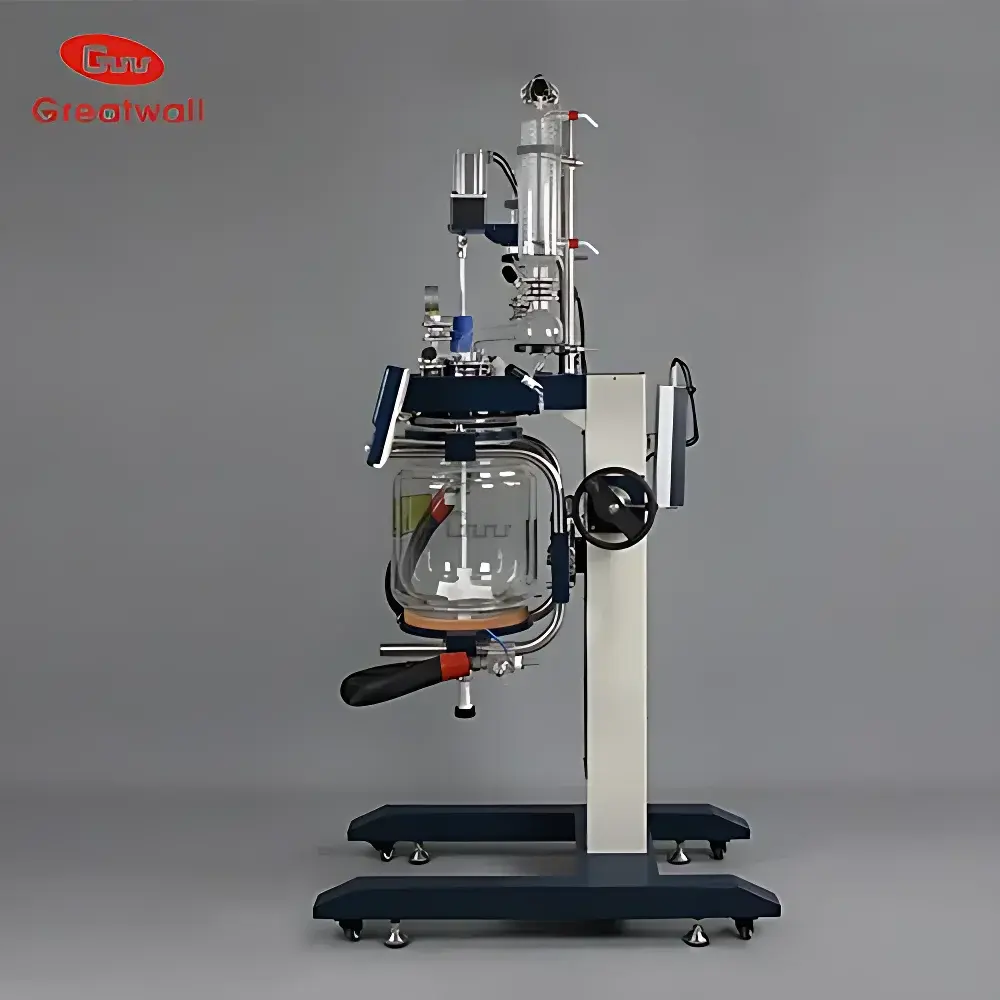
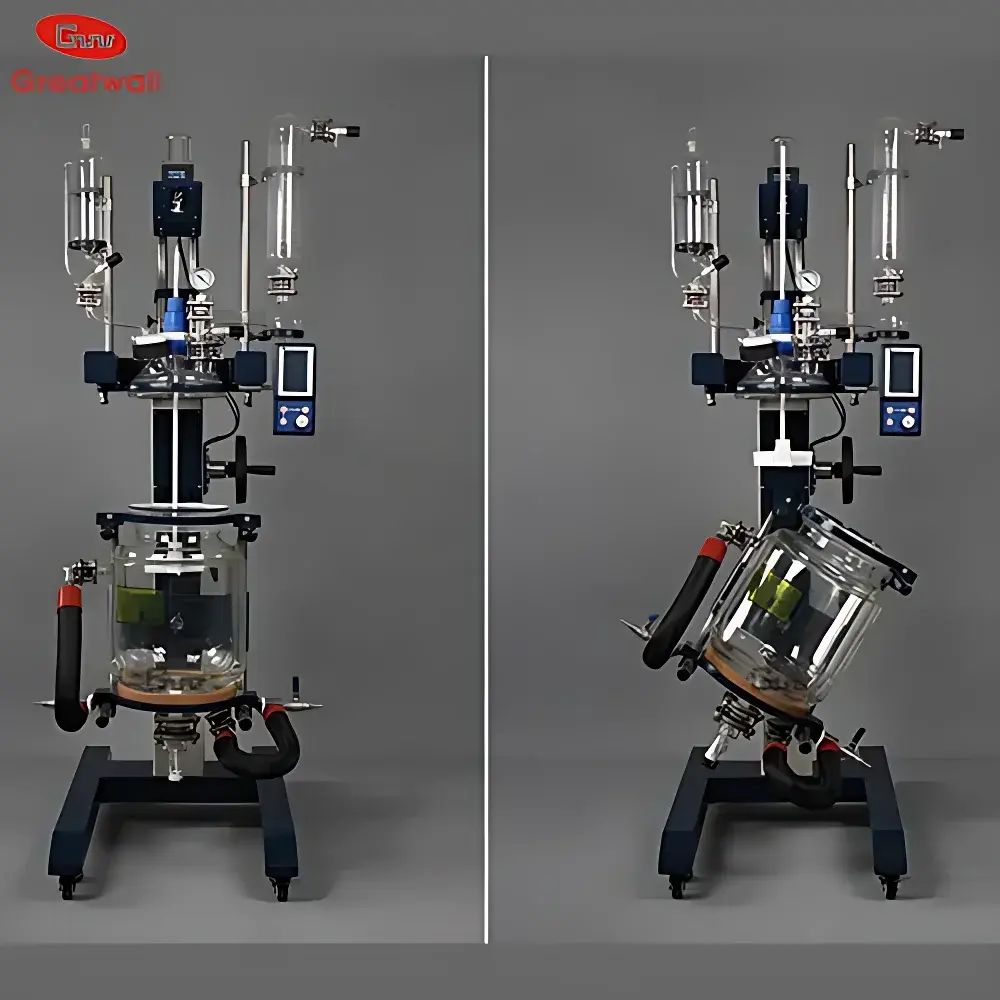
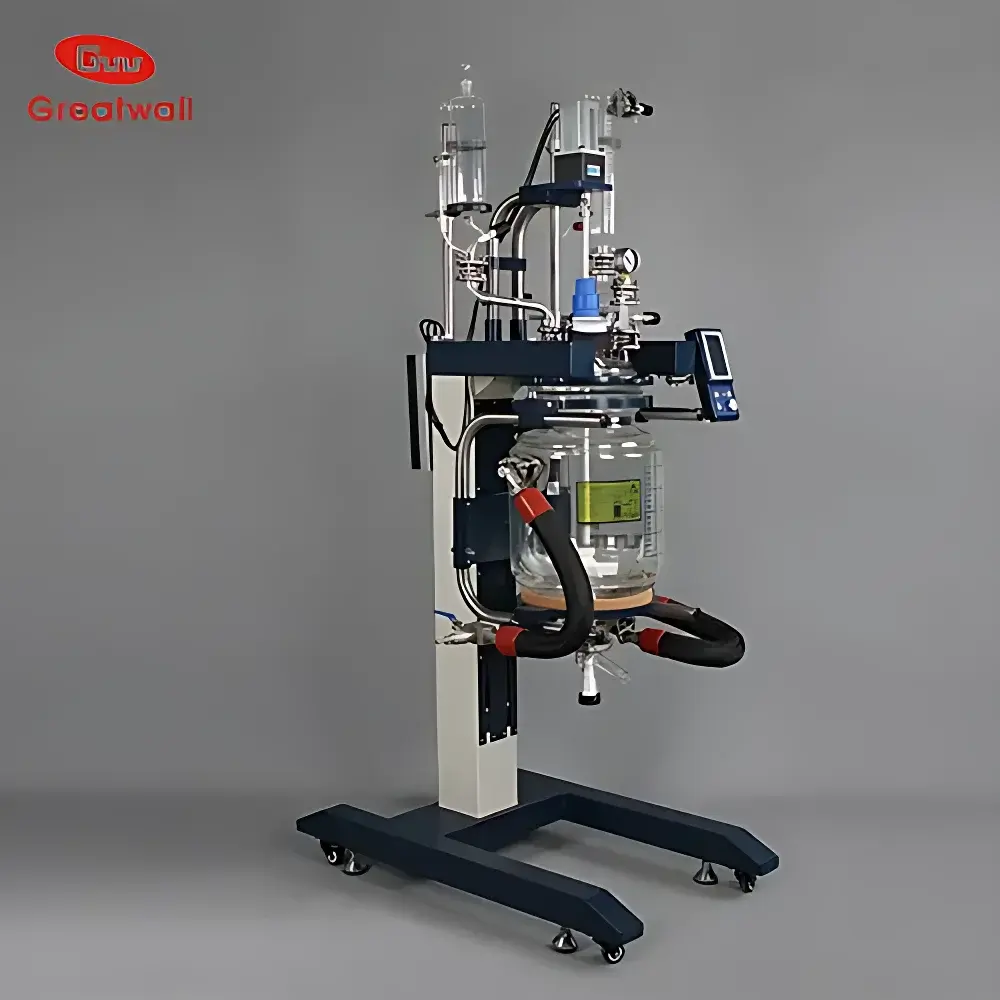
The Great Wall GRL-20 Adjustable Height Variable-Speed Glass Reactor
| Brand | The Great Wall |
|---|---|
| Origin | Henan, China |
| Manufacturer Type | Direct Manufacturer |
| Origin Category | Domestic |
| Model | GRL-20 |
| Instrument Classification | Glass Reactor |
| Usable Volume | Medium-Scale |
| Construction Material | Borosilicate Glass 3.3 |
| Operating Pressure Range | −0.1 MPa to 0.0 MPa (Vacuum to Atmospheric) |
| Capacity | 20 L |
| Temperature Range | −80 °C to +200 °C |
| Drive Mechanism | Motorized Speed-Controlled Stirring System with Adjustable Height & 120° Tilt Functionality |
| Frame Material | 06Cr19Ni10 Stainless Steel + Carbon Structural Steel with Powder Coating + Anodized Aluminum Components |
| Stirring Shaft | 06Cr19Ni10 Stainless Steel Core with PTFE Cladding |
| Impeller Material | PTFE |
| Sealing System | Proprietary Magnetic or Mechanical Seal Assembly (Configurable) |
| Discharge Valve | Top-Mounted Angled Drain Valve |
| Jacket Inlet/Outlet | Stainless Steel Flexible Insulated Hoses |
| Mobility | Locking Casters with Brake Mechanism |
Overview
The Great Wall GRL-20 Adjustable Height Variable-Speed Glass Reactor is an engineered solution for controlled chemical synthesis, solvent reflux, distillation, and process development under vacuum or inert atmosphere. Designed around the principles of transparent process observation and mechanical reproducibility, it employs a double-jacketed borosilicate glass 3.3 vessel (DIN/ISO 3585 compliant) to enable precise thermal management via external heating/cooling media circulation. Its core operational architecture integrates vertical position adjustment and 120° tilting capability—mechanically decoupled from the stirring drive—to facilitate safe sample loading, unloading, and thorough cleaning without disassembly. The reactor operates within a validated pressure envelope of −0.1 MPa (75 Torr absolute) to ambient, supporting applications ranging from cryogenic lithiation at −80 °C to high-boiling-point esterification at +200 °C. All wetted surfaces—including the reaction chamber, condenser, and collection flask—are constructed exclusively from Class A borosilicate glass, ensuring hydrolytic resistance (ISO 719 HGB 1), thermal shock tolerance (>100 K ΔT), and minimal ion leaching in sensitive catalytic or pharmaceutical syntheses.
Key Features
- Adjustable-height frame with precision lead-screw actuation and locking collar, enabling repeatable vertical positioning for optimized condenser alignment and headspace control.
- 120° tilt mechanism with dual-axis support bearings, allowing full gravitational drainage and residue-free cleaning—critical for multi-step batch synthesis and GLP-compliant documentation.
- PTFE-coated 06Cr19Ni10 stainless steel stirring shaft and fully PTFE impeller, eliminating metal contamination and providing consistent torque transmission across viscosities up to 50,000 mPa·s.
- Proprietary sealing assembly featuring dual-lip PTFE gaskets and adjustable compression preload, achieving leak rates <1×10⁻⁶ mbar·L/s under sustained vacuum—validated per ASTM E493 helium leak testing protocols.
- Thermally isolated jacket ports with flexible stainless steel braided hoses (EPDM liner, 316SS braid), eliminating torsional stress on glass joints during thermal cycling.
- Modular frame construction using powder-coated carbon steel, electropolished 06Cr19Ni10, and anodized aluminum components—designed for corrosion resistance in halogenated solvent environments and compatibility with ISO 14644-1 Class 7 cleanroom maintenance protocols.
Sample Compatibility & Compliance
The GRL-20 accommodates heterogeneous, viscous, and gas-evolving reaction mixtures typical of Grignard preparations, hydrogenation, polymerization initiations, and crystallization studies. Its all-glass fluid path ensures compatibility with strong acids (e.g., concentrated H₂SO₄), bases (e.g., 50% NaOH), and aggressive solvents (e.g., THF, chlorobenzene, DMF). The system conforms to key international design and safety references: ISO 15500-5 (pressure equipment interfaces), EN 61000-6-3 (EMC emissions), and ASME B31.3 Process Piping guidelines for jacketed vessel auxiliary circuits. While not certified as PED 2014/68/EU Category I equipment due to its atmospheric/vacuum classification, it includes CE-marked electrical components (IEC 61000-4 series immunity) and meets UL 61010-1 requirements for laboratory electrical safety.
Software & Data Management
The GRL-20 is available with optional integrated digital control modules supporting RS485 Modbus RTU or Ethernet TCP/IP communication. When paired with The Great Wall’s LabControl Suite (v3.2+), users gain time-stamped logging of stir speed (0–250 rpm, ±1 rpm accuracy), jacket temperature (−80 °C to +200 °C, ±0.5 °C), and vacuum level (0–1000 mbar abs, ±5 mbar). Audit trails comply with FDA 21 CFR Part 11 requirements when deployed on validated Windows OS platforms, including electronic signatures, role-based access control, and immutable data export in CSV/Excel formats. Raw sensor data supports post-run kinetic modeling in MATLAB or Python-based cheminformatics workflows.
Applications
- Batch synthesis of fine chemicals and active pharmaceutical ingredients (APIs) requiring visual endpoint confirmation and strict solvent recovery protocols.
- Process optimization studies under reduced pressure for heat-sensitive intermediates (e.g., enol ether formation, diazotization).
- Scale-down modeling of industrial jacketed reactors for CFD validation and residence time distribution analysis.
- Educational demonstration of reaction thermodynamics, phase separation behavior, and mass transfer limitations in undergraduate and graduate chemistry laboratories.
- Development of nanomaterial dispersions and colloidal suspensions where shear history and particle agglomeration must be monitored in real time through the transparent vessel wall.
FAQ
What is the maximum allowable vacuum level for continuous operation?
The reactor is rated for sustained operation at −0.1 MPa (absolute pressure ≈ 0.03 atm), verified over 10,000 thermal cycles between −40 °C and +150 °C.
Can the system be purged with inert gas prior to reaction initiation?
Yes—the standard configuration includes dual Schlenk-type inlet/outlet valves compatible with nitrogen or argon line connections and pressure monitoring via integrated Bourdon tube gauge.
Is third-party calibration documentation available for the temperature and pressure sensors?
Factory calibration certificates traceable to NIST standards are provided; optional UKAS-accredited calibration services are available upon request.
What maintenance intervals are recommended for the stirring seal assembly?
Under normal use (≤8 hrs/day, non-abrasive media), inspect gasket integrity every 6 months; replace PTFE seals annually or after exposure to >180 °C sustained temperatures.
Does the frame support integration with overhead condensers or automated dosing systems?
Yes—standard DIN 29 and ISO 228/1 threaded ports (M27×2, M33×2) allow direct mounting of Liebig, Dimroth, or Vigreux condensers, as well as peristaltic pump manifolds with quick-connect fittings.



