
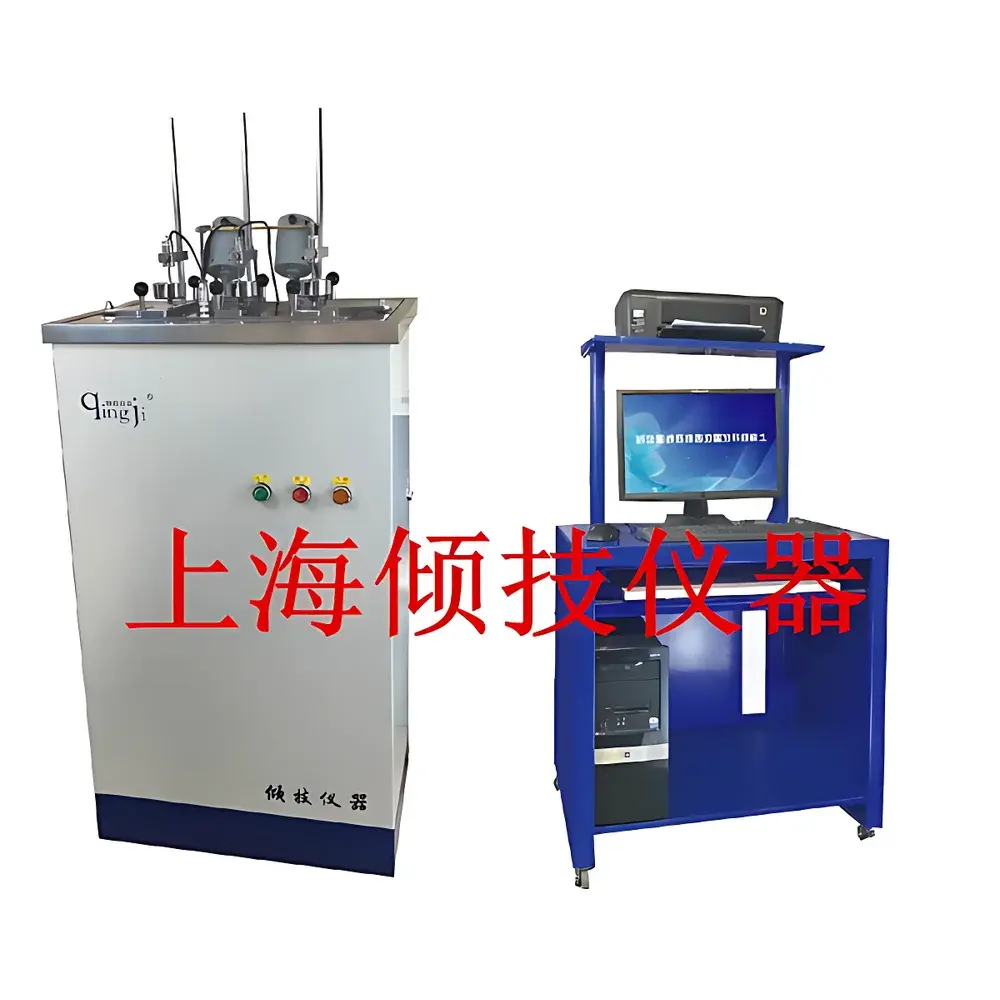
Qinji QJWK-507 Four-Station Wire Heat Distortion Tester
| Brand | Qinji |
|---|---|
| Origin | Shanghai, China |
| Model | QJWK-507 |
| Temperature Range | RT–300 °C |
| Heating Rate Options | (12 ±1) °C/6 min or (5 ±0.5) °C/6 min |
| Temperature Accuracy | ±1 °C |
| Deflection Measurement Range | 0–10 mm |
| Deflection Resolution | 0.001 mm |
| Heating Medium | Methyl Silicone Oil |
| Heating Power | 4 kW |
| Cooling Method | Natural cooling above 150 °C |
| Power Supply | AC 220 V, 20 A, 50 Hz |
| Dimensions (L×W×H) | 540 × 520 × 1360 mm |
| Compliance | GB/T 1633, GB/T 1634, GB 8802, ISO 75, ISO 306, ISO 2507 |
Overview
The Qinji QJWK-507 Four-Station Wire Heat Distortion Tester is a precision thermal-mechanical testing system engineered for the standardized determination of Vicat Softening Temperature (VST) and Heat Deflection Temperature (HDT) of thermoplastic polymers, thermosetting resins, and rigid polymer composites—including insulated wire and cable jacketing materials. It operates on the principle of controlled thermal loading under defined flexural stress, where specimen deformation under constant load is monitored as temperature increases at a prescribed rate. This method provides critical data for material qualification, process validation, and comparative thermal performance assessment in R&D, quality control, and regulatory submission workflows. The instrument supports simultaneous evaluation of up to four specimens—enabling statistically robust inter-batch comparisons and accelerated throughput without compromising measurement traceability or thermal uniformity across stations.
Key Features
- Four independent test stations with identical thermal and mechanical boundary conditions, ensuring high intra- and inter-run reproducibility (CV < 1.2% per ASTM D648 repeatability guidelines)
- Dual selectable heating rates: (12 ± 1) °C/6 min (120 ± 10) °C/h for VST per ISO 306 and GB/T 1633; and (5 ± 0.5) °C/6 min (50 ± 5) °C/h for HDT per ISO 75 and GB/T 1634
- High-stability methyl silicone oil bath with uniform temperature distribution (±0.8 °C across all stations at 200 °C), validated per ASTM E220 calibration protocol
- High-resolution linear displacement sensing: 0.001 mm resolution over 0–10 mm range, using either calibrated digital dial indicators or integrated LED-based optical encoders
- Programmable temperature ramping via microprocessor-controlled PID regulator with real-time deviation logging and automatic hold-on-event functionality
- Modular cooling architecture: passive convection cooling above 150 °C; switchable water-cooling circuit (with flow sensor and overheat cutoff) for rapid cooldown below 150 °C
- Robust mechanical frame with corrosion-resistant stainless steel bath housing and reinforced support columns for long-term dimensional stability
Sample Compatibility & Compliance
The QJWK-507 accommodates standard rectangular bars (e.g., 10 mm × 10 mm × ≈80 mm) and cylindrical wire specimens (diameter 1–6 mm, length ≥100 mm) mounted in three-point bending fixtures per ISO 75-1 and GB/T 1634-1. It fully complies with international standards including ISO 75-1/2/3 (Plastics — Determination of temperature of deflection under load), ISO 306 (Plastics — Thermoplastics — Determination of Vicat softening temperature), ISO 2507-1/2 (Thermoplastics pipes and fittings — Vicat softening temperature), and corresponding Chinese national standards GB/T 1633, GB/T 1634, and GB 8802. All thermal and mechanical calibrations are documented against NIST-traceable references, supporting GLP-compliant lab environments and audit readiness per ISO/IEC 17025 requirements.
Software & Data Management
The system integrates with optional PC-based acquisition software compatible with Windows 10/11 (64-bit), supporting real-time plotting of temperature vs. deflection curves, automatic endpoint detection (e.g., 0.34 mm deflection for HDT, 1 mm penetration for VST), and export of raw datasets in CSV and XML formats. Audit trails record operator ID, timestamp, calibration status, and parameter changes—meeting FDA 21 CFR Part 11 electronic record requirements when configured with user authentication and digital signature modules. Data files include embedded metadata: test standard selected, load condition (0.45 MPa or 1.80 MPa), specimen ID, and environmental ambient log.
Applications
- Quality assurance of PVC, PE, PP, ABS, and cross-linked polyolefin insulation compounds used in automotive wiring harnesses and building cables
- Thermal stability screening during formulation development of flame-retardant polymer blends
- Comparative HDT/VST benchmarking for supplier qualification and material substitution studies
- Regulatory documentation for UL, CSA, and CCC certification submissions requiring standardized thermal deformation data
- Evaluation of aging effects on wire jacket integrity after thermal cycling or UV exposure protocols
FAQ
What standards does the QJWK-507 support for wire-specific testing?
It meets GB 8802 for PVC-U pipe and fitting VST, and is routinely adapted for insulated wire testing per IEC 60811-201 (electric cables — test methods for non-metallic materials), with custom fixture kits available.
Can the instrument be integrated into a LIMS or MES environment?
Yes — the optional RS-232/USB interface supports SCPI command set and OPC UA connectivity for bidirectional data exchange with laboratory information management systems.
Is third-party calibration certification included with purchase?
A factory-issued calibration report (traceable to CNAS-accredited labs) is provided; ISO/IEC 17025 accredited field calibration services are available upon request.
What maintenance is required to ensure long-term accuracy?
Annual verification of temperature uniformity, load cell linearity, and displacement sensor drift is recommended; silicone oil replacement every 18 months (or per ASTM D2196 viscosity monitoring).



