
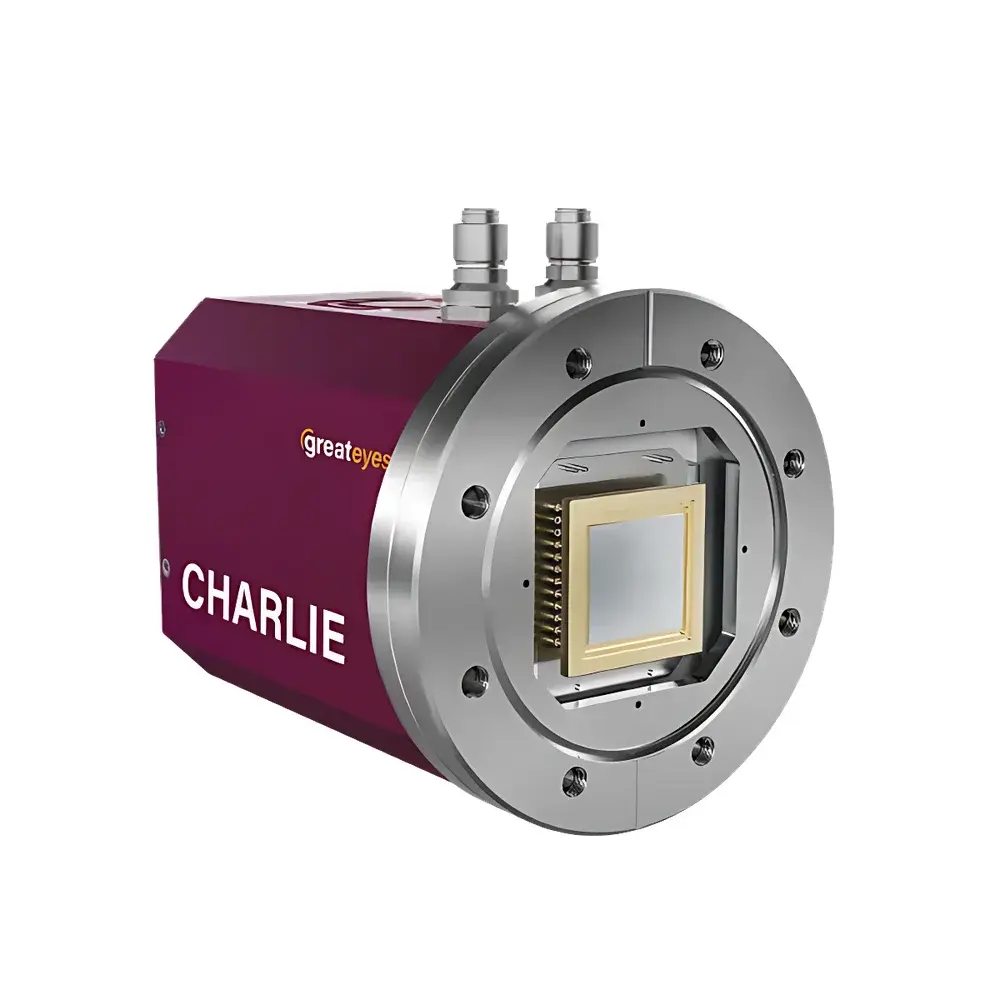
greateyes CHARLIE Series Back-Illuminated sCMOS Camera for EUV, Soft X-ray & X-ray Detection
| Brand | greateyes |
|---|---|
| Origin | Germany |
| Model | CHARLIE 2k2k-11 |
| Sensor Format | 2048 × 2048 pixels |
| Pixel Size | 11 µm × 11 µm |
| Active Area | 22.5 mm × 22.5 mm |
| Cooling Temperature | -50 °C (stabilized) |
| Readout Speed | 48 fps (full frame) |
| Quantum Efficiency | up to 99% (EUV–soft X-ray range) |
| Dynamic Range | 12-bit SDR & 16-bit HDR modes |
| Flange-to-Focal-Plane Distance | 1.0 mm (CF DN 63/100) |
| Dimensions | 8.3 cm × 10.0 cm × 11.9 cm |
| Weight | 3.1 kg |
| Interface | Gigabit Ethernet & USB 3.0 |
| Compliance | UHV-compatible (≤10⁻⁹ mbar), RoHS, CE |
Overview
The greateyes CHARLIE Series is a high-performance, back-illuminated scientific CMOS (sCMOS) camera engineered specifically for photon-starved detection in extreme ultraviolet (EUV), vacuum ultraviolet (VUV), soft X-ray, and hard X-ray regimes. Built upon greateyes’ decades-long expertise in ultra-high vacuum (UHV)-compatible sensor packaging and deep-cooled imaging systems, the CHARLIE platform leverages monolithic, thinned, and passivated silicon sensors to achieve near-theoretical quantum efficiency—up to 99% at 50–100 eV—with intrinsic single-photon sensitivity. Its operation relies on direct detection of ionizing radiation via photoelectron generation in the silicon bulk, eliminating the need for intensifiers or scintillator coupling that degrade spatial resolution and introduce gain non-uniformity. Designed for integration into synchrotron beamlines, free-electron laser (FEL) endstations, laboratory-scale HHG sources, and EUV lithography metrology tools, CHARLIE delivers quantitative, low-noise, high-fidelity imaging with exceptional temporal stability and pixel-level linearity across its full 2048 × 2048 array.
Key Features
- Back-illuminated sCMOS architecture with >95% QE from 13.5 nm (92 eV) to 1.24 keV (1 nm), optimized for direct EUV/X-ray detection without phosphor conversion
- Active cooling to -50 °C with thermoelectric stabilization, reducing dark current to <0.001 e⁻/pix/s—critical for long-exposure spectroscopy and ptychographic reconstruction
- True 12-bit standard dynamic range (SDR) and selectable 16-bit high-dynamic-range (HDR) mode enabling simultaneous capture of weak diffraction signals and intense Bragg peaks
- Compact, UHV-rated mechanical design (CF DN 63 and DN 100 flanges available) with 1.0 mm flange-to-focal-plane distance for minimal optical path intrusion
- Dual high-bandwidth interfaces: GigE Vision for deterministic remote acquisition in distributed control environments and USB 3.0 for local setup and rapid prototyping
- Rotatable mounting interface facilitating alignment-critical installations in constrained beamline geometries
Sample Compatibility & Compliance
CHARLIE is fully compatible with UHV and XHV environments (rated for ≤10⁻⁹ mbar), making it suitable for direct mounting on beamline front-ends, FEL diagnostic chambers, and EUV mask inspection tools. The sensor window is optional—devices can be operated windowless for maximum transmission below 50 eV or fitted with thin Si₃N₄ or Al filters for spectral bandpass selection. All electronics are housed in an EMI-shielded, grounded enclosure conforming to IEC 61326-1 (EMC for laboratory equipment) and CE marking requirements. The system supports audit-ready metadata logging and time-stamped frame acquisition—fully compliant with GLP and GMP-aligned data integrity practices when used with validated greateyes Vision software workflows.
Software & Data Management
The CHARLIE camera is controlled via greateyes Vision—a cross-platform (Windows/Linux) application offering real-time preview, hardware-triggered acquisition, region-of-interest (ROI) readout, and non-uniformity correction (NUC). It provides native support for GenICam-compliant GigE Vision drivers and includes comprehensive SDKs (C/C++, Python, MATLAB) for integration into EPICS, Tango, or custom LabVIEW-based control systems. Raw image data is saved in HDF5 or TIFF formats with embedded calibration metadata (gain, offset, temperature, exposure timestamp), ensuring traceability for ISO/IEC 17025-accredited laboratories. Optional firmware upgrades enable synchronized multi-camera triggering with sub-microsecond jitter—essential for pump-probe experiments at XFEL facilities.
Applications
- X-ray absorption spectroscopy (XAS), including NEXAFS and EXAFS measurements at bending magnet and insertion device beamlines
- Coherent diffractive imaging (CDI) and ptychography requiring high-modulation-transfer-function (MTF) detectors with <1 µm effective point-spread function
- Time-resolved resonant inelastic X-ray scattering (RIXS) experiments demanding high frame rates and low read noise
- EUV lithography mask inspection and actinic aerial image metrology under 13.5 nm illumination
- High-harmonic generation (HHG) beam characterization and attosecond pulse diagnostics
- Small-angle X-ray scattering (SAXS) and wide-angle X-ray scattering (WAXS) for structural biology and materials science
- FEL single-shot imaging, where radiation hardness and fast readout mitigate detector damage and enable burst-mode acquisition
FAQ
Is CHARLIE suitable for hard X-ray detection above 10 keV?
Yes—when coupled with optional thick-depletion or hybrid pixel sensor variants (available under custom configuration), CHARLIE supports direct detection up to 25 keV. Standard configurations are optimized for <5 keV; consult technical specifications for sensor thickness options.
Does CHARLIE support hardware synchronization with external lasers or choppers?
Yes—the camera features TTL-compatible trigger input/output ports with programmable delay (10 ns resolution) and supports master-slave timing modes for lock-in or stroboscopic acquisition.
Can CHARLIE operate in continuous streaming mode at full frame rate?
Yes—via GigE Vision with sufficient network bandwidth (≥1 Gbps dedicated link), full-frame 48 fps streaming is supported with on-the-fly disk buffering using greateyes Vision’s ring-buffer acquisition module.
What vacuum feedthroughs are supported for electrical connections?
Standard configurations include ConFlat-compatible SMA and D-Sub feedthroughs rated for UHV; custom KF or ISO-K solutions are available upon request.
Is firmware update capability available remotely?
Yes—firmware updates can be deployed over GigE or USB using signed binaries and integrated bootloader verification, meeting IEC 62443-3-3 requirements for secure device management.




