
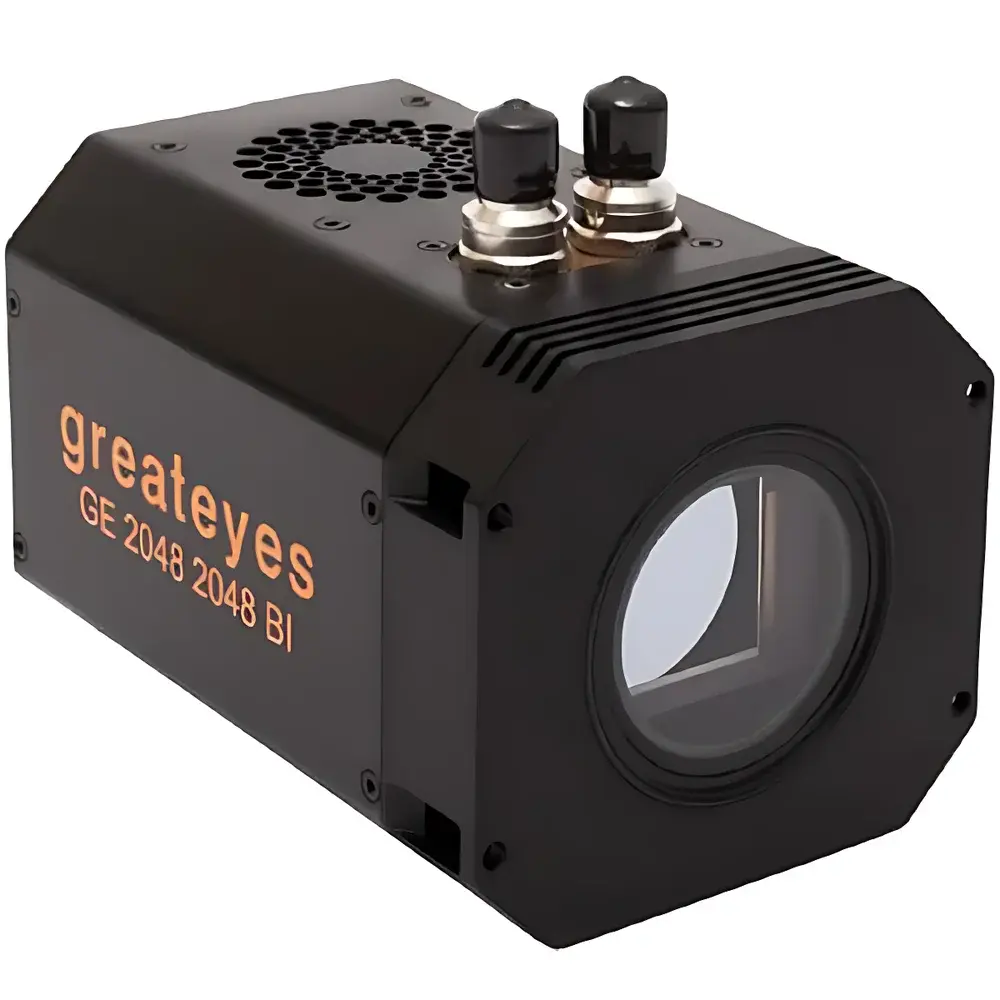
greateyes UV-Optimized Deep-Cooling Scientific CCD Camera
| Brand | greateyes |
|---|---|
| Origin | Germany |
| Model | CCD Camera |
| Cooling | -100 °C (via multi-stage thermoelectric cooling) |
| Sensor Type | Full-frame CCD |
| Spectral Range | UV to NIR (180–1100 nm) |
| Read Noise | <3 e⁻ (typ.) |
| Pixel Count | Up to 4096 × 4096 (model-dependent) |
| Binning | Software-configurable (1×1 to 8×8) |
| Trigger Modes | TTL, LVDS, optical, internal |
| Gain Control | Digital and analog, software-adjustable |
| Temperature Monitoring | On-sensor and housing sensors |
| Compliance | CE, RoHS, ISO 9001 manufacturing environment |
| Software Interface | Native support for LabVIEW, MATLAB, Python (greateyes SDK), and third-party spectroscopy platforms |
Overview
The greateyes UV-Optimized Deep-Cooling Scientific CCD Camera is engineered for high-fidelity photon detection in low-light scientific applications spanning ultraviolet (UV), visible (VIS), and near-infrared (NIR) spectral regions. Its core architecture centers on a full-frame, back-illuminated CCD sensor housed within a hermetically sealed vacuum chamber featuring a single fused silica or MgF₂ optical window—optimized for transmission down to 180 nm (deep UV). The camera employs a multi-stage thermoelectric (Peltier) cooling system capable of stabilizing the sensor at –100 °C, reducing dark current by more than five orders of magnitude compared to ambient operation. This enables integration times from milliseconds to hours without significant thermal noise accumulation—critical for applications such as Raman spectroscopy, synchrotron beamline imaging, time-resolved fluorescence, and astronomical spectroscopy where signal-to-noise ratio (SNR) directly determines detection limits and quantitative accuracy.
Key Features
- Ultra-deep thermoelectric cooling to –100 °C with active temperature stabilization ±0.1 °C, ensuring long-term dark current stability (<0.001 e⁻/pixel/s at –100 °C)
- Back-illuminated, thinned CCD sensor with quantum efficiency >90% at 250–700 nm and enhanced UV response via specialized anti-reflection and lumogen coatings
- Vacuum-sealed, non-evaporable getter (NEG)-pumped chamber eliminating condensation and outgassing—essential for UV transmission and sensor longevity
- Fully programmable binning (1×1 to 8×8) and region-of-interest (ROI) readout to optimize frame rate, dynamic range, and spatial resolution per application
- Multi-mode triggering (TTL, LVDS, optical fiber, internal clock) with sub-microsecond jitter for synchronization with pulsed lasers, choppers, or detector gating systems
- On-board sensor temperature monitoring and real-time feedback control integrated into all acquisition software interfaces
- Low-noise, correlated double sampling (CDS) electronics with selectable gain paths (high-sensitivity and high-dynamic-range modes)
Sample Compatibility & Compliance
The greateyes CCD camera supports diverse optical configurations including direct coupling to spectrometers (Czerny-Turner, Echelle), microscope ports, vacuum beamlines, and cryogenic sample stages. Its single-window design minimizes optical aberrations and eliminates internal reflections—particularly advantageous for stray-light-sensitive UV measurements. All models comply with CE marking requirements and are manufactured under ISO 9001-certified processes. The vacuum housing meets UHV-compatible flange standards (CF, KF, or custom), facilitating integration into cleanroom and synchrotron environments. While not intrinsically FDA- or GLP-certified, the camera’s deterministic behavior, audit-trail-capable SDK, and hardware-level timestamping support compliance with 21 CFR Part 11 when deployed within validated laboratory information management systems (LIMS).
Software & Data Management
The camera ships with the greateyes Control Center—a cross-platform application supporting Windows, Linux, and macOS. It provides real-time image preview, dark frame subtraction, flat-field correction, and non-uniformity compensation. The native SDK offers C/C++, Python (PyGreateyes), MATLAB, and LabVIEW APIs, enabling seamless integration into custom data acquisition pipelines. All acquired frames include embedded metadata (exposure time, sensor temperature, gain setting, trigger source, calibration timestamps), ensuring traceability. Raw data is saved in FITS or HDF5 format—both widely adopted in astrophysics and metrology communities for long-term archival and interoperability with analysis tools such as IRAF, DS9, or SciPy-based workflows.
Applications
- UV resonance Raman spectroscopy of biological macromolecules and catalysts
- High-resolution echelle spectroscopy in astronomical observatories and planetary atmospheric studies
- In situ monitoring of plasma emission lines (e.g., Ar II, O I, N II) in fusion diagnostics
- Time-gated luminescence lifetime imaging (FLIM) using pulsed UV excitation sources
- Soft X-ray and EUV imaging at synchrotron beamlines (with appropriate scintillator coupling)
- Quantitative thin-film thickness mapping via spectral reflectometry in semiconductor process control
FAQ
What is the typical dark current at –100 °C?
At –100 °C, measured dark current is typically <0.001 e⁻/pixel/s for standard greateyes full-frame sensors—verified per pixel during factory characterization and provided in individual sensor certification reports.
Can the camera be operated in vacuum environments?
Yes—the camera housing is UHV-compatible and may be mounted directly onto vacuum chambers using standard CF or KF flanges; optional feedthroughs support external trigger and power connections.
Is UV window material specified per model?
Standard models use synthetic fused silica (180–2000 nm); deep-UV variants employ magnesium fluoride (MgF₂) windows with transmission down to 115 nm—custom window options available upon request.
Does the SDK support automated calibration routines?
Yes—the SDK includes functions for automated dark frame acquisition at user-defined temperatures and exposure times, as well as gain calibration and linearity verification protocols compliant with ISO 15739.
How is sensor uniformity corrected?
Factory-measured pixel response non-uniformity (PRNU) and dark signal non-uniformity (DSNU) maps are supplied with each unit and can be applied in real time via the Control Center or programmatically through the SDK.






