
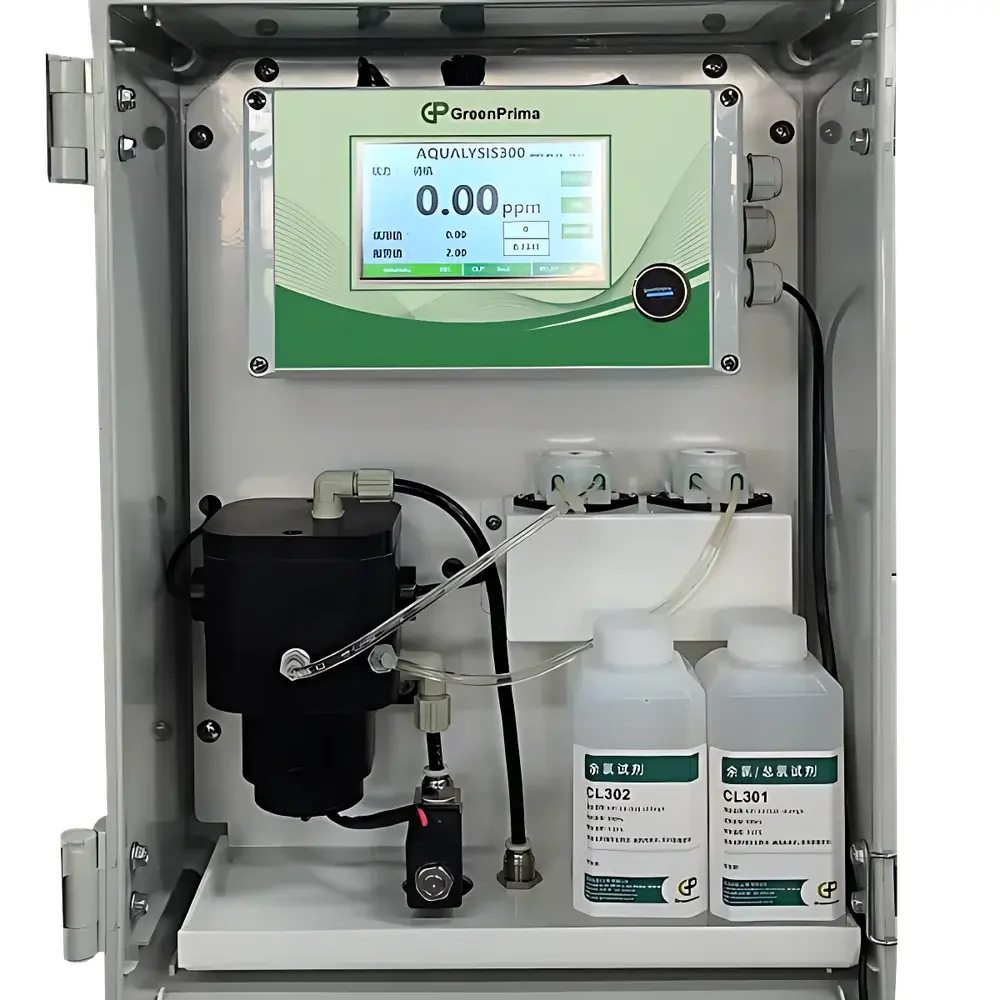
GreenPrima Aqualysis 300 Online Residual and Total Chlorine Analyzer
| Brand | GreenPrima |
|---|---|
| Origin | United Kingdom |
| Manufacturer Type | Original Equipment Manufacturer (OEM) |
| Product Category | Imported Instrument |
| Model | Aqualysis 300 |
| Instrument Type | Online Analyzer |
| Measurement Principle | DPD Colorimetric Method |
| Measured Parameters | Residual Chlorine, Total Chlorine |
| Measurement Range | 0.02–2 ppm (low range), 0.02–10 ppm (high range) |
| Accuracy | ±2% of full scale value |
| Repeatability | ±1% of full scale value |
| Limit of Detection | 0.02 ppm |
| Dimensions | 400 × 300 × 150 mm (H × W × D) |
| Weight | 4 kg |
| Enclosure Rating | IP65 |
| Power Supply | 85–265 VAC, 47–63 Hz |
| Display | Touchscreen LCD with bilingual (English/Chinese) interface |
| Output Options | Two programmable relay outputs (max. 250 V, 4 A), one isolated 4–20 mA analog output (load ≤750 Ω), one RS485 Modbus RTU port |
| Input Options | Two digital inputs (IN1 for flow-triggered analysis/start command |
| Sample Temperature Range | 5–45 °C |
| Ambient Operating Temperature | 0–45 °C |
| Sample Pressure Range | 0.2–5 bar (recommended: 1–2 bar) |
| Analysis Cycle Interval | User-configurable |
| Flush Duration | Programmable |
| Data Storage | Internal USB logging with event/fault history |
Overview
The GreenPrima Aqualysis 300 is a fully automated, online colorimetric analyzer engineered for continuous, real-time monitoring of residual chlorine and total chlorine concentrations in water distribution systems and process streams. It implements the standardized N,N-diethyl-p-phenylenediamine (DPD) colorimetric method—recognized by ISO 7393-2, APHA Standard Methods 4500-Cl G, and EPA Method 334.0—as its primary measurement principle. In this method, free chlorine or total chlorine reacts with DPD reagent under controlled pH and reaction time to form a stable pink-colored complex, the absorbance of which is quantified photometrically at 515 nm. The instrument’s optical path employs dual-beam photometry with temperature-compensated LED light source and solid-state detector, ensuring high stability against ambient thermal drift and long-term baseline integrity. Designed for unattended operation in municipal, industrial, and regulated environments, the Aqualysis 300 delivers trace-level sensitivity (LOD: 0.02 ppm) and metrological consistency aligned with GLP and routine QC requirements.
Key Features
- DPD-based colorimetric detection validated per international standard methods (ISO 7393-2, APHA 4500-Cl G)
- Two selectable measurement ranges: 0.02–2 ppm (optimized for drinking water compliance) and 0.02–10 ppm (suited for disinfection process control)
- Integrated automatic zero adjustment and multi-point calibration verification using onboard reagent delivery and air/water blank cycles
- Self-diagnostic architecture with real-time fault logging, reagent depletion alerts, and optical path contamination monitoring
- Compact wall-mount enclosure (400 × 300 × 150 mm, IP65-rated) suitable for indoor utility rooms, pump stations, and chlorination skids
- Configurable analysis interval (1–120 minutes) and programmable flush duration to adapt to variable sample matrix conditions
- Bilingual (English/Chinese) capacitive touchscreen interface with intuitive navigation and contextual help prompts
- Dual digital inputs (IN1/IN2) enabling external synchronization with flow meters, solenoid valves, or SCADA triggers
Sample Compatibility & Compliance
The Aqualysis 300 is compatible with potable water, treated wastewater effluent, cooling tower make-up, pharmaceutical process water, and food-grade rinse water—provided sample temperature remains between 5–45 °C and pressure is maintained within 0.2–5 bar (optimal: 1–2 bar). Turbidity below 5 NTU and absence of strong oxidants (e.g., ozone, permanganate) or heavy metal interference (e.g., >0.1 mg/L Fe³⁺, Cu²⁺) are recommended to preserve measurement fidelity. The analyzer supports audit-ready operation under GLP and GMP frameworks: all calibrations, maintenance events, and critical alarms are timestamped and stored internally via USB mass storage. Optional firmware configuration enables 21 CFR Part 11-compliant electronic signatures and audit trail generation when integrated with compliant LIMS or MES platforms.
Software & Data Management
Data acquisition and device management are handled through embedded firmware supporting Modbus RTU over RS485 for seamless integration into existing PLC or SCADA infrastructures. The 4–20 mA analog output is galvanically isolated and scalable to match user-defined engineering units (e.g., ppm Cl₂). All operational logs—including reagent usage counters, optical intensity diagnostics, and error codes—are recorded with UTC timestamps and exportable via USB flash drive in CSV format. Firmware updates are performed offline via USB without requiring network connectivity. Remote monitoring is achievable through optional gateway modules that support MQTT or OPC UA protocols—enabling centralized dashboards for multi-site water quality surveillance.
Applications
- Real-time monitoring of chlorine residuals at drinking water treatment plant effluent points and distribution network entry zones
- Process feedback control in chlorination dosing systems for dynamic adjustment of sodium hypochlorite or gaseous chlorine feed rates
- Compliance verification for regulatory reporting under EU Drinking Water Directive (98/83/EC), US EPA Stage 2 Disinfectants and Disinfection Byproducts Rule (DBPR), and China’s GB 5749–2022
- Quality assurance in pharmaceutical purified water (PW) and water-for-injection (WFI) loops where chlorine carryover must be verified prior to carbon bed breakthrough
- Sanitation validation in beverage production lines and dairy processing facilities requiring documented residual biocide levels
- Early warning detection of chlorine decay or nitrification events in aging distribution mains
FAQ
What reagents are required, and how often do they need replacement?
Two dedicated reagent kits are used: CL-302 (residual chlorine) and CL-303 (total chlorine), each supplied in 250 mL bottles. Typical consumption is 1.2–1.8 mL per analysis cycle; at 30-minute intervals, one bottle lasts approximately 6–8 weeks. Reagent shelf life is 12 months when stored at 5–25 °C.
Can the Aqualysis 300 distinguish between free chlorine and combined chlorine?
No—it measures residual chlorine (free + combined) and total chlorine separately via distinct DPD reaction protocols. Free chlorine is determined first; total chlorine is measured after addition of potassium iodide to convert combined forms. The difference yields combined chlorine concentration.
Is field calibration possible without specialist tools?
Yes. The instrument supports on-site single-point calibration using NIST-traceable chlorine standards (e.g., 1.0 ppm Cl₂ in buffered phosphate solution). No optical alignment or hardware adjustment is required.
How does the system handle sample particulates or biofilm buildup?
An integrated peristaltic sampling pump with adjustable stroke volume and programmable flush cycles minimizes clogging. Optional inline 5 µm pre-filtration is recommended for turbid or high-sediment sources. Optical cuvette surfaces are chemically resistant and accessible for manual cleaning if fouling occurs.







