
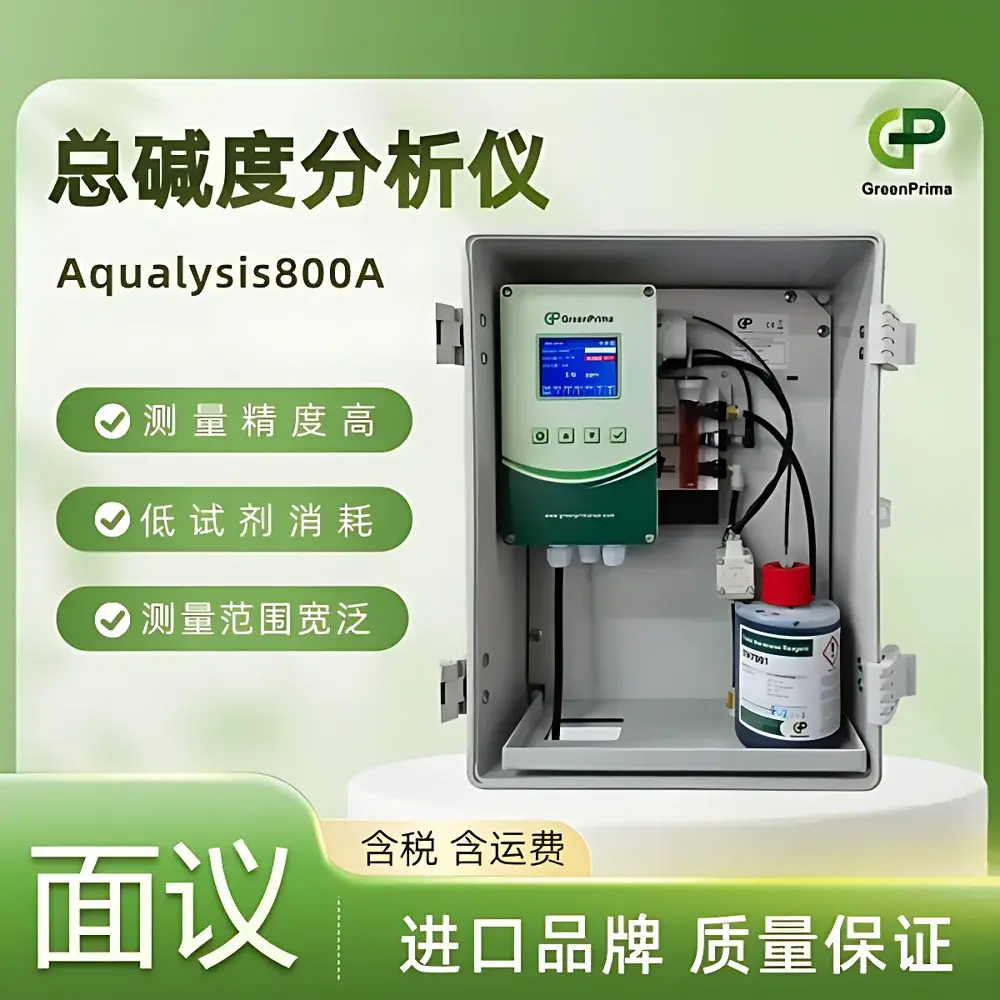
GreenPrima Aqualysis 800A Total Alkalinity Analyzer
| Brand | GreenPrima |
|---|---|
| Origin | United Kingdom |
| Manufacturer Type | Manufacturer |
| Origin Category | Imported |
| Model | Aqualysis 800A |
| Measurement Principle | Titrimetric Colorimetry |
| Measurement Time | 2–8 min (alkalinity-dependent) |
| Accuracy | ±2% of selected reagent upper limit |
| Repeatability | ±2% of selected reagent upper limit |
| Power Supply | 85–265 VAC, 47–63 Hz |
| Power Consumption | 25 VA (operational), 3.5 VA (standby) |
| Enclosure Rating | IP65 |
| Dimensions | 400 × 300 × 180 mm (H×W×D) |
| Weight | 4 kg |
| Display | Color LCD |
| Output Options | 4 programmable relay outputs (250 VAC, 4 A max), 1 isolated 4–20 mA output (750 Ω max), 1 RS485 interface |
| Input Options | 2 programmable digital inputs (IN1: start analysis |
| IN2 | stop analysis) |
| Sampling Interval | 1–360 min (configurable) or triggered by external/flow signal |
| Rinse Duration | 15–1800 s (user-configurable) |
| Sample Water Requirements | pH 4–10 |
| Environmental Operating Range | 10–40 °C |
| Compatible Units | °dH, °f, ppm CaCO₃, mmol/L |
Overview
The GreenPrima Aqualysis 800A Total Alkalinity Analyzer is an industrial-grade, online analytical instrument engineered for continuous or interval-based quantification of total alkalinity in aqueous process streams. It employs a validated titrimetric colorimetric measurement principle—combining precise acid dosing with photometric endpoint detection—to determine alkalinity as calcium carbonate (CaCO₃) equivalence across a defined concentration range. Unlike potentiometric or conductivity-based approximations, this method delivers chemically specific, stoichiometrically grounded results compliant with standard water quality protocols including ISO 9963-1, ASTM D1067, and APHA Standard Methods 2320 B. Designed for unattended operation in demanding utility and pharmaceutical environments, the Aqualysis 800A integrates robust fluidic architecture, low-reagent consumption chemistry, and fail-safe diagnostic routines to ensure long-term measurement integrity without manual intervention.
Key Features
- Automated titration cycle with dual-wavelength photometric endpoint recognition for high reproducibility (±2% repeatability relative to reagent span)
- Configurable measurement intervals from 1 to 360 minutes—or externally triggered via digital input or flow pulse signal
- Four independently programmable relay outputs supporting alarm, control, and maintenance sequencing (250 VAC / 4 A rating)
- Isolated 4–20 mA analog output with full-scale mapping to user-selected units (ppm CaCO₃, mmol/L, °dH, or °f)
- RS485 Modbus RTU interface for integration into SCADA, DCS, or centralized laboratory informatics systems
- IP65-rated enclosure with front-panel color LCD display enabling local status monitoring, parameter configuration, and event log review
- Onboard data logging for up to 30 days of measurement history, calibration events, fault codes, and system diagnostics
- Programmable rinse duration (15–1800 s) and automatic line purge to mitigate carryover in multi-channel deployments
- Low-power standby mode (3.5 VA) and wide-input AC power supply (85–265 VAC, 47–63 Hz) for global electrical compatibility
Sample Compatibility & Compliance
The Aqualysis 800A is optimized for use with clarified, non-turbid water samples meeting specified matrix constraints: pH 4–10, dissolved iron < 3 ppm, copper < 0.2 ppm, aluminum < 0.1 ppm, and manganese < 0.2 ppm. Sample temperature must remain between 5 °C and 40 °C, with inlet pressure maintained at 0.2–5 bar (1–2 bar recommended). These specifications align with common pretreatment requirements for online analyzers deployed in boiler feedwater, cooling tower circuits, and purified water (PW) distribution systems per USP , EP 2.2.43, and ISO 20957. The analyzer supports audit-ready operation under GLP and GMP frameworks through timestamped calibration records, configurable user access levels, and tamper-evident event logging—features essential for regulated pharmaceutical and power generation facilities subject to FDA 21 CFR Part 11 compliance reviews.
Software & Data Management
Configuration and diagnostics are managed locally via the intuitive color LCD interface or remotely using GreenPrima’s proprietary Aqualysis Configuration Suite (Windows-based, USB/RS485 connectivity). All operational parameters—including titrant concentration, unit selection, alarm thresholds, relay logic, and communication settings—are stored in non-volatile memory with write-protection options. Measurement data, calibration logs, error timestamps, and system uptime statistics are retained onboard and exportable via USB or Modbus polling. The device supports time-synchronized data transmission when integrated with NTP-enabled controllers, facilitating traceable trend analysis in LIMS or MES platforms. Firmware updates are delivered via signed binary packages to maintain cybersecurity integrity throughout the instrument lifecycle.
Applications
- Real-time alkalinity monitoring in boiler feedwater treatment plants to prevent caustic embrittlement and scale formation
- Process control of ion exchange softeners and lime-soda ash units in municipal and industrial water treatment
- Quality assurance of purified water (PW) and water for injection (WFI) in pharmaceutical manufacturing (compliant with EU GMP Annex 1 and WHO TRS 970)
- Corrosion management in closed-loop cooling systems by maintaining optimal alkalinity-pH buffering capacity
- Regulatory reporting for surface water discharge permits requiring alkalinity as a key indicator parameter
- Multi-point deployment via MCS-series channel selectors for simultaneous monitoring of up to eight sample streams
FAQ
What measurement principle does the Aqualysis 800A use?
It applies titrimetric colorimetry: a standardized sulfuric acid titrant is dosed incrementally into the sample until the bromocresol green/methyl red indicator undergoes a spectrophotometrically resolved endpoint shift.
Can the instrument operate in hazardous areas?
No—the Aqualysis 800A is rated IP65 for dust/water ingress protection but lacks ATEX or IECEx certification for explosive atmospheres.
Is calibration traceable to national standards?
Yes—calibration verification may be performed using NIST-traceable alkalinity reference standards (e.g., certified CaCO₃ solutions), and all calibration events are digitally recorded with operator ID and timestamp.
How often does the reagent require replacement?
Typical reagent cartridge life exceeds 30 days at 15-minute sampling intervals, depending on alkalinity concentration and rinse frequency—reagent consumption is optimized to ≤1.2 mL per analysis.
Does it support remote firmware updates?
Firmware updates must be initiated locally via USB or serial connection; over-the-air (OTA) updates are not supported for security and validation reasons in regulated environments.
Related Products






