
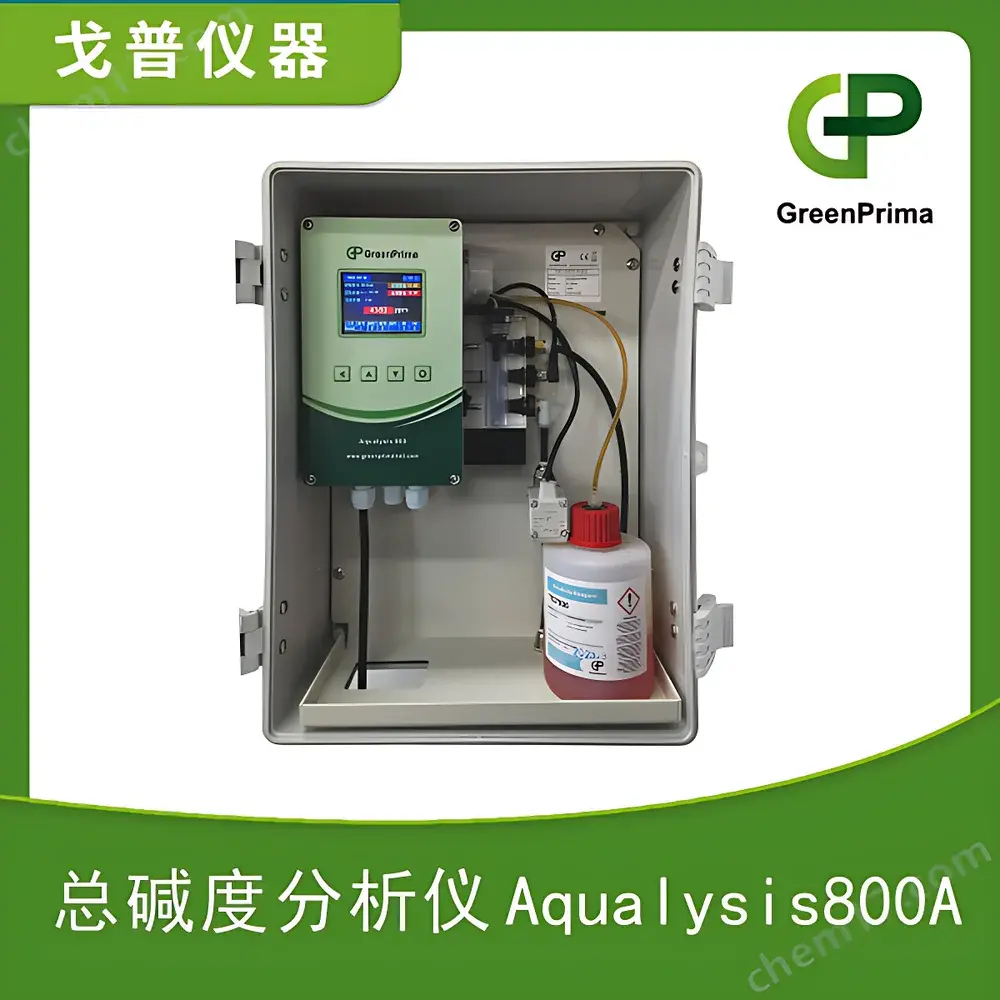
GreenPrima Aqualysis 800A Total Alkalinity Analyzer for Surface Water
| Brand | GreenPrima |
|---|---|
| Origin | United Kingdom |
| Manufacturer Type | Original Equipment Manufacturer (OEM) |
| Import Status | Imported |
| Model | Aqualysis 800A |
| Pricing | Available Upon Request |
Overview
The GreenPrima Aqualysis 800A is a fully automated, online total alkalinity analyzer engineered for continuous or interval-based monitoring of carbonate, bicarbonate, and hydroxide alkalinity in surface water and industrial process streams. It operates on the principle of potentiometric titration coupled with colorimetric endpoint detection—specifically, a standardized acid titration (typically using sulfuric or hydrochloric acid) with bromocresol green–methyl red indicator system, enabling precise determination of total alkalinity expressed as mg/L CaCO₃ or mmol/L HCO₃⁻ equivalents. Designed for deployment in demanding environments—including cooling towers, boiler feedwater systems, pharmaceutical purified water loops, and municipal surface water intake stations—the Aqualysis 800A delivers stable, traceable measurements without manual intervention. Its architecture complies with fundamental requirements of ISO 9963-1:2021 (Water quality — Determination of alkalinity — Part 1: Titrimetric methods) and supports method validation under GLP and GMP frameworks where regulatory documentation and audit trails are mandated.
Key Features
- Automated dual-mode operation: configurable for continuous analysis or programmable interval measurement (1–360 minutes), synchronized via internal timer, external digital trigger (IN1/IN2), or flow-pulse signal.
- Integrated self-diagnostic suite including reagent level monitoring, electrode drift compensation, blank calibration verification, and fault logging with timestamped event history.
- Compact footprint (400 × 300 × 180 mm; 4 kg) and IP65-rated enclosure suitable for indoor or semi-outdoor installation near sampling points.
- Low reagent consumption (< 1.2 mL per analysis) and extended maintenance intervals—typical service cycle exceeds 6 months under standard operating conditions.
- Flexible I/O architecture: two programmable digital inputs (dry contact or 24 VDC), four relay outputs (250 VAC / 4 A max), one isolated 4–20 mA analog output (750 Ω load), and RS485 Modbus RTU interface for SCADA integration.
- High-resolution color LCD display with multilingual UI (English, German, French, Spanish), real-time trend visualization, and local data storage (≥10,000 records).
Sample Compatibility & Compliance
The Aqualysis 800A accepts raw or filtered surface water, softened effluent, and low-conductivity pharmaceutical water (WFI/PW) within defined matrix constraints: pH 4–10, temperature 5–40 °C, pressure 0.2–5 bar (recommended 1–2 bar), and maximum contaminant thresholds—Fe < 3 ppm, Cu < 0.2 ppm, Al < 0.1 ppm, Mn < 0.2 ppm—to prevent catalyst poisoning or indicator interference. All wetted components are constructed from chemically resistant PTFE, PVDF, and borosilicate glass. The analyzer meets CE marking requirements per Directive 2014/30/EU (EMC) and 2014/35/EU (LVD), and its firmware architecture supports 21 CFR Part 11-compliant electronic recordkeeping when deployed with validated data acquisition software.
Software & Data Management
Data export and remote supervision are enabled via embedded Modbus RTU over RS485, allowing seamless integration into DCS, PLC, or cloud-based IIoT platforms. Optional GreenPrima Analytics Suite provides secure web-based configuration, historical data retrieval, alarm threshold management, and PDF report generation—including calibration logs, maintenance alerts, and QC check summaries. Audit trail functionality records all user actions (e.g., parameter changes, calibration events, output modifications) with operator ID, timestamp, and pre-/post-value states—fully aligned with ALCOA+ data integrity principles.
Applications
- Real-time alkalinity control in ion exchange softening systems to optimize resin regeneration cycles and minimize salt consumption.
- Boiler feedwater monitoring to prevent caustic embrittlement and scale formation through early detection of carbonate carryover.
- Surface water quality assessment at reservoir intakes and river monitoring stations for compliance with EU Drinking Water Directive (98/83/EC) Annex I parameters.
- Cooling circuit optimization in HVAC and power generation facilities, ensuring effective corrosion inhibition and microbiological stability.
- Pharmaceutical water systems (USP , EP 2.2.43) where alkalinity serves as a critical indicator of carbon dioxide ingress or deionizer breakthrough.
FAQ
What measurement principle does the Aqualysis 800A use?
It employs acid–base titration with dual-indicator colorimetric endpoint detection, conforming to ISO 9963-1 methodology.
Can it be integrated into an existing SCADA system?
Yes—via RS485 Modbus RTU or 4–20 mA analog output with configurable scaling and damping.
Is the instrument suitable for unattended operation in remote locations?
Absolutely—the low power draw (25 VA operational / 3.5 VA standby), wide AC input range (85–265 VAC), and built-in data logging support autonomous deployment for >30 days without connectivity.
Does it require daily maintenance or frequent recalibration?
No—factory-calibrated sensors and automated zero/span checks enable monthly verification; full calibration is recommended every 3–6 months depending on sample matrix severity.
How is reagent consumption managed to ensure long-term operational cost efficiency?
Precise micro-dosing pumps and adaptive titrant delivery reduce acid usage by up to 40% compared to conventional batch titrators, while onboard reagent level sensors trigger proactive replenishment alerts.






