
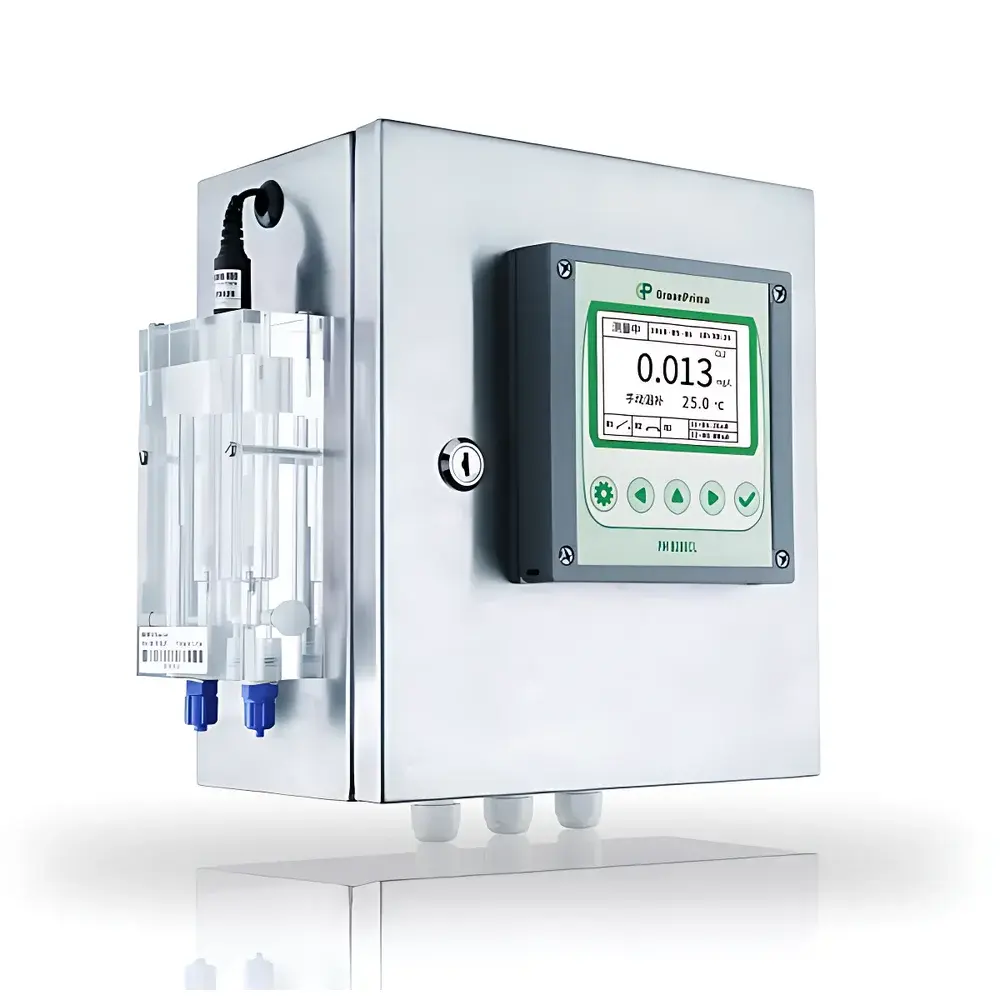
GreenPrima PM8200CL Dissolved Ozone Analyzer for Drinking Water Disinfection in Swine Farming
| Brand | GreenPrima |
|---|---|
| Origin | Switzerland |
| Manufacturer Type | Original Equipment Manufacturer (OEM) |
| Product Category | Imported Instrument |
| Model | PM8200CL |
| Instrument Type | Online Analyzer |
| Measurement Principle | Electrochemical Amperometric Sensor (Three-Electrode System with Dual Platinum Working Electrodes) |
| Measured Parameters | Residual Chlorine, Chlorine Dioxide, Dissolved Ozone (O₃) |
| Measurement Ranges | 0–2.000 ppm and 0–20.00 ppm (switchable) |
| Accuracy | ±0.001 ppm / ±0.01 ppm (depending on range) |
| Repeatability | ±0.001 ppm / ±0.01 ppm |
| Resolution | 0.001 ppm / 0.01 ppm |
| Limit of Detection (LOD) | 0.001 ppm |
| Temperature Compensation | –10 to 130 °C (NTC10K or PT1000 selectable, manual/automatic) |
| Operating Temperature | 0 to 70.0 °C |
| Storage Temperature | –20 to 70.0 °C |
| Display | Backlit dot-matrix LCD |
| Language Interface | English & Chinese |
| Data Storage Capacity | 600,000 records |
| Power Supply | 90–260 VAC, 50/60 Hz or optional 24 VDC |
| Enclosure Rating | IP65 |
| Communication | RS485 Modbus RTU protocol |
| Analog Outputs | Two isolated 4–20 mA outputs (max. loop resistance 500 Ω, accuracy 0.1% FS) |
| Cleaning Control Output | Adjustable cleaning interval (0.1–1000 h) and duration (1–1000 s) |
| Mounting Options | Wall-mount, pole-mount, panel-mount |
| Dimensions | 144 × 144 × 106 mm |
| Panel Cutout | 138 × 138 mm |
| Weight | 0.86 kg |
| Sensor Model | Bsens650 Ozone Electrode |
| Electrode Material | Borosilicate glass body |
| Sensing Element | Triple-ceramic-pore membrane with dual platinum ring working electrodes and Ag/AgCl reference system |
| Electrolyte | Solid-state gel electrolyte |
| Max. Operating Pressure | 6 bar |
| Temp. Range (Electrode) | –5 to 100 °C |
| Immersion Depth (min.) | 25 mm |
| Cable Length | 3 m |
| Connection | PG13.5 threaded fitting |
| Flow Stabilization Module | BAF615 constant-flow cell |
Overview
The GreenPrima PM8200CL is a dedicated online dissolved ozone (O₃) analyzer engineered for continuous, real-time monitoring of disinfectant residual in potable water systems—specifically validated for swine farm drinking water applications where microbial control and animal health compliance are critical. Unlike spectrophotometric or colorimetric methods, the PM8200CL employs a three-electrode amperometric sensing architecture based on constant-potential electrochemistry. The Bsens650 sensor utilizes dual platinum ring working electrodes and an integrated Ag/AgCl reference system housed behind a triple-ceramic-pore membrane, enabling selective oxidation of dissolved ozone at a fixed bias voltage while rejecting common interferences such as chlorine dioxide, free chlorine, and hydrogen peroxide. This design ensures high specificity, long-term stability, and minimal drift under variable pH and temperature conditions typical in agricultural water distribution networks.
Key Features
- True multi-analyte capability: Simultaneous configuration for dissolved ozone (O₃), free chlorine (Cl₂), and chlorine dioxide (ClO₂) via software-selectable calibration curves—no hardware modification required.
- Zero-reagent, zero-membrane operation: Eliminates consumables including replacement membranes, liquid electrolytes, and colorimetric reagents—reducing total cost of ownership and operator dependency.
- Robust electrochemical architecture: Bsens650 electrode features solid-state gel electrolyte, corrosion-resistant glass body, and pressure-rated (up to 6 bar) ceramic diaphragm—suitable for direct inline installation or bypass loop configurations.
- Integrated flow stabilization: BAF615 constant-flow cell maintains laminar, pulse-free sample delivery to the sensor surface, ensuring measurement reproducibility independent of upstream pump fluctuations or pressure transients.
- Dual-range auto-scaling: Switchable 0–2.000 ppm and 0–20.00 ppm measurement spans with corresponding 0.001 ppm and 0.01 ppm resolution—optimized for both low-dose hygiene monitoring and high-output ozone generator feedback control.
- Industrial-grade transmitter: IP65-rated enclosure with dual isolated 4–20 mA analog outputs, RS485 Modbus RTU interface, and programmable cleaning cycle output for automated maintenance synchronization.
Sample Compatibility & Compliance
The PM8200CL is designed for direct measurement in cold, ambient-temperature, or thermally stabilized drinking water streams with turbidity < 5 NTU and suspended solids < 10 mg/L. It operates reliably across pH 4.0–9.0 and conductivity 50–2000 µS/cm—conditions commonly encountered in municipal-supplied or well-derived swine farm water. No pretreatment (e.g., filtration, dechlorination, or pH adjustment) is required. The system complies with ISO 7888 (water quality — determination of ozone), ASTM D6505 (standard test method for dissolved ozone in water), and supports audit-ready data integrity when configured with timestamped logging and Modbus register access. Its firmware architecture accommodates GLP/GMP-aligned operational protocols—including user-access level management, calibration event logging, and electronic signature support for critical parameter changes.
Software & Data Management
The embedded firmware supports local configuration via intuitive bilingual (English/Chinese) menu navigation on the backlit dot-matrix display. All calibration coefficients, alarm thresholds, temperature compensation settings, and cleaning schedules are stored non-volatilely. Raw sensor signals, compensated concentration values, temperature readings, and diagnostic flags (e.g., electrode impedance, signal noise index) are logged at user-defined intervals (1 s to 1 h) into internal flash memory—capable of retaining 600,000 records. Data export is supported via Modbus RTU polling by SCADA or LIMS platforms. Optional PC-based configuration utility enables batch calibration import/export, trend visualization, and CSV report generation compliant with FDA 21 CFR Part 11 requirements when deployed with external authentication and audit trail modules.
Applications
Primary deployment includes continuous monitoring of ozonated drinking water in intensive swine production facilities—ensuring consistent biocidal efficacy against Escherichia coli, Salmonella, and Enterococcus spp. without over-dosing that may compromise gut microbiota or corrode stainless-steel piping. Secondary use cases span municipal water treatment plant final disinfection verification, pharmaceutical process water loops, hospital wastewater effluent validation, and power plant cooling tower make-up water control. The instrument also serves as a feedback sensor for closed-loop ozone generator control systems—enabling dynamic dose modulation based on real-time demand and contact time modeling.
FAQ
Does the PM8200CL require daily calibration?
No. Field calibration is recommended every 7–14 days depending on water matrix stability; initial factory calibration remains traceable to NIST-certified ozone standards.
Can the Bsens650 electrode be used in hot water applications?
Yes—the electrode is rated for continuous operation up to 100 °C, though optimal ozone solubility and sensor longevity are achieved below 40 °C.
Is the system compatible with existing PLCs or DCS platforms?
Yes. RS485 Modbus RTU implementation conforms to standard register mapping (holding registers 40001–40050), enabling seamless integration with Siemens S7, Rockwell ControlLogix, Schneider EcoStruxure, and similar industrial controllers.
What maintenance does the BAF615 flow cell require?
None beyond periodic visual inspection; its passive hydrodynamic design has no moving parts, seals, or replaceable components.
How is temperature compensation applied?
Real-time compensation uses either built-in NTC10K or external PT1000 probe input, applying polynomial correction per ISO 7888 Annex B to normalize ozone signal response across –10 to 130 °C.
Related Products







