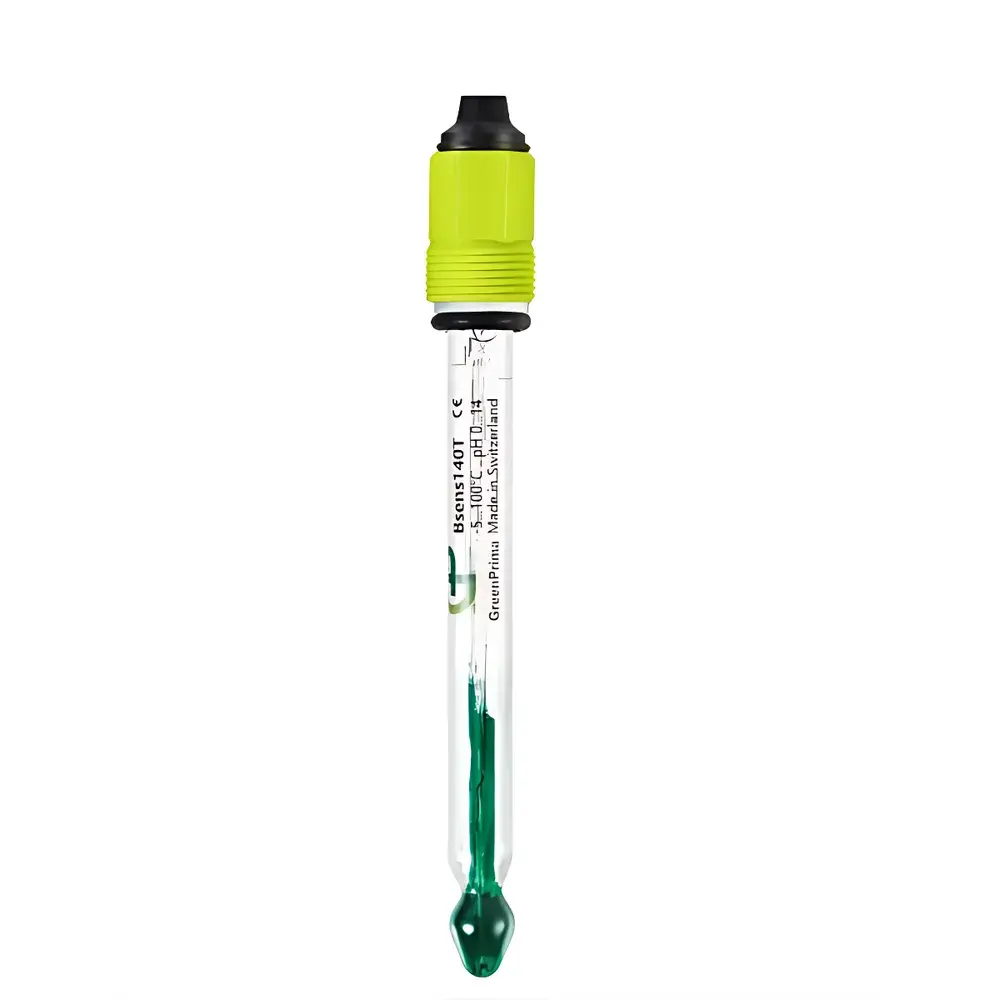
GreenPrima Bsens140T Online pH Sensor for Ultrapure Water
| Brand | GreenPrima |
|---|---|
| Origin | Switzerland |
| Manufacturer Type | Original Equipment Manufacturer (OEM) |
| Product Category | Imported Industrial Online pH Sensor |
| Model | Bsens140T |
| Output Signals | Dual 4–20 mA, RS485 Modbus RTU |
| Operating Temperature | −5 to 100 °C |
| pH Measurement Range | 0–14 pH |
| Reference Electrode | Ag/AgCl Cartridge |
| Temperature Sensor | PT1000 |
| Max. Process Pressure | 6 bar |
| Electrode Body Material | Lab-Grade Glass |
| Electrolyte | Polymer-Gel Filled |
| Junction | Triple Ceramic Porous Diaphragm |
| pH Glass Membrane | S-Type Low-Drift Glass |
| Minimum Immersion Depth | 20 mm |
| Zero Point Offset | ±20 mV |
| Sensitivity | 57–59 mV/pH at 25 °C |
| Minimum Sample Conductivity | 0.1 µS/cm |
| Response Time (pH 4–7) | <30 s |
| Process Connection | PG13.5 Metric Thread |
| Cable Length | 5 m |
Overview
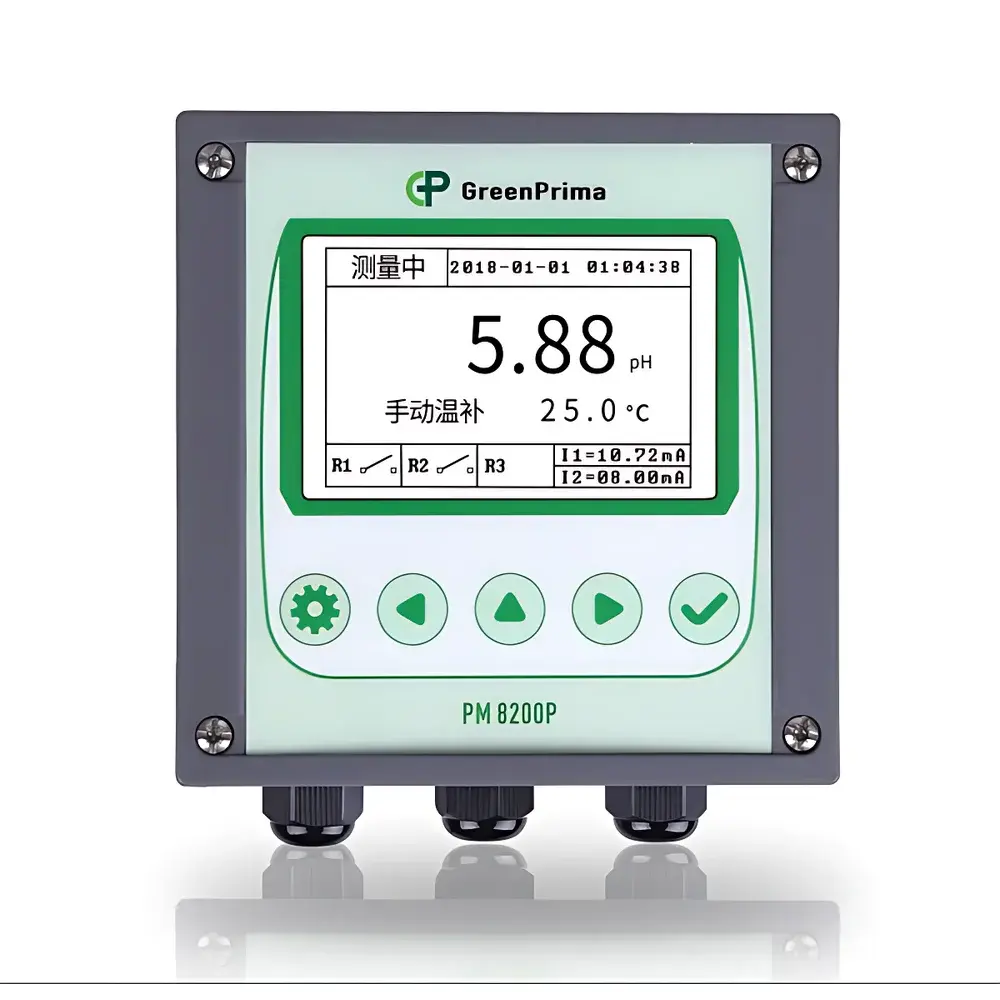
The GreenPrima Bsens140T is a high-stability, low-drift online pH sensor engineered specifically for continuous monitoring of ultrapure water, deionized water, reverse osmosis (RO) permeate, and other low-conductivity aqueous streams (<1 µS/cm). Unlike conventional pH electrodes, the Bsens140T employs an S-type glass membrane with optimized ion exchange kinetics and a triple-ceramic junction architecture to minimize liquid junction potential drift and clogging—critical failure modes in ultrapure water applications. Its polymer-gel electrolyte eliminates leakage and refilling requirements while maintaining stable reference potential under low-ionic-strength conditions. The sensor operates on the fundamental principle of potentiometric measurement: the voltage difference between the pH-sensitive glass membrane and the Ag/AgCl reference electrode is linearly proportional to pH according to the Nernst equation (−59.16 mV/pH at 25 °C), with temperature compensation provided by the integrated PT1000 sensor. Designed for seamless integration with the GreenPrima PM8200P pH/ORP controller, the Bsens140T delivers traceable, reproducible measurements compliant with ISO 17025-accredited calibration practices.
Key Features
- S-type low-resistance glass membrane optimized for rapid equilibration and minimal alkaline error in sub-1 µS/cm water
- Triple-ceramic porous junction ensures consistent electrolyte outflow and resistance to fouling in low-conductivity media
- Polymer-gel electrolyte system eliminates maintenance, leakage, and refilling—ideal for unattended 24/7 operation
- Integrated PT1000 temperature sensor enables real-time, high-accuracy automatic temperature compensation (ATC)
- Robust all-glass construction with PG13.5 metric thread fitting supports sanitary and industrial process connections
- Rated IP68 ingress protection when mated with compatible PM8200P housing; suitable for wet, humid, or splash-prone environments
- Calibration stability verified per ASTM D1293 and ISO 10523 protocols using NIST-traceable buffer standards
Sample Compatibility & Compliance
The Bsens140T is validated for use in ultrapure water systems (UPW) meeting SEMI F63 and ASTM D5127 specifications, including semiconductor fab rinse tanks, pharmaceutical WFI (Water for Injection) loops, and power plant condensate monitoring. It maintains measurement integrity at conductivities as low as 0.1 µS/cm—well below the threshold where conventional electrodes exhibit unstable junction potentials or excessive drift. The sensor complies with IEC 61508 (SIL2-capable when paired with PM8200P), meets EMC directive 2014/30/EU, and supports audit-ready data logging aligned with FDA 21 CFR Part 11 requirements when used with GreenPrima’s certified firmware. All materials contacting the sample stream are USP Class VI compliant and extractables-tested per ICH Q5A guidelines.
Software & Data Management
When connected to the GreenPrima PM8200P controller, the Bsens140T supports dual 4–20 mA analog outputs (pH and temperature), Modbus RTU over RS485, and configurable relay outputs for proportional dosing control (e.g., acid/base addition). The embedded firmware provides automated calibration validation, drift trending, and diagnostic alerts—including junction impedance monitoring and glass membrane resistance diagnostics. Data export adheres to CSV and OPC UA 1.04 standards, enabling direct ingestion into SCADA, MES, or LIMS platforms. Audit trails include timestamped calibration events, operator ID (via optional RFID login), and full change history—fully traceable for GLP/GMP environments.
Applications
- Real-time pH monitoring in semiconductor ultrapure water distribution networks
- Continuous verification of Water for Injection (WFI) quality in biopharmaceutical clean steam generators
- Condensate return loop surveillance in thermal power plants to detect corrosion-inducing acidity
- pH feedback control in RO and EDI polishing stages for electronics-grade water production
- Environmental compliance monitoring of low-TDS effluent streams prior to discharge
- Research-grade pH stability studies in electrochemistry and membrane science laboratories
FAQ
What is the minimum water conductivity this sensor can reliably measure?
The Bsens140T is validated for stable operation down to 0.1 µS/cm—making it suitable for ultrapure water applications where conventional sensors fail due to high impedance and junction instability.
Is the sensor compatible with third-party controllers?
Yes—the Bsens140T outputs standard mV signals (Ecell) and integrates with any controller supporting high-impedance pH input, though optimal performance (including ATC and diagnostics) requires the GreenPrima PM8200P platform.
How often does the sensor require calibration in UPW service?
Under stable operating conditions, calibration intervals may extend to 7–14 days; however, daily verification using a two-point NIST-traceable buffer check is recommended per ASTM D1293 Annex A1.
Can the sensor be sterilized in place (SIP)?
No—the maximum rated temperature is 100 °C at 6 bar; SIP cycles exceeding these parameters will damage the glass membrane and gel electrolyte.
Does the triple-ceramic junction require cleaning or maintenance?
Unlike single-junction designs, the triple-pore geometry significantly reduces clogging risk; routine cleaning with deionized water is sufficient—no chemical soaking or mechanical brushing is required.
Related Products