
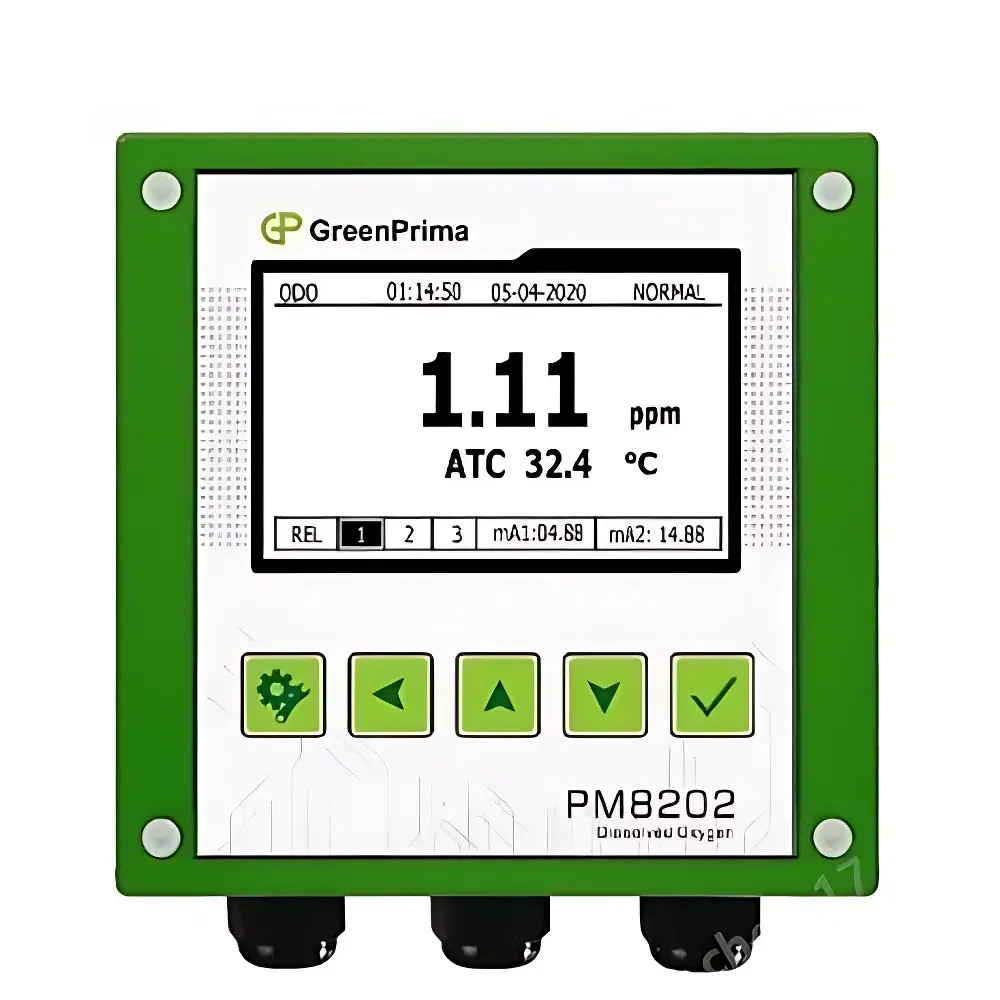
GreenPrima PM 8202 D Online Polarographic Dissolved Oxygen Analyzer
| Brand | GreenPrima |
|---|---|
| Origin | UK |
| Manufacturer Type | Manufacturer |
| Origin Category | Imported |
| Model | PM 8202 D |
| Instrument Type | Online |
| Measurement Principle | Electrochemical Probe — Polarographic |
| Measurement Range | 0.00–20.00 ppm, 0.00–200.00 ppb |
| Accuracy | ±0.02 ppm |
| Resolution | 0.001 ppm, 0.01 ppb |
| Temperature Compensation | –10 to 130 °C (manual/automatic |
| Operating Temperature | –10 to 70.0 °C |
| Storage Temperature | –20 to 70.0 °C |
| Display | Backlit large-dot-matrix LCD |
| Language | English/Chinese |
| Data Storage | 600,000 records |
| Power Supply | 90–260 VAC, 50/60 Hz or optional 24 VDC |
| Output | Two isolated 4–20 mA outputs (max. loop resistance 500 Ω, accuracy 0.1% FS, configurable for DO or temperature) |
| Communication | RS485 Modbus RTU |
| Cleaning Cycle | 0.1–1000 h adjustable |
| cleaning duration | 1–1000 s adjustable |
| Alarm Outputs | Two independent Hi/Lo relay alarms (5 A / 250 VAC / 30 VDC, with hysteresis setting) |
| Enclosure Rating | IP65 |
| Mounting Options | Wall-mounted, panel-mounted, pipe-mounted |
| Dimensions (W×H×D) | 144 × 144 × 108 mm |
| Cut-out Size | 138 × 138 mm |
| Weight | 0.87 kg |
Overview
The GreenPrima PM 8202 D Online Polarographic Dissolved Oxygen Analyzer is an industrial-grade, continuous-monitoring instrument engineered for precise and stable dissolved oxygen (DO) measurement in dynamic aqueous environments. It operates on the Clark-type polarographic principle: molecular oxygen diffuses through a gas-permeable membrane into an electrolyte-filled electrochemical cell, where it undergoes reduction at a cathode (typically gold or platinum) under a fixed polarizing voltage (–0.6 to –0.8 V vs. Ag/AgCl). The resulting diffusion-limited current is linearly proportional to the partial pressure of dissolved O2, enabling quantitative determination across wide concentration ranges. Designed specifically for aquaculture systems—including recirculating aquaculture systems (RAS), hatcheries, and pond monitoring—the analyzer delivers high reproducibility in turbid, organic-rich, or biofouling-prone water matrices where optical sensors may drift or require frequent calibration.
Key Features
- Robust IP65-rated enclosure with fully sealed, corrosion-resistant housing—engineered for long-term deployment in humid, saline, or chemically aggressive environments typical of aquaculture facilities and wastewater treatment plants.
- Large backlit dot-matrix LCD display showing real-time DO (ppm/ppb), temperature (°C), system time, relay status, and diagnostic indicators—supporting both English and Chinese language modes without firmware modification.
- Modular electrode compatibility: supports interchangeable polarographic probes (e.g., Bsens420, Bsens430, Bsens440) optimized for varying flow conditions, fouling resistance, and response time requirements.
- Dual isolated 4–20 mA analog outputs—configurable independently for DO concentration and temperature signals—with full-scale accuracy of ±0.1% and maximum loop resistance up to 500 Ω for seamless integration into PLCs, SCADA systems, or DCS networks.
- RS485 Modbus RTU interface for bidirectional communication, enabling remote configuration, data polling, and firmware updates via standard industrial protocols compliant with IEC 61158 and EN 50170.
- Programmable cleaning control output: user-defined cleaning intervals (0.1–1000 hours) and durations (1–1000 seconds) to synchronize with automated mechanical or chemical cleaning cycles—critical for maintaining sensor stability in high-biofouling applications.
- Two programmable relay outputs with adjustable hysteresis for discrete process control or alarm signaling (5 A @ 250 VAC / 30 VDC), supporting fail-safe shutdown or pump activation based on DO thresholds.
Sample Compatibility & Compliance
The PM 8202 D is validated for continuous operation in freshwater, brackish water, seawater (up to 35 ppt salinity), and process streams containing suspended solids, algae, or organic particulates. Its Clark-type membrane electrode design provides inherent tolerance to moderate levels of hydrogen sulfide, chlorine residuals, and low-molecular-weight organics—common interferents in aquaculture effluents and bioreactor influents. While not certified for explosive atmospheres, the analyzer complies with CE marking requirements (EMC Directive 2014/30/EU, Low Voltage Directive 2014/35/EU) and meets RoHS 2011/65/EU material restrictions. For regulated environments (e.g., pharmaceutical water systems per USP or ISO 22000-certified food production), the device supports audit-ready data logging (600,000 timestamped records) and password-protected parameter access—facilitating GLP/GMP-aligned documentation practices.
Software & Data Management
Data integrity is maintained through non-volatile internal memory storing up to 600,000 timestamped measurements (DO, temperature, system status) with millisecond-level resolution. All stored entries include checksum validation and are retrievable via Modbus register mapping or local USB export (optional adapter). Configuration parameters—including calibration constants, alarm setpoints, temperature compensation coefficients, and cleaning schedules—are protected by multi-level password security (administrator/operator tiers) to prevent unauthorized changes. While no proprietary PC software is bundled, the Modbus RTU implementation conforms to standard function codes (03h, 06h, 10h), enabling integration with third-party platforms such as Ignition, Siemens Desigo CC, or Schneider EcoStruxure.
Applications
- Aquaculture process control: real-time DO optimization in RAS tanks, larval rearing units, and oxygenation cascades to maintain species-specific physiological thresholds (e.g., >6.0 ppm for salmonids, >4.0 ppm for tilapia).
- Municipal and industrial wastewater treatment: monitoring aerobic zones in activated sludge basins, sequencing batch reactors (SBRs), and membrane bioreactors (MBRs) to ensure nitrification efficiency and energy-efficient aeration control.
- Pharmaceutical water-for-injection (WFI) and purified water (PW) distribution loops—compliant with USP and EU Annex 1 requirements for continuous DO surveillance during sanitization cycles.
- Fermentation and bioprocessing: inline DO feedback for microbial culture optimization in upstream bioreactors, particularly where rapid oxygen demand shifts occur during exponential growth phases.
- Power plant cooling water systems: early detection of low-oxygen conditions that promote microbiologically influenced corrosion (MIC) in condenser tubes and heat exchangers.
FAQ
What maintenance is required for polarographic DO sensors?
Polarographic electrodes require periodic replacement of the electrolyte solution (typically every 3–6 months depending on operating temperature and fouling load) and the gas-permeable membrane (every 6–12 months). Calibration must be performed at least daily in critical applications using air-saturated water (100% air saturation) or zero-oxygen solution (sodium sulfite).
Does the PM 8202 D support automatic temperature compensation?
Yes—it accepts input from either NTC10K or PT1000 temperature sensors and applies ASTM D888-22–based solubility correction algorithms across –10 to 130 °C. Both manual offset and automatic real-time compensation modes are configurable.
Can this analyzer be used in seawater applications?
Yes—the Bsens430 and Bsens440 probe variants feature reinforced PTFE membranes and titanium housings rated for continuous immersion in seawater up to 35 ppt salinity. Salinity compensation is applied via user-entered values or external conductivity input (via optional module).
Is the data logger compliant with FDA 21 CFR Part 11?
The PM 8202 D provides secure, time-stamped, tamper-evident data storage and role-based access control—but lacks electronic signature capability and audit-trail encryption required for full Part 11 compliance. It may serve as a compliant subsystem when integrated with validated higher-level data acquisition platforms.







