
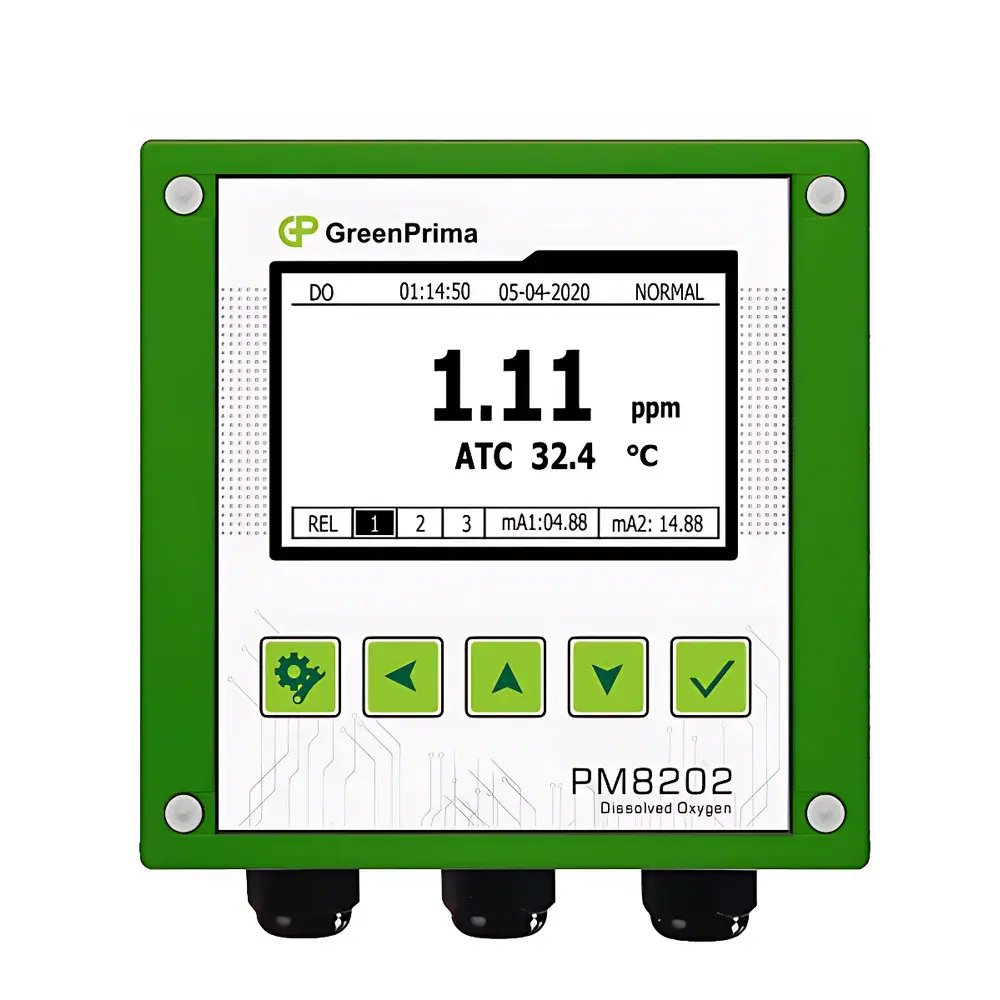
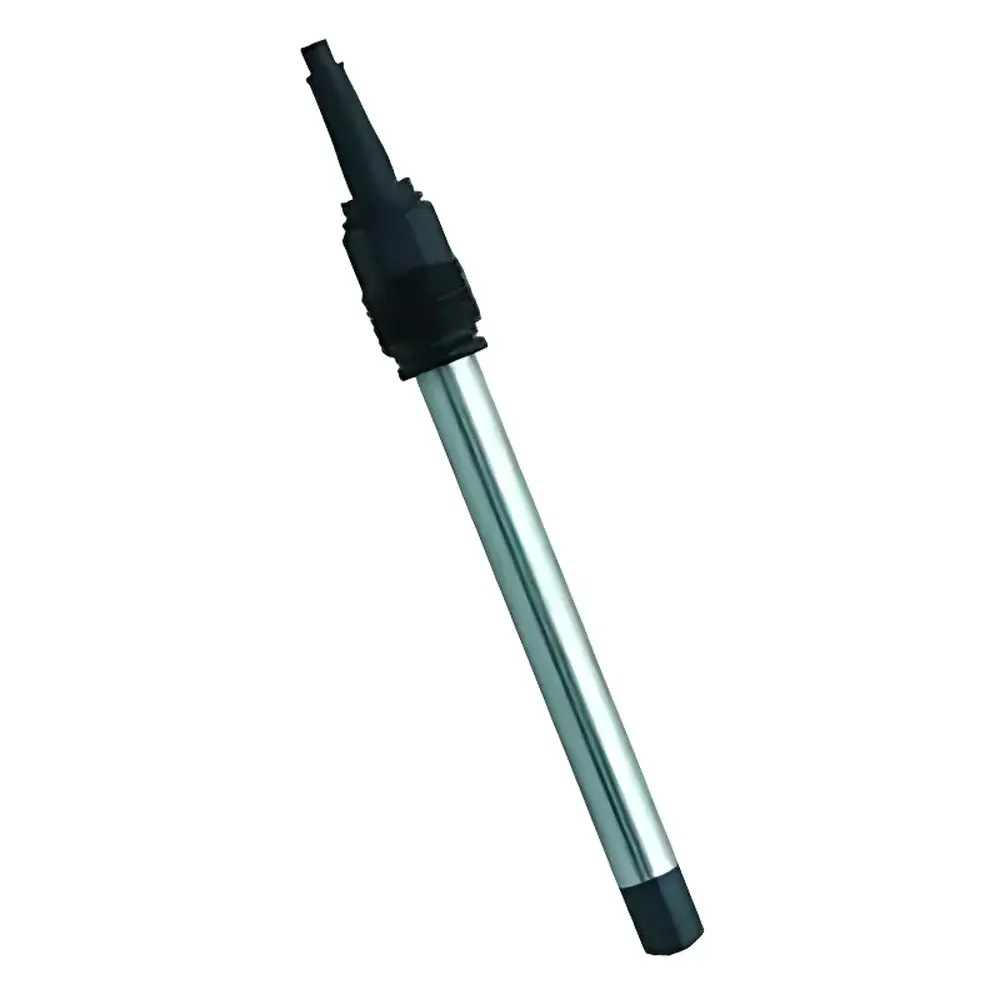
GreenPrima PM 8202D Online Dissolved Oxygen Analyzer
| Brand | GreenPrima |
|---|---|
| Origin | Taiwan |
| Manufacturer Type | Manufacturer |
| Model | PM 8202D |
| Instrument Type | Online |
| Measurement Principle | Electrochemical (Polarographic) Probe |
| Measurement Range | 0–20 ppm |
| Accuracy | ±2% FS |
| Repeatability | ±2% FS |
| Detection Limit | 0.01 ppm |
| Temperature Compensation | Automatic NTC (22 kΩ) |
| Pressure Compensation Range | 600–1100 mbar |
| Salinity Compensation Range | 0.0–45.1 ppt |
| Operating Temperature | −10.0 to +60.0 °C |
| Relative Humidity | 10–90% RH (non-condensing) |
| Display | Backlit LCD (44 × 65 mm, yellow) |
| Power Supply | 90–260 VAC, 50/60 Hz |
| Output Signals | Two isolated 4–20 mA outputs (configurable, max. 600 Ω) |
| Relay Outputs | Two SPDT relays (5 A / 250 VAC, 5 A / 30 VDC), independently programmable Hi/Lo with hysteresis |
| Enclosure Rating | IP65 |
| Mounting | Panel mount (cutout: 136 × 136 mm) |
| Dimensions | 144 × 144 × 108 mm |
| Weight | 0.8 kg |
| Compatible Sensor | GreenPrima BSens 420 Maintenance-Free DO Electrode |
Overview
The GreenPrima PM 8202D Online Dissolved Oxygen Analyzer is an industrial-grade, panel-mounted process analyzer engineered for continuous, stable measurement of dissolved oxygen (DO) concentration in aqueous media using polarographic electrochemical detection. Based on Clark-type sensor principles, the system employs a membrane-covered cathode and silver/silver chloride reference electrode immersed in an electrolyte gel, enabling selective O₂ reduction at a controlled polarization voltage (typically −0.65 V vs. Ag/AgCl). Oxygen diffuses through a gas-permeable membrane, reacts at the cathode surface, and generates a current linearly proportional to partial pressure—converted to concentration (ppm or % saturation) via temperature-, pressure-, and salinity-compensated algorithms. Designed for long-term unattended operation, the PM 8202D integrates seamlessly with the GreenPrima BSens 420 maintenance-free DO probe—a robust, factory-calibrated sensor featuring a hydrophobic PTFE membrane and solid-gel electrolyte that eliminates liquid refills, electrolyte leakage, or frequent membrane replacement. The analyzer’s wide operating temperature range (−10.0 to +60.0 °C), IP65-rated enclosure, and EMI-hardened circuitry ensure reliable performance in demanding environments including wastewater treatment plants, aquaculture facilities, drinking water distribution networks, and surface water monitoring stations.
Key Features
- True maintenance-free operation enabled by the BSens 420 polarographic DO sensor with solid-gel electrolyte and stable PTFE membrane
- Automatic temperature compensation using integrated NTC 22 kΩ thermistor (±10.0 °C offset adjustable)
- Simultaneous automatic compensation for barometric pressure (600–1100 mbar) and salinity (0.0–45.1 ppt)
- Large backlit LCD display (44 × 65 mm, yellow backlight) showing real-time DO (ppm and % sat), temperature (°C), relay status, and fault indicators
- Dual independent relay outputs (SPDT, 5 A @ 250 VAC / 30 VDC) with user-defined Hi/Lo setpoints, hysteresis control, and visual status indication
- Two fully isolated 4–20 mA analog outputs, each configurable for DO, temperature, or % saturation; load capacity up to 600 Ω
- Wide universal AC power input (90–260 VAC, 50/60 Hz) with surge and noise suppression for industrial electrical environments
- Password-protected configuration interface prevents unauthorized parameter changes; one-button factory reset option available
- Onboard auto-calibration routine supporting air-saturation and zero-oxygen (sodium sulfite) standards with selectable buffer options
Sample Compatibility & Compliance
The PM 8202D is validated for continuous monitoring of DO in low-to-moderate conductivity aqueous samples, including municipal and industrial wastewater effluents, raw and treated drinking water, surface water (rivers, lakes, reservoirs), recirculating aquaculture systems (RAS), and cooling tower make-up water. It complies with fundamental metrological requirements outlined in ISO 5814:2012 (Water quality — Determination of dissolved oxygen — Electrochemical probe method) and supports traceability per ISO/IEC 17025 when used with certified calibration standards. While not FDA 21 CFR Part 11–certified out-of-the-box, its audit-ready data logging (when paired with optional external SCADA or historian systems), password-protected configuration, and non-volatile parameter storage align with GLP and GMP documentation expectations for environmental QA/QC applications. The BSens 420 electrode meets RoHS and REACH material compliance requirements.
Software & Data Management
The PM 8202D operates as a standalone, firmware-driven instrument with no embedded operating system or remote software dependency. All configuration—including measurement units, relay logic, analog output scaling, compensation parameters, and calibration history—is managed locally via intuitive membrane keypad navigation. Calibration events (date, time, standard used, slope, zero offset) are stored in non-volatile memory and accessible through the display menu. For integration into centralized monitoring infrastructures, the dual 4–20 mA outputs provide direct compatibility with PLCs, DCS, and SCADA systems. Optional Modbus RTU (RS-485) communication module is available as an accessory, enabling read-only access to live measurements, diagnostics, and calibration logs—supporting basic audit trail functionality required under environmental management systems (e.g., ISO 14001).
Applications
- Wastewater treatment: Aeration basin control, activated sludge optimization, and final effluent compliance monitoring per local discharge limits
- Drinking water production: Post-filtration DO verification, reservoir stratification assessment, and corrosion potential evaluation in distribution systems
- Aquaculture & hatcheries: Real-time DO surveillance in raceways, tanks, and RAS to prevent hypoxia-induced mortality and support feed optimization
- Surface water quality networks: Long-term ecological monitoring of eutrophication trends, diurnal oxygen cycling, and seasonal deoxygenation events
- Industrial process water: Boiler feedwater deaerator validation, cooling water system corrosion risk assessment, and bioreactor DO feedback control
FAQ
What calibration standards are supported?
The PM 8202D supports two-point calibration using ambient air (100% saturation at local temperature/pressure) and chemical zero solution (e.g., sodium sulfite), with automatic saturation table lookup per ISO 5814.
Can the BSens 420 electrode be used in high-solids or viscous wastewater?
Yes—the BSens 420 features a rugged, fouling-resistant PTFE membrane and self-cleaning flow design; periodic manual cleaning with soft brush and mild detergent is recommended for heavy sludge applications.
Is pressure compensation mandatory for accurate DO readings?
Yes—since DO solubility is directly dependent on atmospheric pressure, barometric compensation (600–1100 mbar range) is essential for field-deployed installations above or below sea level.
Does the analyzer support MODBUS communication natively?
No—Modbus RTU is available only via optional RS-485 expansion module; standard configuration relies on analog and relay I/O.
How often does the BSens 420 require recalibration?
Under stable conditions, quarterly calibration is typical; however, recalibration is advised after sensor cleaning, exposure to extreme pH (10), or mechanical impact.







