
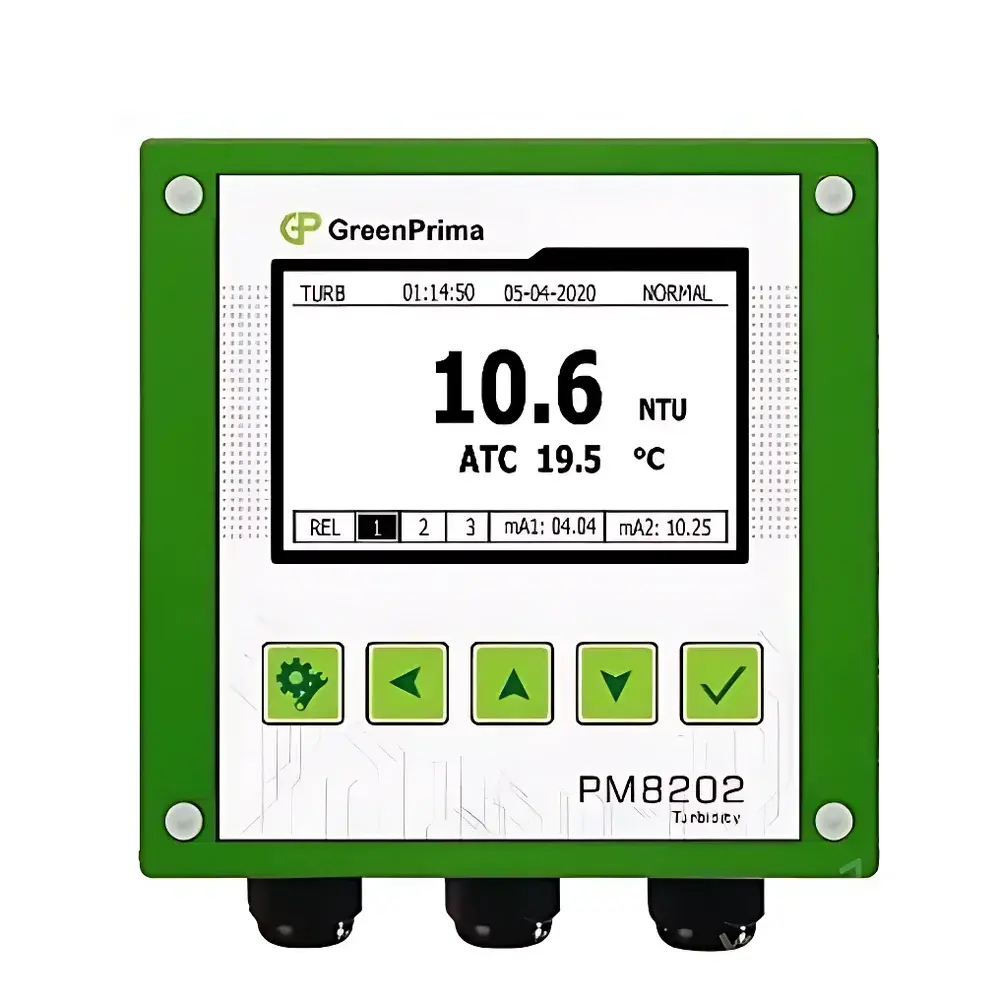
GreenPrima PM 8202T Online Turbidimeter with Integrated Power Monitoring
| Brand | GreenPrima |
|---|---|
| Origin | United Kingdom |
| Manufacturer Type | Manufacturer |
| Origin Category | Imported |
| Model | PM 8202T |
| Product Type | Online |
| Operating Temperature | −10 °C to +70 °C |
| Storage Temperature | −20 °C to +70 °C |
| Display | Backlit Graphic LCD |
| Communication | RS485 Modbus RTU |
| Analog Outputs | 2 × Isolated 4–20 mA (≤500 Ω, 0.1% FS) |
| Alarm Outputs | 2 × SPDT Relays (5 A / 250 VAC / 30 VDC) |
| Cleaning Control | Adjustable Interval (0.1–1000 h) & Duration (1–1000 s) |
| Enclosure Rating | IP65 |
| Mounting Options | Wall, Pipe, Panel |
| Dimensions | 144 × 144 × 108 mm |
| Cutout | 138 × 138 mm |
| Weight | 0.87 kg |
| Temperature Compensation | −10 °C to +130 °C (NTC30K or PT1000 sensor input) |
| Data Storage | 600,000 records |
| Power Supply | 90–260 VAC, 50/60 Hz or Optional 24 VDC |
Overview
The GreenPrima PM 8202T Online Turbidimeter is an industrial-grade, continuous-monitoring instrument engineered for reliable turbidity and suspended solids (SS) quantification in real-time water process streams. It operates on the principle of infrared (IR) 90° light scattering—compliant with EN ISO 7027—using a stable near-infrared LED source (typically 850 nm) to minimize interference from sample color, dye absorption, or ambient light. A built-in reference photodetector continuously monitors source intensity and optical path integrity, enabling dynamic compensation for lens fouling, aging of the LED, and chromatic drift. Unlike benchtop or portable units, the PM 8202T integrates controller and sensor (Bsens580/Bsens580L) into a unified online architecture designed for permanent installation in wastewater treatment plants, drinking water distribution networks, industrial cooling circuits, and environmental monitoring stations.
Key Features
- Infrared 90° scattered-light detection per EN ISO 7027, ensuring metrological traceability and inter-laboratory comparability
- Dual-range sensor options (e.g., 0–100 NTU and 0–4000 NTU) selectable via configuration software to optimize signal-to-noise ratio across diverse applications
- IP65-rated, hermetically sealed enclosure with corrosion-resistant housing—validated for continuous operation in high-humidity, chemically aggressive, or outdoor-exposed environments
- Backlit graphic LCD display showing real-time turbidity (NTU), temperature (°C), system time, relay status, and diagnostic flags—fully navigable via membrane keypad
- Bilingual (English/Chinese) menu interface with hierarchical parameter structure, supporting field commissioning without external PC
- Two galvanically isolated 4–20 mA analog outputs configurable independently for turbidity and temperature signals, each calibrated to ≤0.1% full-scale accuracy
- RS485 serial interface compliant with Modbus RTU protocol (slave ID, baud rate, parity configurable), enabling seamless integration into SCADA, DCS, or PLC-based control systems
- Programmable relay-driven cleaning sequence—interval (0.1–1000 hours) and duration (1–1000 seconds) fully adjustable to match site-specific fouling rates
- Two independent alarm relays with user-defined high/low setpoints, hysteresis adjustment, and fail-safe state reporting for process safety compliance
- Onboard data logger storing up to 600,000 timestamped records (turbidity, temperature, alarm events, cleaning cycles) with cyclic overwrite policy
Sample Compatibility & Compliance
The PM 8202T is validated for use with aqueous samples exhibiting turbidity levels from sub-1 NTU (clarified potable water) to >3000 NTU (raw sewage or industrial effluent). Its IR optical design reduces spectral interference from yellow-colored organics (e.g., humic substances) and eliminates UV-induced photodegradation artifacts common in mercury-vapor-based systems. The sensor’s flow-through or immersion configuration supports both pressurized pipe installations (via flanged or threaded adapters) and open-channel applications (with optional mounting brackets). Regulatory alignment includes conformance to EN ISO 7027:2016 for measurement methodology, CE marking per EU Machinery Directive 2006/42/EC and EMC Directive 2014/30/EU, and RoHS 2011/65/EU material restrictions. While not intrinsically safe, its low-power electronics and non-sparking design permit deployment in Zone 2 classified areas when installed per IEC 60079-14.
Software & Data Management
Configuration, calibration, and diagnostics are managed locally via the front-panel interface or remotely via GreenPrima’s proprietary PC-based configuration tool (Windows-compatible, USB-to-RS485 adapter required). The tool supports multi-point calibration using NIST-traceable formazin or AMCO-AE standards, slope/offset adjustment, zero drift correction, and sensor health diagnostics (e.g., LED output stability, reference photodiode response). Logged data can be exported in CSV format for trend analysis in third-party platforms (e.g., PI System, Ignition SCADA). Audit trails—including parameter changes, calibration events, and relay activations—are timestamped and retained in non-volatile memory. Though not FDA 21 CFR Part 11–certified out-of-the-box, the system supports GLP/GMP-aligned workflows when deployed with controlled access protocols and external electronic logbook integration.
Applications
- Real-time monitoring of influent/effluent turbidity in municipal wastewater treatment plants for regulatory reporting (e.g., EPA NPDES permits)
- Coagulation/flocculation control loops in drinking water facilities, where turbidity serves as a surrogate for pathogen removal efficiency
- Monitoring of cooling tower blowdown, boiler feedwater, and reverse osmosis pre-filtration stages in power generation and semiconductor manufacturing
- Environmental surveillance of rivers, reservoirs, and estuaries under national water quality frameworks (e.g., EU WFD, US Clean Water Act)
- Process validation in food & beverage production, particularly for CIP rinse water clarity verification
FAQ
What measurement principle does the PM 8202T employ, and why is it preferred for industrial applications?
It uses 90° infrared scattered-light detection per EN ISO 7027, offering superior immunity to color interference and long-term optical stability compared to white-light or backscatter methods.
Can the device operate unattended for extended periods in remote locations?
Yes—the integrated data logger, programmable self-cleaning, dual power input options (AC/DC), and IP65 enclosure enable maintenance intervals exceeding 6 months under typical municipal water conditions.
Is temperature compensation automatic, and what sensor types are supported?
Temperature compensation is fully automatic; users may select either NTC30K thermistors or PT1000 RTDs via software configuration, covering a compensated range from −10 °C to +130 °C.
How is calibration traceability maintained in continuous operation?
Calibration is performed using certified standard suspensions; the reference photodetector ensures ongoing signal normalization, reducing recalibration frequency to quarterly or semi-annually per ISO/IEC 17025–based QA programs.
Does the unit support integration with cloud-based monitoring platforms?
While native cloud connectivity is not embedded, the Modbus RTU interface allows interoperability with industrial IoT gateways (e.g., Siemens Desigo CC, Ignition Edge) that provide MQTT/HTTPS bridging to AWS IoT or Azure IoT Hub.



