
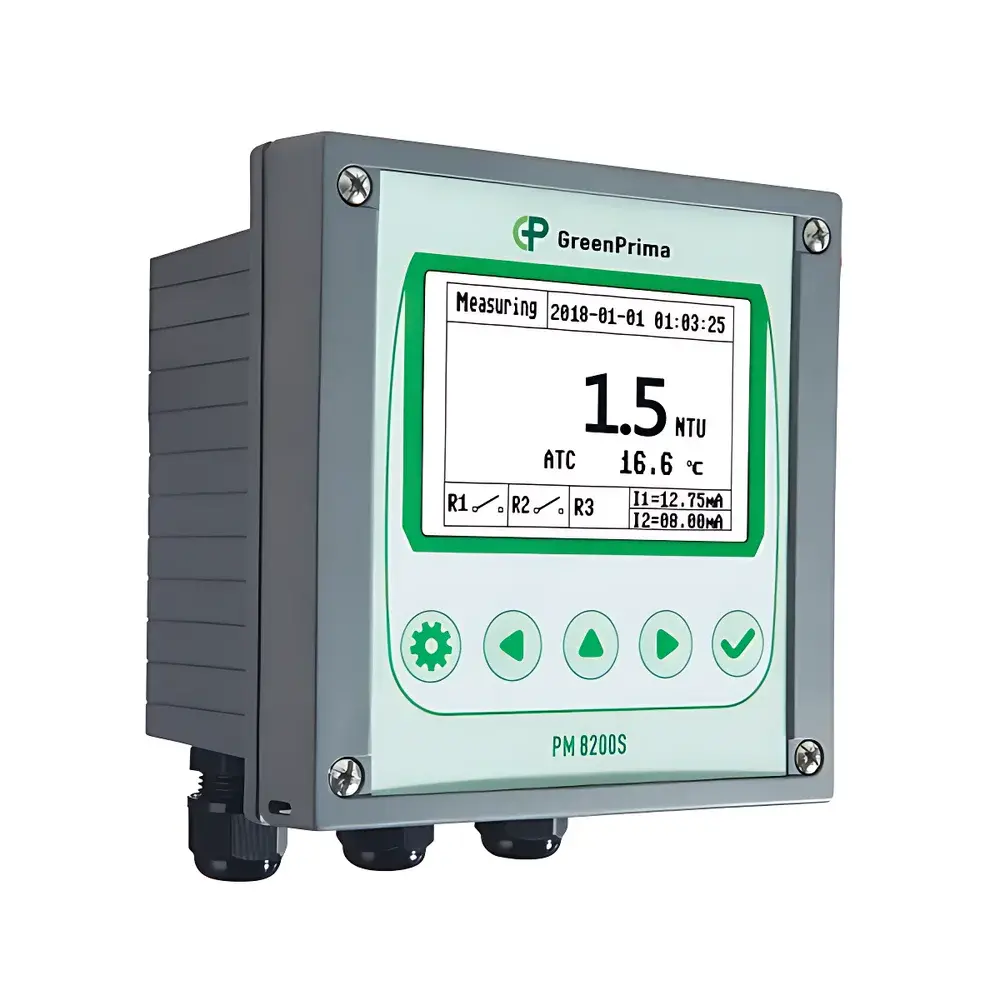
GreenPrima PM8200 S High-Range Online Turbidimeter
| Brand | GreenPrima |
|---|---|
| Origin | United Kingdom |
| Manufacturer Type | Original Equipment Manufacturer (OEM) |
| Product Origin | Imported |
| Model | PM8200 S |
| Instrument Type | Online |
| Measurement Principle | 90° Near-Infrared Light Scattering |
| Compliance | EN ISO 7027 |
| Sensor Type | Bsens580 High-Turbidity Sensor |
| Measuring Range | 5–4000 NTU / 0–4500 mg/L (as SS) |
| Resolution | 0.01–1 NTU (or mg/L) |
| Accuracy | < ±5% of reading |
| Temperature Compensation | NTC10K or PT1000, -10 to 130 °C (manual/automatic) |
| Operating Temperature (Controller) | 0–70 °C |
| Operating Temperature (Sensor) | 0–50 °C |
| Storage Temperature | -20 to 70 °C |
| Max. Pressure (Sensor) | 5 bar |
| Sensor Housing | IP68 |
| Controller Enclosure | IP65 |
| Display | Backlit dot-matrix LCD with Chinese/English menu |
| Output | Dual isolated 4–20 mA (0.1% FS, max. 500 Ω), RS485 Modbus RTU (HART optional) |
| Cleaning Output | Adjustable interval (0.1–1000 h) and duration (1–1000 s) |
| Alarm Outputs | Two independent Hi/Lo relay outputs (5 A / 250 VAC / 30 VDC) |
| Power Supply | 90–260 VAC, 50/60 Hz or 24 VDC optional |
| Mounting Options | Wall-mounted, pipe-mounted, panel-mounted |
| Dimensions (Controller) | 144 × 144 × 106 mm |
| Panel Cutout | 138 × 138 mm |
| Weight (Controller) | 0.86 kg |
| Sensor Dimensions | Ø27 × 170 mm |
| Standard Cable Length | 7 m |
Overview
The GreenPrima PM8200 S High-Range Online Turbidimeter is an industrial-grade, continuously operating turbidity and suspended solids (SS) analyzer engineered for demanding water quality monitoring applications. It operates on the 90° near-infrared (NIR) light scattering principle—fully compliant with EN ISO 7027—ensuring stable optical performance across variable water color, particulate composition, and ambient lighting conditions. Unlike visible-light turbidimeters, the NIR wavelength (typically ~850 nm) minimizes interference from natural chromophores (e.g., humic substances) and eliminates phototropic biological growth effects on the optical path. The instrument integrates a proprietary reference beam technology that dynamically compensates for LED intensity drift, lens fouling, and spectral shifts caused by temperature or aging—enabling long-term measurement stability without frequent recalibration. Designed for permanent installation in wastewater treatment plants, drinking water distribution networks, industrial process streams, and surface water monitoring stations, the PM8200 S delivers traceable, repeatable turbidity data under high-solids conditions where conventional low-range sensors saturate or drift.
Key Features
- High-range measurement capability: 5–4000 NTU and 0–4500 mg/L SS—optimized for raw influent, sludge blanket interfaces, and reclaimed water streams
- Dual-channel compensation architecture: Real-time reference beam correction for LED output decay, optical window soiling, and temperature-induced refractive index variation
- Robust dual-enclosure design: IP65-rated controller housing and IP68-rated submersible sensor (Ø27 × 170 mm) rated for continuous immersion at up to 5 bar pressure
- Configurable cleaning interface: Programmable cleaning cycle (0.1–1000 hours) and duration (1–1000 seconds) to synchronize with mechanical wipers or air-pulse systems
- Multi-parameter display: Backlit dot-matrix LCD showing real-time turbidity, temperature, timestamp, relay status, and diagnostic flags—all accessible via intuitive bilingual (English/Chinese) menu navigation
- Secure operational control: Password-protected calibration (default code: 1100) and configuration modes (default code: 1200) prevent unauthorized parameter changes
- Flexible power and output options: Supports universal AC input (90–260 VAC, 50/60 Hz) or 24 VDC; dual isolated 4–20 mA outputs configurable for turbidity, temperature, or fault status
Sample Compatibility & Compliance
The PM8200 S is validated for use with heterogeneous aqueous matrices including activated sludge effluent, river water with seasonal algal blooms, industrial cooling water containing metal oxides or polymer flocculants, and potable water post-filtration. Its NIR 90° scattering geometry ensures minimal sensitivity to particle shape anisotropy and refractive index variance—critical for compliance with regulatory reporting requirements under EU Drinking Water Directive (2020/2184) and U.S. EPA Method 180.1. The system supports GLP/GMP-aligned operation through configurable audit trails (via Modbus register logging), user-access-level controls, and traceable calibration records. All firmware and calibration protocols adhere to EN ISO 7027:2016 for turbidimetric measurement equivalence, and the analog outputs meet IEC 61290-1 accuracy class requirements for industrial process instrumentation.
Software & Data Management
Data acquisition and remote supervision are enabled via standard RS485 Modbus RTU protocol (addressable up to 247 nodes), supporting integration into SCADA, DCS, or cloud-based IIoT platforms. Optional HART communication allows interoperability with legacy asset management systems. The controller logs time-stamped measurements internally (non-volatile memory) and transmits diagnostics—including sensor voltage, temperature drift rate, cleaning actuation history, and optical signal-to-noise ratio—for predictive maintenance planning. When paired with GreenPrima’s optional DataHub gateway, users gain secure HTTPS access to live trends, historical export (CSV/Excel), alarm event filtering, and automated report generation aligned with ISO/IEC 17025 documentation standards.
Applications
- Wastewater treatment: Real-time monitoring of secondary clarifier effluent, thickener overflow, and digester supernatant
- Drinking water production: Control feedback for coagulation/flocculation dosing and filter backwash initiation
- Industrial process water: Monitoring of cooling tower blowdown, boiler feed pretreatment, and semiconductor rinse water purity
- Environmental surveillance: Long-term deployment in rivers, reservoirs, and estuaries for sediment transport modeling
- Food & beverage manufacturing: Verification of CIP rinse clarity and post-carbon filtration integrity
FAQ
What turbidity standards are supported for field calibration?
The PM8200 S accepts Formazin (FNU), AMCO AEPA-1 (NTU), and StablCal® primary standards. Calibration is performed using two-point (low/high) or single-point verification per ISO 7027 Annex B procedures.
Can the sensor be installed in pressurized pipelines?
Yes—the Bsens580 sensor is rated for continuous operation at up to 5 bar static pressure and features a threaded NPT 3/4″ mounting interface compatible with ANSI B16.5 Class 150 flanges or custom saddle mounts.
Is temperature compensation mandatory for accurate readings?
Temperature compensation is enabled by default using either integrated NTC10K or external PT1000 probes. For applications with rapid thermal transients (>2 °C/min), automatic compensation is recommended to maintain <±2% reading stability across 0–50 °C.
How often does the optical window require manual cleaning?
Under typical municipal wastewater conditions, fouling necessitates cleaning every 2–4 weeks. With scheduled air-blast or brush-based auto-cleaning, intervals extend to 3–6 months—validated by continuous signal-to-noise ratio trending in the diagnostic log.
Does the device support FDA 21 CFR Part 11 compliance?
While the base unit does not include electronic signature or audit trail encryption, the optional DataHub gateway provides Part 11-compliant user authentication, immutable record storage, and role-based access control—fully deployable in regulated pharmaceutical or biotech water systems.
Related Products







