
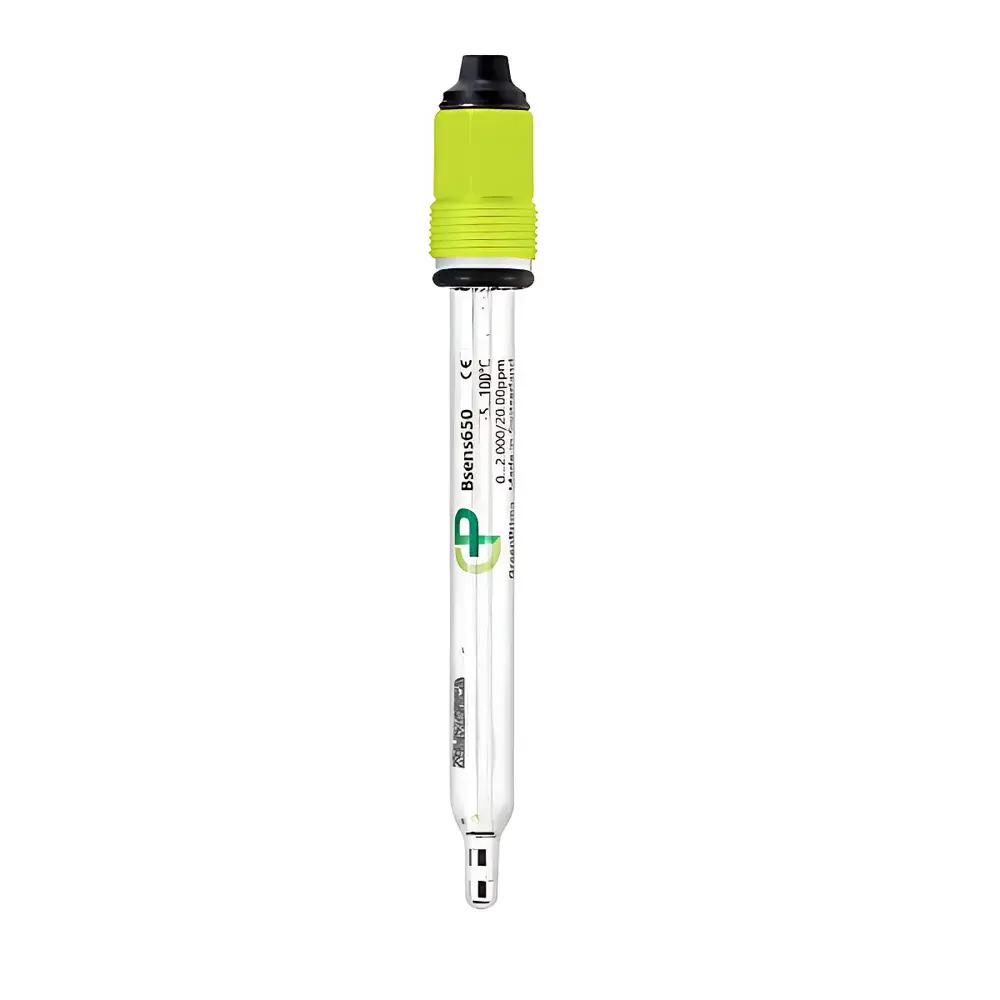
GreenPrima PM8200CL Residual Ozone Analyzer
| Brand | GreenPrima |
|---|---|
| Origin | Switzerland |
| Manufacturer Type | OEM Manufacturer |
| Instrument Type | Online Analyzer |
| Measurement Principle | Amperometric Electrochemical Sensor (Constant Potential Method) |
| Measured Parameter | Dissolved Ozone (O₃) |
| Range | 0–2.000 ppm and 0–20.00 ppm |
| Accuracy | ≤ ±2% of Full Scale |
| Repeatability | ±0.001 ppm / ±0.01 ppm |
| Resolution | 0.001 ppm / 0.01 ppm |
| Detection Limit | 0.001 ppm / 0.01 ppm |
| Temperature Compensation | –10 to 130 °C (manual/automatic) |
| Operating Temperature | 0–70.0 °C |
| Storage Temperature | –20 to 70 °C |
| Display | Backlit Graphic LCD |
| Languages | English, Chinese |
| Data Storage | 600,000 records |
| Power Supply | 90–260 VAC, 50/60 Hz or 24 VDC optional |
| Analog Outputs | Dual 4–20 mA (O₃ concentration & temperature), max. loop resistance 500 Ω, accuracy 0.1% FS |
| Cleaning Output | Adjustable interval (0.1–1000 h) and duration (1–1000 s) |
| Enclosure Rating | IP65 |
| Controller Dimensions | 144 × 144 × 106 mm |
| Electrode Dimensions | Ø12 × 120 mm |
| Mounting | Wall-mounted, panel-mounted, or pole-mounted controller |
Overview
The GreenPrima PM8200CL is a high-stability online dissolved ozone analyzer engineered for continuous, real-time monitoring of aqueous ozone (O₃) concentrations in municipal and industrial water treatment systems. It operates on the amperometric electrochemical principle—specifically, the constant-potential (galvanic) method—where a precisely controlled voltage is applied between a working electrode (gold-ring sensor, Bsens660/Bsens650) and a reference electrode. Dissolved ozone undergoes selective reduction at the polarized gold surface, generating a diffusion-limited current linearly proportional to its concentration. This architecture eliminates dependence on chemical reagents, membrane replacement, or electrolyte refilling—significantly reducing operational overhead and long-term calibration drift. Designed for integration into chlorine-free disinfection processes, the PM8200CL delivers trace-level detection (LOD: 0.001 ppm) with full-scale accuracy ≤ ±2%, making it suitable for regulatory compliance in drinking water distribution networks, hospital effluent streams, and recirculating pool systems where precise oxidative residual control is critical.
Key Features
- True maintenance-free operation: No membrane, no internal electrolyte, no colorimetric reagents required
- Gold-ring amperometric sensor (Bsens660) optimized for low-range ozone detection (0–2 ppm) with enhanced signal-to-noise ratio
- Dual-range auto-ranging capability (0–2.000 ppm / 0–20.00 ppm) with selectable resolution (0.001 or 0.01 ppm)
- Integrated BAF615 constant-flow cell ensuring laminar, pressure-stable sample delivery—critical for reproducible mass-transfer conditions
- Full-temperature compensation (–10 to 130 °C) with both manual and automatic modes to correct for kinetic and solubility effects
- Robust IP65-rated controller housing compatible with humid, chemically aggressive environments typical of pump rooms and chlorination shelters
- Dual isolated 4–20 mA analog outputs: one for ozone concentration, one for process temperature—each traceable to NIST-calibrated references
- Configurable cleaning protocol via relay output, supporting automated periodic electrode surface refresh without operator intervention
Sample Compatibility & Compliance
The PM8200CL is validated for use with potable water, filtered surface water, wastewater effluent, and swimming pool recirculation streams. Its electrochemical architecture exhibits minimal cross-sensitivity to free chlorine (< 0.5% interference at 2 ppm Cl₂), nitrate, and dissolved oxygen—provided pH remains within 5.5–8.5. The system complies with ISO 20582:2020 (Water quality — Determination of dissolved ozone — Electrochemical method) and supports audit-ready data integrity per FDA 21 CFR Part 11 when paired with compliant SCADA or LIMS platforms. All firmware logs—including calibration events, cleaning cycles, and alarm timestamps—are time-stamped and non-erasable, satisfying GLP/GMP documentation requirements for utilities undergoing third-party certification (e.g., NSF/ANSI 60, DVGW W556).
Software & Data Management
The embedded controller firmware supports local configuration via intuitive menu navigation on the backlit graphic LCD. Data logging captures up to 600,000 timestamped entries (ozone value, temperature, status flags) with cyclic overwrite protection. RS485 Modbus RTU interface enables seamless integration into existing PLC-based control architectures (Siemens S7, Rockwell ControlLogix, Schneider EcoStruxure). Optional cloud gateway modules support MQTT/HTTPS transmission to centralized dashboards (e.g., Ignition SCADA, Grafana) with TLS 1.2 encryption. Audit trails include user login history, parameter change logs, and calibration certificate metadata—fully exportable as CSV or PDF for regulatory submission.
Applications
- Real-time monitoring of ozone dose in municipal drinking water plants post-ozone contact chambers
- Process control of ozone generators in pharmaceutical-grade purified water (PW) and water-for-injection (WFI) loops
- Compliance verification in hospital wastewater decontamination units treating pathogen-laden effluent
- Performance validation of UV/ozone hybrid disinfection systems in aquaculture recirculation tanks
- Leak detection and residual mapping in ozone-treated cooling tower circuits to prevent biofilm resurgence
FAQ
Does the PM8200CL require routine calibration? How often?
Calibration is recommended every 30 days using certified ozone standard solutions traceable to NIST SRM 2977; however, zero-point stability typically exceeds 90 days under stable temperature and flow conditions.
Can the sensor be used in seawater or high-TDS applications?
Not without pre-treatment: chloride ion concentrations > 500 mg/L induce measurable drift due to competitive oxidation at the gold surface. A dechlorinated side-stream with conductivity < 2 mS/cm is advised.
Is the BAF615 flow cell compatible with existing pipe schedules?
Yes—the PG13.5 threaded interface mates directly with ISO 228-1 G½” fittings; custom adapters are available for DN20/DN25 PVC or stainless steel lines.
How does temperature compensation affect measurement uncertainty?
The dual-mode algorithm (lookup table + real-time thermal coefficient adjustment) reduces temperature-induced error from ±0.8% per °C (uncorrected) to ±0.05% per °C across the full operating range.
What cybersecurity protocols are implemented in the RS485/Modbus interface?
The communication layer implements read-only register mapping by default; write-access requires physical key-switch authentication and encrypted session handshake—aligned with IEC 62443-3-3 Level 1 requirements.







