
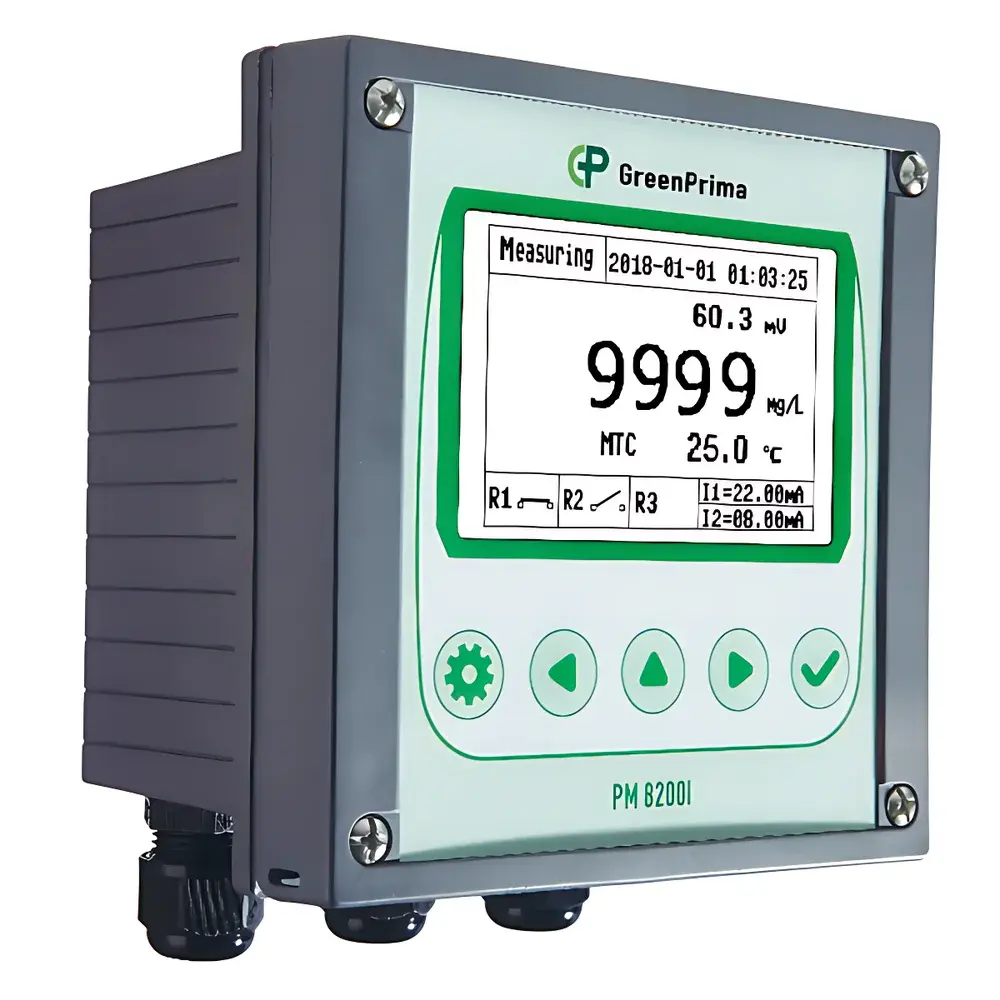
GreenPrima PM8200I Online Calcium Hardness Analyzer for Cement Plant Water Monitoring
| Brand | GreenPrima |
|---|---|
| Origin | United Kingdom |
| Manufacturer Type | Original Equipment Manufacturer (OEM) |
| Product Category | Imported Instrument |
| Model | PM8200I |
| Instrument Type | Online Water Quality Analyzer |
| Measured Parameter | Calcium Ion (Ca²⁺) |
| Measurement Principle | Ion-Selective Electrode (ISE) Method |
| Range | 0.00–20,000 ppm CaCO₃ equivalent |
| Resolution | 0.01 / 0.1 / 1 ppm |
| Accuracy | ±0.01 / ±0.1 / ±1 ppm (depending on range) |
| Temperature Compensation | –10 to 130 °C (NTC10K or PT1000 sensor input) |
| Operating Temperature | 0–70 °C |
| Storage Temperature | –20 to 70 °C |
| Display | Backlit dot-matrix LCD |
| Data Storage | 600,000 records |
| Output Signals | Dual isolated 4–20 mA (max. 500 Ω, 0.1% FS), RS485 MODBUS RTU |
| Relay Output | 1 multifunctional relay (cleaning control, periodic alarm, fault alarm) |
| Cleaning Control | Adjustable interval (0.1–1000 h) and duration (1–1000 s) |
| Enclosure Rating | IP65 |
| Power Supply | 90–260 VAC, 50/60 Hz or optional 24 VDC |
| Dimensions | 144 × 144 × 106 mm |
| Panel Cutout | 138 × 138 mm |
| Weight | 0.86 kg |
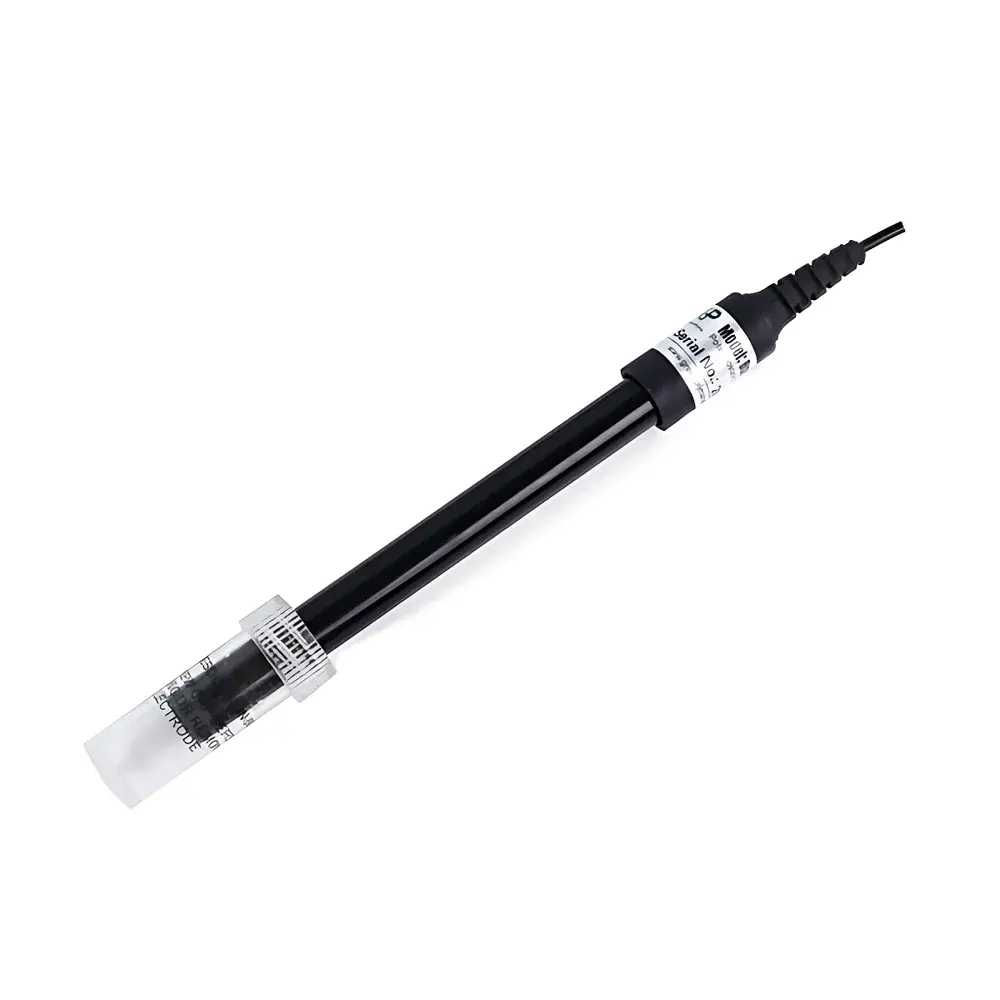
| Electrode Model | Bsens740 |
| Electrode Range | 0–40,000 mg/L Ca²⁺ |
| Electrode Resolution | 0.01 mg/L |
| Electrode Accuracy | ±3% FS |
| Electrode Body Material | Polyphenylsulfone (PPS) |
| Electrode Max. Pressure | 3.5 bar |
| Electrode Connection | PG13.5 fixed thread |
| Electrode Cable Length | 5 m |
Overview
The GreenPrima PM8200I is a dedicated online calcium hardness analyzer engineered for continuous, reagent-free monitoring of calcium ion concentration in industrial water systems—particularly in cement manufacturing facilities where boiler feedwater, cooling tower makeup, and process rinse water require strict hardness control to prevent scale formation, heat exchanger fouling, and refractory degradation. Unlike titrimetric or colorimetric methods, the PM8200I employs a robust ion-selective electrode (ISE) measurement principle, specifically optimized for Ca²⁺ detection in high-conductivity, variable-pH, and particulate-prone aqueous streams typical of cement plant effluent and recirculated water circuits. Its design prioritizes long-term stability under harsh ambient conditions—including dust exposure, thermal cycling, and vibration—without reliance on consumable reagents, peristaltic pumps, or complex fluidic manifolds. The instrument reports hardness as ppm CaCO₃ equivalent, aligning with ASTM D1126 and ISO 6059 standards for total hardness assessment, while enabling direct correlation with scaling propensity indices such as Langelier Saturation Index (LSI) and Ryznar Stability Index (RSI).
Key Features
- Reagent-free ISE-based calcium measurement eliminates chemical handling, waste generation, and tubing clogging—critical for unattended operation in remote or high-dust environments.
- Dual isolated 4–20 mA analog outputs support integration into DCS/SCADA systems for real-time process feedback control of softening units or antiscalant dosing pumps.
- RS485 interface with standard MODBUS RTU protocol ensures interoperability with PLCs and central data historians compliant with ISA-88 and ISA-95 frameworks.
- IP65-rated sealed enclosure with PPS-bodied sensor enables reliable deployment in outdoor meter pits, boiler rooms, or wet-process areas without additional weatherproof enclosures.
- Configurable cleaning cycle (interval: 0.1–1000 h; duration: 1–1000 s) mitigates electrode surface fouling from suspended solids or carbonate precipitation—common in cement plant water with elevated alkalinity and silica content.
- Onboard data logging stores up to 600,000 timestamped readings (Ca²⁺, temperature, system status), supporting GLP-compliant trend analysis and audit-ready record retention.
- Backlit dot-matrix LCD provides simultaneous display of measured value, temperature compensation status, relay state, and diagnostic flags—accessible via intuitive bilingual (English/Chinese) menu navigation without physical keypads.
Sample Compatibility & Compliance
The PM8200I is validated for use in aqueous samples with conductivity up to 5,000 µS/cm, pH 4.5–10.5, and suspended solids ≤50 mg/L—conditions routinely encountered in cement plant water treatment streams, including clarifier effluent, reverse osmosis permeate, and low-pressure steam condensate return lines. It complies with electromagnetic compatibility requirements per EN 61326-1 (industrial environment), safety standards per EN 61010-1, and environmental protection directives under RoHS 2011/65/EU. While not certified for SIL-rated safety functions, its architecture supports integration into GMP-aligned water monitoring systems per EU Annex 1 and USP , particularly when paired with documented calibration procedures and periodic electrode verification using NIST-traceable Ca²⁺ standards.
Software & Data Management
No proprietary software is required for basic configuration; all setup—including measurement range selection, temperature compensation mode (manual/automatic), relay logic assignment, and MODBUS slave ID—is performed locally via the front-panel interface. For advanced data retrieval, GreenPrima provides a free Windows-based PC utility supporting CSV export, historical curve plotting, and firmware updates. Logged data includes UTC timestamps, measurement values, temperature readings, and system event logs (e.g., cleaning activation, sensor timeout, power interruption). The dual 4–20 mA outputs are independently scalable and assignable to Ca²⁺ concentration or temperature—enabling redundant signal routing for critical control loops. Audit trails meet FDA 21 CFR Part 11 requirements when deployed with time-synchronized network clocks and role-based access controls on connected SCADA platforms.
Applications
- Continuous hardness monitoring of boiler feedwater in cement kiln auxiliary steam systems to maintain <1 ppm Ca²⁺ and prevent calcium silicate scale on superheater tubes.
- Real-time control of lime-soda softening units treating quarry runoff before reuse in concrete batching water circuits.
- Verification of ion exchange resin exhaustion in make-up water polishing skids serving air-cooled condensers.
- Trend analysis of hardness drift across multi-stage filtration trains—identifying breakthrough events in multimedia filters or activated carbon beds.
- Compliance reporting for ISO 50001 energy management systems, where hardness-related scaling directly impacts thermal efficiency of heat recovery steam generators (HRSGs).
FAQ
Does the PM8200I measure total hardness or only calcium?
It measures calcium ion activity selectively via ISE. Total hardness (Ca²⁺ + Mg²⁺) is estimated assuming a consistent Mg/Ca ratio in source water; for true total hardness, a separate magnesium-specific electrode or laboratory titration is recommended.
Can the sensor operate in hot water above 70 °C?
The Bsens740 electrode has a maximum operating temperature of 70 °C. For higher-temperature applications (e.g., steam condensate at 90 °C), a cooled sample bypass line with temperature-controlled mixing must be implemented prior to sensor insertion.
How often does the electrode require calibration?
Initial two-point calibration (low: 50 ppm; high: 1,000 ppm Ca²⁺) is required at commissioning. Field recalibration is recommended every 30 days in stable water matrices or after cleaning cycles exceeding 200 hours.
Is the 4–20 mA output intrinsically safe?
No—the output is non-IS rated. For hazardous area installation (e.g., Zone 2 gas environments), a certified signal isolator or barrier must be installed upstream of the transmitter.
What maintenance is required beyond electrode cleaning?
Annual verification of reference junction integrity and zero-point drift using deionized water is advised. No electrolyte refills or membrane replacements are needed—the solid-state ISE design eliminates liquid-filled reference chambers.
Related Products







