
GreenPrima PM8200I Online Fluoride Ion Analyzer
| Brand | GreenPrima |
|---|---|
| Origin | United Kingdom |
| Manufacturer Type | Original Equipment Manufacturer (OEM) |
| Product Category | Imported Instrument |
| Model | PM8200I |
| Instrument Type | Online Water Quality Analyzer |
| Measured Parameter | Fluoride Ion (F⁻) |
| Measurement Range | 0.00–20,000 ppm |
| Resolution | 0.01 / 0.1 / 1 ppm |
| Accuracy | ±0.01 / ±0.1 / ±1 ppm (depending on range) |
| Temperature Compensation | –10 to 130 °C (manual/automatic |
| Operating Temperature | 0 to 70.0 °C |
| Storage Temperature | –20 to 70.0 °C |
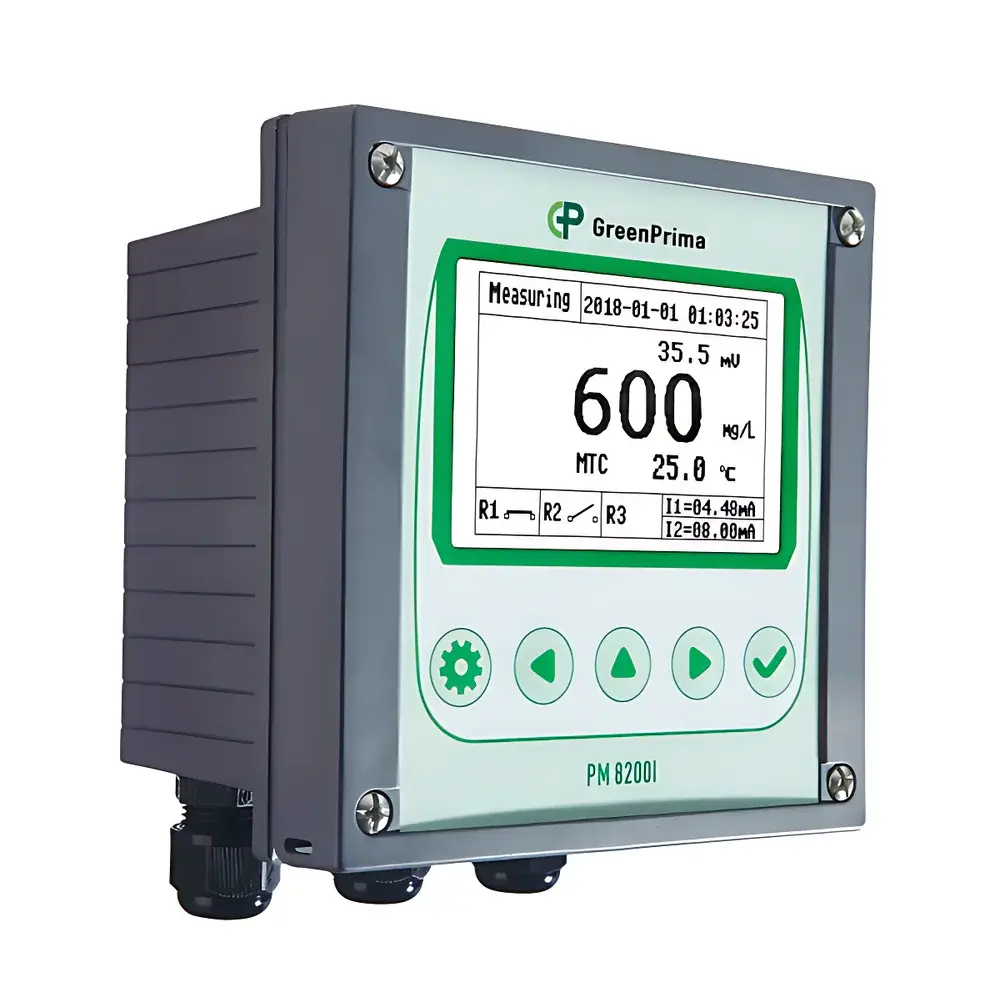
| Display | Backlit large-dot-matrix LCD (showing F⁻ concentration, temperature, time, relay status) |
| Language Interface | English & Chinese selectable |
| Data Storage | Up to 600,000 records |
| Power Supply | 90–260 VAC, 50/60 Hz or optional 24 VDC |
| Enclosure Rating | IP65 |
| Communication | RS485, MODBUS RTU protocol |
| Analog Outputs | Two isolated 4–20 mA outputs (max. loop resistance 500 Ω, accuracy ±0.1% FS) |
| Relay Output | One multifunctional relay (for cleaning control, periodic alarm, fault alarm) |
| Cleaning Control | Adjustable interval (0.1–1000 h) and duration (1–1000 s) |
| Mounting Options | Wall-mounted, pole-mounted, panel-mounted |
| Dimensions | 144 × 144 × 106 mm |
| Panel Cutout | 138 × 138 mm |
| Weight | 0.86 kg |
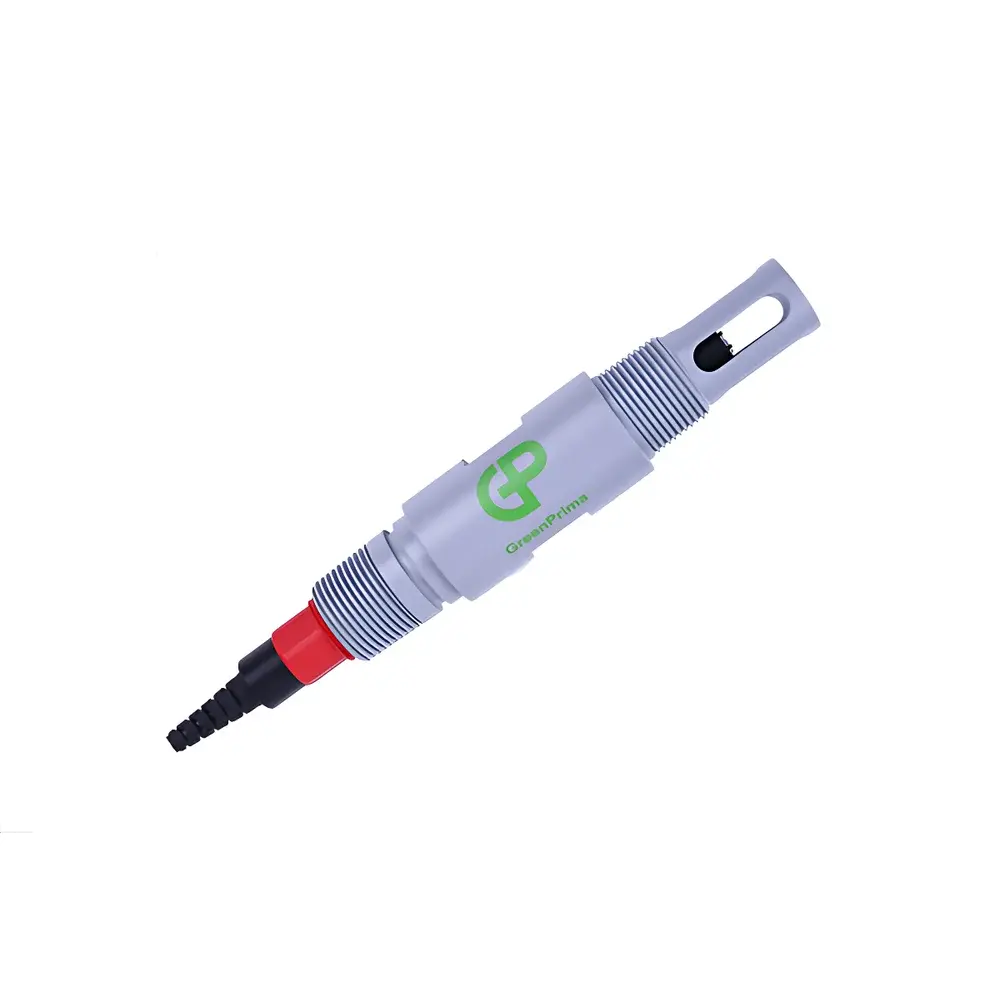
| Fluoride Electrode | Bsens710 |
| Electrode Measuring Range | 0–20 ppm F⁻ |
| Electrode Resolution | 0.1 mg/L |
| Electrode Accuracy | ±3% FS |
| Electrode Body Material | Polyphenylsulfone (PPS) |
| Electrode Operating Temp. | –5 to 70.0 °C |
| Max. Pressure Rating | 3.5 bar |
| Electrode Connection | PG13.5 fixed thread |
| Electrode Cable Length | 5 m |
Overview
The GreenPrima PM8200I Online Fluoride Ion Analyzer is a dedicated electrochemical monitoring system engineered for continuous, real-time quantification of fluoride ion (F⁻) concentration in aqueous matrices. It operates on the principle of potentiometric measurement using a solid-state, ion-selective electrode (ISE) — specifically the Bsens710 fluorine-specific sensor — which generates a stable, Nernstian potential response proportional to the logarithm of free F⁻ activity in solution. This method complies with standardized potentiometric techniques referenced in ISO 10304-1 (water quality — determination of dissolved anions by liquid chromatography) and ASTM D3869 (standard test methods for fluoride in water), and is widely accepted for regulatory compliance in drinking water, wastewater effluent, and industrial process streams. The analyzer is designed for unattended operation in fixed-location applications where long-term stability, low maintenance, and trace-level detection sensitivity are required — particularly in environments subject to variable pH, turbidity, or organic load.
Key Features
- Integrated Bsens710 fluoride-selective electrode with PPS housing, rated for continuous immersion at pressures up to 3.5 bar and temperatures from –5 °C to 70 °C.
- Triple-range configurable measurement capability (0.00–20,000 ppm), enabling high-resolution detection down to 0.01 ppm in low-concentration regimes (e.g., potable water) and robust full-scale performance in high-fluoride industrial discharges.
- Automatic temperature compensation using either NTC10K or PT1000 sensors, supporting accurate readings across a broad thermal envelope (–10 °C to 130 °C).
- IP65-rated sealed enclosure with corrosion-resistant materials, suitable for outdoor deployment, wet utility rooms, or chemically aggressive plant environments.
- Dual isolated 4–20 mA analog outputs with 0.1% full-scale accuracy, configurable for fluoride concentration and temperature — compatible with PLCs, SCADA systems, and DCS architectures.
- MODBUS RTU over RS485 interface enables bidirectional communication for remote configuration, data polling, and firmware updates without physical access.
- Programmable cleaning cycle with adjustable frequency (0.1–1000 hours) and duration (1–1000 seconds), mitigating electrode fouling in suspended-solids-rich or scaling-prone waters.
- Onboard non-volatile memory stores up to 600,000 timestamped records — including F⁻ value, temperature, system status, and event logs — supporting retrospective analysis and audit readiness.
Sample Compatibility & Compliance
The PM8200I is validated for use in municipal drinking water distribution systems, secondary and tertiary wastewater treatment effluents, surface water monitoring stations, and industrial discharge points — including semiconductor rinse waters, solar cell etching baths, electroplating rinse tanks, and pharmaceutical process cooling loops. It maintains measurement integrity in samples with pH 4–9 (within ISE operational limits) and total dissolved solids (TDS) < 10,000 mg/L. While not intrinsically certified for hazardous locations, its design meets CE marking requirements for electromagnetic compatibility (EN 61326-1) and safety (EN 61010-1). For regulated environments, the system supports GLP/GMP-aligned data integrity practices via secure time-stamped logging and user-accessible audit trails — consistent with FDA 21 CFR Part 11 principles when integrated with compliant host software.
Software & Data Management
No proprietary PC software is required for basic operation; all setup, calibration, and diagnostics are performed locally via the intuitive backlit LCD interface with dual-language (English/Chinese) menu navigation. However, the MODBUS RTU protocol allows seamless integration into third-party supervisory platforms such as Ignition, Siemens Desigo, or Schneider EcoStruxure. Data export is supported through serial polling or via optional Ethernet gateway modules (sold separately). Calibration history, sensor diagnostics (e.g., slope, offset, impedance), and relay activation events are retained in internal memory and retrievable on demand. Firmware updates are delivered via SD card or serial upload, ensuring long-term adaptability to evolving analytical protocols.
Applications
- Municipal water utilities: Continuous compliance monitoring against WHO (1.5 mg/L) and EPA (4.0 mg/L) fluoride limits in finished drinking water.
- Wastewater treatment plants: Real-time tracking of fluoride breakthrough in lime precipitation or activated alumina adsorption units.
- Semiconductor manufacturing: In-line verification of post-etching rinse water to prevent wafer contamination and meet SEMI F57 purity specifications.
- Electroplating and metal finishing facilities: Control of fluoride-containing brighteners and complexing agents in nickel and zinc plating baths.
- Pharmaceutical production: Monitoring of fluoride residuals in purified water (PW) and water-for-injection (WFI) distribution loops per USP .
- Environmental agencies: Fixed-site river and reservoir monitoring for geogenic or anthropogenic fluoride contamination.
FAQ
What electrode technology does the PM8200I use for fluoride detection?
It employs the Bsens710 solid-contact, lanthanum fluoride (LaF₃)-based ion-selective electrode, optimized for selectivity against hydroxide and common anions under controlled pH conditions.
Can the analyzer operate in seawater or brackish water?
Not recommended for direct use in high-ionic-strength media (>10,000 µS/cm) without dilution or matrix-matched calibration due to activity coefficient deviations and junction potential instability.
Is automatic calibration supported?
No — calibration requires manual two-point (or three-point) standardization using certified fluoride reference solutions; however, calibration intervals, slopes, and offsets are logged and traceable.
How is electrode drift managed during extended deployment?
Drift is minimized via temperature-compensated measurement, regular automated cleaning cycles, and scheduled verification against check standards — typical recalibration intervals range from 7 to 30 days depending on sample matrix severity.
Does the system comply with ISO/IEC 17025 requirements for accredited laboratories?
While the instrument itself is not a certified reference material, its documented measurement uncertainty, traceable calibration procedures, and audit-ready data logging support method validation per ISO/IEC 17025:2017 Clause 7.7 when operated within defined scope and environmental controls.
Related Products







