
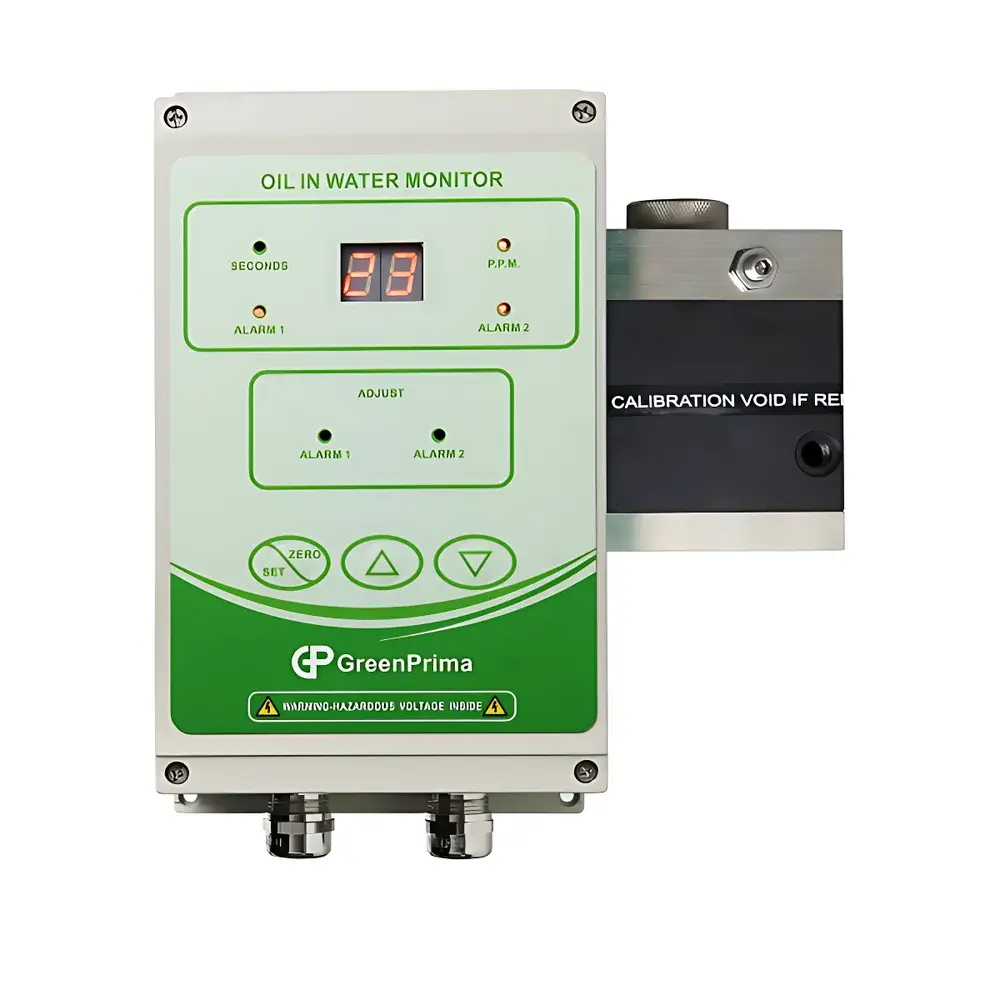
GreenPrima PR OCON7000 Online Oil-in-Water Analyzer
| Brand | GreenPrima |
|---|---|
| Origin | United Kingdom |
| Manufacturer Type | Manufacturer |
| Origin Category | Imported |
| Model | PR OCON7000 |
| Instrument Type | Online |
| Measurement Principle | Fluorescence Spectrophotometry |
| Measurement Range | 0–99 ppm |
| Accuracy | ±2 ppm |
| Alarm Setpoint Range | 1–98 ppm (adjustable) |
| Alarm Delay 1 | 0–60 s (adjustable) |
| Alarm Delay 2 | 10–240 s (adjustable) |
| Display | 240 × 128 pixel touchscreen |
| Output Signals | 0/4–20 mA (min. load 820 Ω), 0–5 V / 1–5 V DC (min. load 50 kΩ) |
| Ambient Temperature | 1–60 °C |
| Relative Humidity | max. 90 % RH at 55 °C |
| Sample Temperature | 1–40 °C |
| Sample Flow Rate | 0.1–2 L/min |
| Sample Pressure | 0.1–10 bar |
| Weight | 2.25 kg |
| Dimensions (H×W×D) | 215 × 242 × 73 mm |
| Power Supply | 230 V / 115 V AC or 24 V AC |
| Max. Power Consumption | 10 VA |
| Enclosure Rating | IP55 |
| Electrical Installation Overvoltage Category | EN 61010-1 / IEC 664 Category II |
Overview
The GreenPrima PR OCON7000 Online Oil-in-Water Analyzer is an industrial-grade, fluorescence-based photometric instrument engineered for continuous, real-time monitoring of hydrocarbon contamination in aqueous streams. It operates on the principle of ultraviolet-induced fluorescence: when oil compounds—such as mineral oils, lubricants, and diesel—are excited by UV light (typically 254 nm or 365 nm, depending on optical configuration), they emit characteristic fluorescence signals proportional to concentration. This method delivers high selectivity for aromatic and unsaturated hydrocarbons while minimizing interference from turbidity, suspended solids, or colored dissolved organic matter—common challenges in cooling water and wastewater matrices. Designed specifically for demanding process environments, the PR OCON7000 provides reliable detection down to sub-ppm levels with a calibrated linear range of 0–99 ppm and a stated accuracy of ±2 ppm. Its robust architecture supports uninterrupted operation in power generation, refinery utilities, marine engine rooms, and industrial effluent treatment plants where early leak detection in heat exchangers or condensate systems is critical to preventing equipment damage and regulatory noncompliance.
Key Features
- Automated measurement cycle with built-in self-diagnostic routines and real-time drift compensation to ensure long-term signal stability without manual recalibration.
- Configurable alarm logic with two independent relay outputs: Alarm 1 (adjustable delay 0–60 s) and Alarm 2 (10–240 s), both programmable across 1–98 ppm thresholds.
- Intuitive 240 × 128 pixel resistive touchscreen interface enabling local setup, trend review, and parameter adjustment without external software.
- Flexible analog output options: isolated 0/4–20 mA (min. 820 Ω load) and voltage outputs (0–5 V / 1–5 V DC, min. 50 kΩ load) compliant with standard DCS/PLC input modules.
- Programmable analysis interval (e.g., 1–60 min) and external start/stop triggering via dry-contact inputs, supporting integration into plant-wide control strategies.
- IP55-rated enclosure with IP65-rated external terminal block for field wiring—designed for humid, chemically exposed environments typical of utility tunnels, pump houses, and outdoor skids.
- No consumables or reagents required; optical path is maintained via flow-through quartz cell with integrated cleaning flush capability (optional accessory).
Sample Compatibility & Compliance
The PR OCON7000 is validated for use with freshwater, boiler condensate, closed-loop cooling water, and pre-treated industrial wastewater. It demonstrates stable response across sample temperatures from 1 °C to 40 °C and pressures up to 10 bar, accommodating both gravity-fed and pressurized sampling lines. While optimized for mineral oil and diesel-range hydrocarbons, sensitivity varies with oil type due to differences in fluorophore content—users are advised to perform application-specific verification per ASTM D7622 (Standard Test Method for Determination of Oil Content in Water by Fluorescence). The analyzer meets EN 61010-1 safety requirements for electrical equipment for measurement, control, and laboratory use, and its analog outputs support traceability under ISO/IEC 17025 quality management systems. Though not intrinsically safe, it may be deployed in Zone 2 classified areas when installed per IEC 60079-14 guidelines.
Software & Data Management
Local data logging is supported via optional USB flash drive interface (FAT32 formatted), storing timestamped concentration values, alarm events, and diagnostic logs at user-defined intervals. No proprietary software is required for basic operation; however, GreenPrima provides a Windows-compatible configuration utility (PR ConfigTool v3.x) for advanced calibration mapping, alarm hysteresis tuning, and firmware updates. All analog outputs include linearization coefficients stored in non-volatile memory, ensuring repeatability after power cycles. Audit trails—including parameter changes and alarm acknowledgments—are retained in internal memory for ≥30 days and can be exported for GLP/GMP documentation purposes. The device does not implement FDA 21 CFR Part 11 electronic signature functionality but supports external SCADA-level audit logging through Modbus RTU (optional RS485 module).
Applications
- Monitoring lube oil cooler leakage in gas turbine and steam turbine generator sets.
- Continuous surveillance of engine jacket water circuits in marine propulsion systems.
- Early detection of hydrocarbon ingress in boiler feedwater and condensate return lines—critical for minimizing tube fouling and corrosion.
- Compliance-driven discharge monitoring of treated industrial wastewater prior to environmental release.
- Groundwater remediation site verification where low-level petroleum hydrocarbon plumes require quantification against regulatory action levels (e.g., EPA Method 418.1 equivalents).
FAQ
What hydrocarbon types does the PR OCON7000 detect most effectively?
It exhibits highest sensitivity toward aromatic and polycyclic compounds found in diesel fuel, lubricating oils, and transformer oils. Aliphatic hydrocarbons (e.g., straight-chain paraffins) yield weaker fluorescence and may require higher concentrations for reliable detection.
Is field calibration required after installation?
No routine field calibration is necessary. The instrument performs automatic zero tracking during idle periods and includes factory-applied calibration curves traceable to NIST-certified mineral oil standards. Users may perform validation checks using certified reference materials per internal SOP.
Can the analyzer operate with variable sample flow rates?
Yes—it maintains measurement integrity across 0.1–2 L/min. Below 0.5 L/min, residence time in the optical cell increases, potentially enhancing sensitivity but requiring verification of response time against process dynamics.
Does the unit support hazardous area installation?
Not natively. For Zone 1 or Division 1 locations, it must be housed in an approved purge cabinet or installed remotely with sample transport line, following IEC 60079-13 guidance for pressurized enclosures.
How is maintenance performed?
Primary maintenance involves periodic visual inspection of the quartz flow cell for fouling and quarterly verification of optical window cleanliness using isopropyl alcohol and lint-free wipes. No lamp replacement is needed—the UV LED source has a rated lifetime exceeding 20,000 hours.
Related Products







