
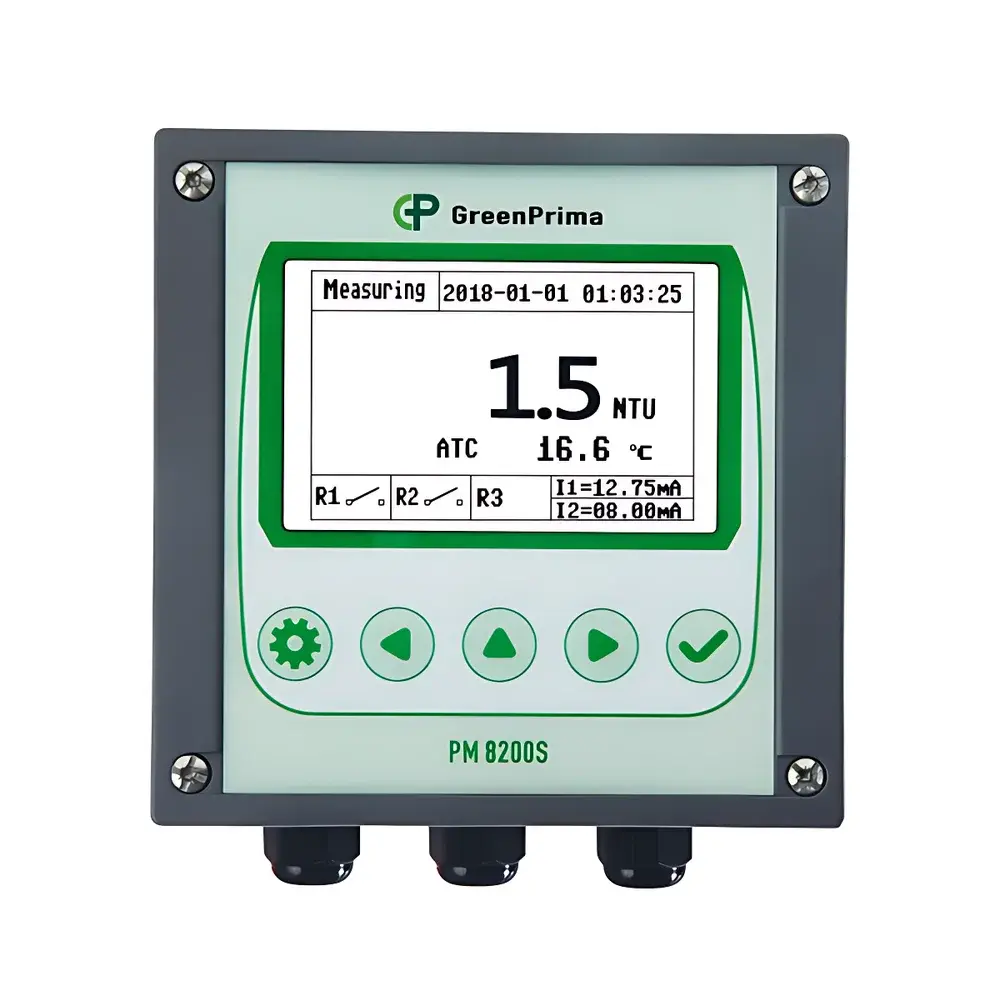
GreenPrima PM8200S Low-Range Online Turbidity Analyzer
| Brand | GreenPrima |
|---|---|
| Origin | United Kingdom |
| Manufacturer Type | Original Equipment Manufacturer (OEM) |
| Product Category | Imported Instrument |
| Model | PM8200S |
| Instrument Type | Online |
| Measurement Principle | 90° Near-Infrared Light Scattering |
| Compliance | EN ISO 7027 |
| Sensor Type | Bsens580L Low-Turbidity Sensor |
| Range | 0–10 NTU / 0–100 NTU |
| Resolution | 0.01 NTU (0–10 NTU), 0.1 NTU (0–100 NTU) |
| Accuracy | ±1% FS (0–10 NTU), ±2% FS (0–50 NTU), ±5% FS (0–100 NTU) |
| Operating Temp. | 0–50 °C (sensor), –10–70.0 °C (controller) |
| Max. Pressure | 4 bar |
| Output | Dual isolated 4–20 mA, RS485 Modbus RTU, optional HART |
| Enclosure Rating | IP65 (controller), IP68 (sensor) |
| Display | Backlit dot-matrix LCD with Chinese/English menu |
| Power Supply | 90–260 VAC, 50/60 Hz or 24 VDC option |
| Dimensions (controller) | 144 × 144 × 106 mm |
| Mounting | Wall, pipe, or panel mount |
| Weight | 0.86 kg |
Overview
The GreenPrima PM8200S Low-Range Online Turbidity Analyzer is an industrial-grade, continuous-monitoring instrument engineered for high-stability turbidity and suspended solids (SS) measurement in water and wastewater applications. It operates on the 90° near-infrared (NIR) light scattering principle—fully compliant with EN ISO 7027—ensuring trace-level sensitivity and long-term repeatability in low-turbidity environments such as drinking water distribution systems, membrane filtration effluent, ultrapure process water loops, and surface water intake monitoring. Unlike broadband white-light systems, the NIR single-wavelength source minimizes interference from coloration, dissolved organics, and ambient light fluctuations. A patented reference photodiode continuously monitors emitter intensity and optical path integrity, dynamically compensating for lens fouling, LED aging, and chromatic drift—enabling stable calibration intervals exceeding 6 months under typical municipal conditions.
Key Features
- True low-range capability: Dual-range sensor (0–10 NTU and 0–100 NTU) with 0.01 NTU resolution in the sub-10 NTU range—critical for compliance with WHO and EU Drinking Water Directive turbidity limits (≤0.1 NTU at point of consumption).
- Robust optical architecture: Sealed, all-metal Bsens580L sensor with IP68 ingress protection, 1″ GAS thread mounting, and pressure rating up to 4 bar—suitable for pressurized pipelines, submerged installations, and aggressive industrial effluents.
- Intelligent self-diagnostic controller: Backlit dot-matrix LCD displays real-time turbidity, temperature, timestamp, relay status, and system health indicators; supports dual-language (English/Chinese) navigation with password-protected access levels (calibration: 1100, configuration: 1200).
- Flexible integration: Two fully isolated 4–20 mA outputs (0.1% FS accuracy, max 500 Ω loop load) assignable to turbidity or temperature; RS485 Modbus RTU standard; optional HART 7 protocol for legacy DCS compatibility.
- Adaptive maintenance logic: Programmable cleaning cycle (0.1–1000 h interval, 1–1000 s duration) with dry-air or water-jet actuation interface; configurable Hi/Lo alarm relays (5 A @ 250 VAC / 30 VDC) with adjustable hysteresis.
Sample Compatibility & Compliance
The PM8200S is validated for continuous immersion or inline flow-through measurement in clarified potable water, tertiary-treated wastewater, cooling tower make-up, pharmaceutical process water, and natural surface waters with low particulate loading. Its NIR scattering design eliminates spectral bias from yellow-colored humic substances common in reservoirs and groundwater sources. The analyzer meets EN ISO 7027:2016 for method validation and supports audit-ready operation under GLP and GMP frameworks. Temperature compensation (NTC10K or PT1000 input) ensures <±0.02 NTU/°C drift correction across 0–50 °C sensor operating range. Controller electronics comply with IEC 61326-1 (EMC) and IEC 61000-4 series immunity standards.
Software & Data Management
No proprietary PC software is required for basic operation—the PM8200S functions autonomously with local parameter configuration via front-panel keypad. For centralized supervision, the Modbus RTU register map provides full read/write access to all operational parameters, calibration coefficients, event logs, and diagnostic flags—including optical signal-to-noise ratio (SNR), reference channel deviation, and cleaning actuation history. When integrated into SCADA or MES platforms, the device supports time-stamped data logging at user-defined intervals (1 s to 1 h), enabling trend analysis per ISO 5725-2 precision studies. All configuration changes are logged with timestamp and operator ID (if network-authenticated), satisfying FDA 21 CFR Part 11 requirements when deployed with validated electronic record systems.
Applications
- Drinking water treatment: Final effluent verification pre-distribution, filter performance monitoring, and rapid detection of breakthrough events (e.g., filter ripening failure or cryptosporidium risk indicators).
- Municipal wastewater: Tertiary clarifier effluent compliance reporting (e.g., EPA NPDES permit limits), UV disinfection pre-screening, and membrane bioreactor (MBR) permeate quality assurance.
- Industrial process water: Semiconductor fab UPW polishing loop surveillance, food & beverage rinse water validation, and power plant condensate purity control.
- Environmental monitoring: Real-time lake/reservoir clarity trending, stormwater runoff characterization, and regulatory reporting for ISO 14001 environmental management systems.
FAQ
What turbidity standards are supported for calibration?
The PM8200S accepts formazin (FTU), AMCO AEPA-1 (NTU), and StablCal® primary standards. Calibration protocols follow ISO 7027 Annex B procedures with multi-point verification at 0.1, 1.0, 10, and 50 NTU.
Can the sensor be installed in a bypass stream?
Yes—the Bsens580L is rated for flow velocities up to 3 m/s and features a streamlined housing compatible with tee-branch or side-stream configurations using standard 1″ compression fittings.
Is temperature compensation automatic or manual?
Both modes are available: automatic compensation via integrated NTC10K or external PT1000 probe, or fixed-offset manual adjustment for controlled lab environments.
How often does the optical window require cleaning?
Under typical drinking water service (≤1 NTU, low biofilm potential), cleaning intervals exceed 6 months; in high-fouling wastewater, programmable air-blast cleaning every 24–72 h maintains baseline stability without manual intervention.
Does the controller support Modbus TCP/IP?
No—only RS485 physical layer Modbus RTU is natively supported; TCP/IP bridging requires an external protocol converter certified to IEC 62443-3-3.







