
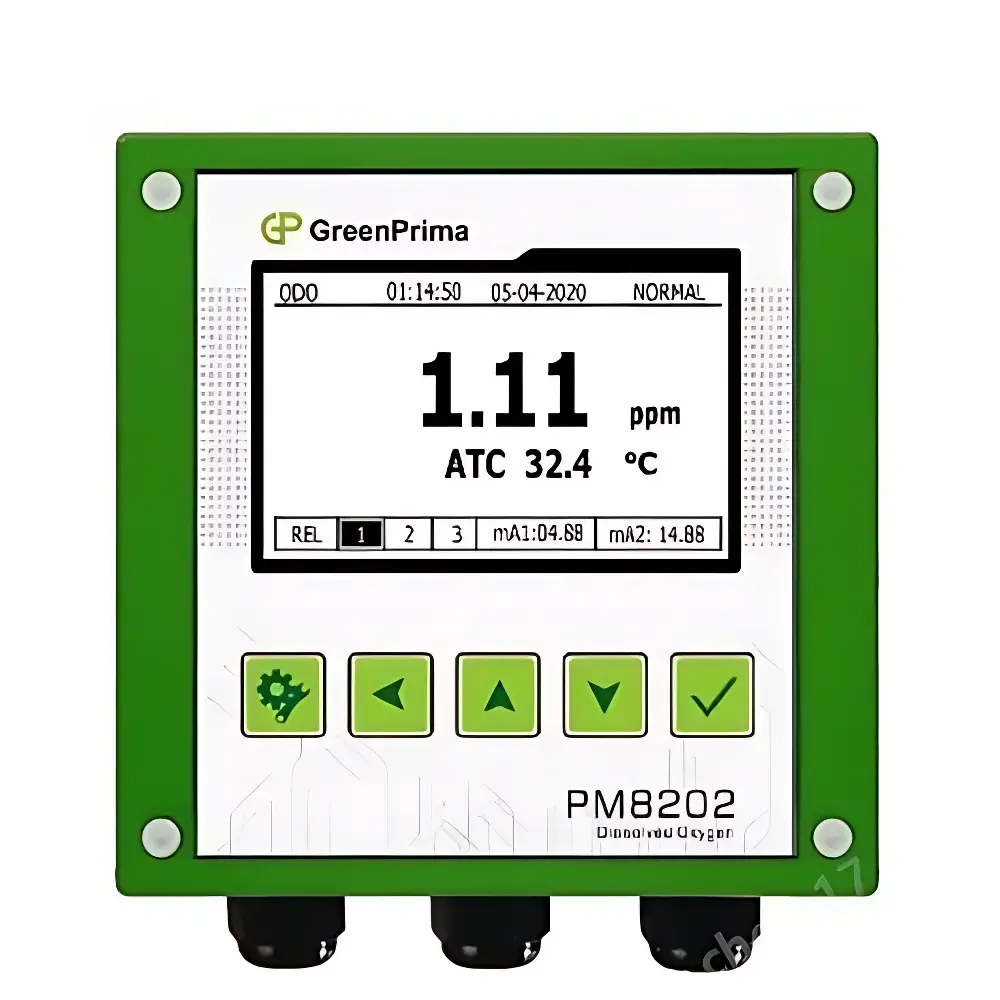
GreenPrima PM8202D Online Polarographic Dissolved Oxygen Analyzer
| Brand | GreenPrima |
|---|---|
| Origin | United Kingdom |
| Manufacturer Type | Original Equipment Manufacturer (OEM) |
| Product Category | Imported Instrument |
| Model | PM8202D |
| Measurement Principle | Polarographic Electrochemical Sensor (Clark-type) |
| Measurement Range | 0.00–20.00 ppm / 0.00–200.00 ppb |
| Accuracy | ±0.02 ppm / ±0.02 ppb |
| Resolution | 0.001 ppm / 0.01 ppb |
| Temperature Compensation | -10 to 130 °C (manual or automatic, NTC10K/PT1000 selectable) |
| Operating Temperature | -10 to 70.0 °C |
| Storage Temperature | -20 to 70.0 °C |
| Display | Backlit dot-matrix LCD (bilingual: English/Chinese) |
| Data Storage | 600,000 records |
| Power Supply | 90–260 VAC, 50/60 Hz or optional 24 VDC |
| Analog Outputs | Two isolated 4–20 mA outputs (max. loop resistance 500 Ω, accuracy ±0.1% FS) |
| Communication | RS485 Modbus RTU |
| Cleaning Control | Adjustable cleaning interval (0.1–1000 h) and duration (1–1000 s) |
| Alarm Outputs | Two independent Hi/Lo relay outputs (5 A / 250 VAC / 30 VDC) |
| Enclosure Rating | IP65 |
| Mounting Options | Wall-mount, panel-mount, pipe-mount |
| Dimensions (W×H×D) | 144 × 144 × 108 mm |
| Panel Cutout | 138 × 138 mm |
| Weight | 0.87 kg |
Overview
The GreenPrima PM8202D Online Polarographic Dissolved Oxygen Analyzer is an industrial-grade, continuous-monitoring instrument engineered for high-reliability dissolved oxygen (DO) measurement in aqueous process streams and environmental water systems. It operates on the Clark-type polarographic principle: a cathode (typically gold or platinum) and silver/silver chloride anode are immersed in an electrolyte-filled chamber, separated from the sample by an oxygen-permeable polytetrafluoroethylene (PTFE) membrane. Molecular oxygen diffuses through the membrane and is electrochemically reduced at the cathode surface, generating a current linearly proportional to the partial pressure of dissolved O₂. This signal is temperature-compensated using integrated NTC10K or PT1000 sensors and converted into concentration units (ppm or ppb) via factory-calibrated algorithms traceable to NIST-standardized reference gases. Designed for unattended operation in demanding environments—including wastewater treatment plants, municipal drinking water distribution networks, aquaculture recirculation systems, and biopharmaceutical fermentation vessels—the PM8202D delivers stable, low-drift performance with minimal maintenance intervals.
Key Features
- Robust IP65-rated enclosure with fully sealed, gas-tight housing—engineered for long-term deployment in humid, corrosive, or splash-prone locations.
- Large backlit dot-matrix LCD display showing real-time DO concentration, measured temperature, system time, and status of two programmable relay outputs.
- Interchangeable polarographic sensor compatibility (e.g., Bsens420, Bsens430, Bsens440), enabling optimization for specific matrix conditions—such as high-suspended solids, low-flow pipes, or sterilizable bioreactor ports.
- Dual isolated 4–20 mA analog outputs configurable for simultaneous transmission of DO and temperature signals, compliant with IEC 61000-6-2/4 EMC standards.
- RS485 interface supporting Modbus RTU protocol for seamless integration into SCADA, DCS, or PLC-based monitoring infrastructures.
- User-accessible password protection for configuration menus, preventing unauthorized parameter changes during routine operation.
- Programmable automatic cleaning control with adjustable frequency (0.1–1000 hours) and duration (1–1000 seconds), compatible with pneumatic or solenoid-driven mechanical wipers or chemical flush systems.
- Two independent relay outputs with user-defined high/low alarm thresholds and adjustable hysteresis—certified for switching up to 5 A at 250 VAC or 30 VDC.
Sample Compatibility & Compliance
The PM8202D is validated for use across diverse aqueous matrices: activated sludge effluents, chlorinated potable water, seawater-influenced aquaculture basins, sterile bioreactor feed streams, and high-purity process water in pharmaceutical manufacturing. Its Clark-type sensor design inherently minimizes interference from redox-active species (e.g., sulfides, ferrous ions) when operated within specified flow velocity (≥15 cm/s recommended) and temperature ranges. The instrument complies with ISO 5814:2012 (water quality — determination of dissolved oxygen — electrochemical probe method) and supports audit-ready data integrity per FDA 21 CFR Part 11 requirements when paired with compliant SCADA logging systems. All electrical interfaces meet CE, RoHS, and UL 61010-1 safety directives. Sensor membranes and electrolytes conform to REACH SVHC restrictions.
Software & Data Management
While the PM8202D operates autonomously without external software, its embedded non-volatile memory stores up to 600,000 timestamped readings (DO value, temperature, system status) with millisecond-level time resolution. Data export is enabled via Modbus polling to third-party historian platforms (e.g., Ignition, Siemens Desigo, Emerson DeltaV). Configuration parameters—including calibration offsets, alarm setpoints, temperature compensation mode, and cleaning schedules—are retained during power loss. Firmware updates are performed via secure USB-to-serial interface using GreenPrima’s certified engineering utility, which logs all configuration changes with operator ID and UTC timestamps—supporting GLP/GMP traceability requirements.
Applications
- Real-time DO monitoring in secondary clarifiers and aerobic digesters to optimize air blower control and reduce energy consumption.
- Continuous verification of residual oxygen levels in deaerated boiler feedwater circuits per ASME PTC 19.11 guidelines.
- Process-critical DO surveillance in mammalian cell culture bioreactors, where deviations >±0.1 ppm may impact monoclonal antibody yield and glycosylation profiles.
- Regulatory compliance reporting for EPA Clean Water Act discharge permits requiring hourly DO telemetry.
- Early detection of nitrification failure in membrane bioreactors (MBRs) via trending of sub-0.5 ppm DO excursions.
- Validation of ozone contactor efficiency in advanced oxidation processes through rapid-response DO depletion kinetics.
FAQ
What maintenance does the polarographic sensor require?
The sensor requires periodic replacement of the oxygen-permeable membrane and replenishment of the internal electrolyte solution—typically every 3–6 months depending on operating temperature, fouling potential, and cleaning frequency. Membrane replacement kits and electrolyte formulations are supplied by GreenPrima under part numbers traceable to ISO 17025-accredited batch certification.
Can the PM8202D be calibrated automatically?
No. Calibration must be performed manually using zero-oxygen (sodium sulfite) and saturated-air (or Winkler titration-verified) standards. However, the instrument supports multi-point calibration storage and drift trend analysis over time.
Is temperature compensation mandatory?
Yes. Oxygen solubility varies nonlinearly with temperature and salinity. The PM8202D mandates either manual entry of process temperature or connection of an NTC10K/PT1000 probe; omission invalidates concentration accuracy per ISO 5814.
Does the unit support hazardous area installation?
The base PM8202D controller is rated for general-purpose environments only (IP65, non-explosion-proof). For Zone 1/21 installations, GreenPrima offers ATEX/IECEx-certified variants (PM8202D-ATEX) with intrinsically safe sensor cabling and barrier-compatible analog outputs.
How is data integrity ensured during power interruptions?
All configuration settings and stored measurements reside in EEPROM with built-in error-correction coding (ECC). Power-loss recovery is deterministic: the device resumes operation within 2 seconds and preserves the last valid reading timestamp without data corruption.







