
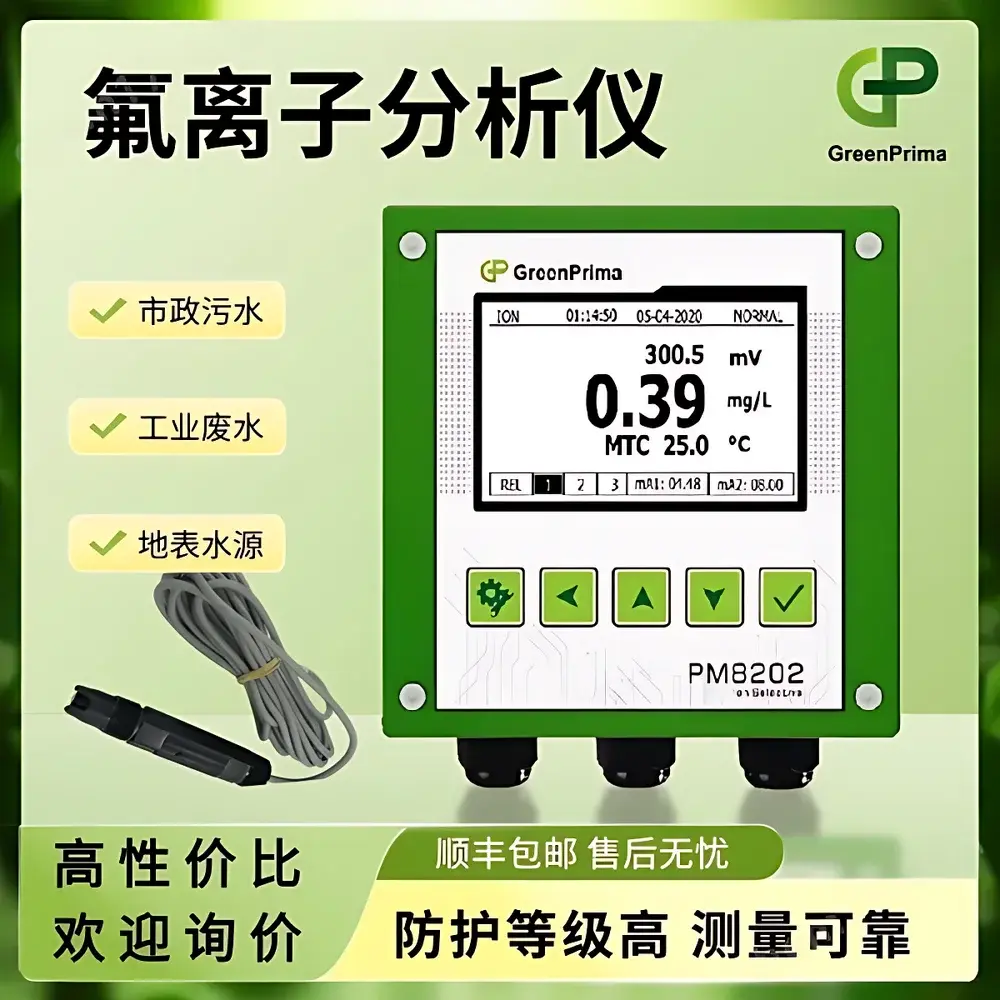
GreenPrima PM8202I Fluoride Ion Analyzer for Potable Water
| Brand | GreenPrima |
|---|---|
| Origin | United Kingdom |
| Manufacturer Type | Original Equipment Manufacturer (OEM) |
| Origin Category | Imported Instrument |
| Model | PM 8202I |
| Pricing | Upon Request |
Overview
The GreenPrima PM8202I Fluoride Ion Analyzer is a dedicated, multi-parameter online monitoring system engineered for continuous, real-time quantification of fluoride ion (F⁻) concentration in potable water distribution systems. Operating on the principle of potentiometric measurement via solid-state ion-selective electrode (ISE) technology, the analyzer delivers stable, trace-level detection with high selectivity against common interferents such as hydroxide (OH⁻), chloride (Cl⁻), and phosphate (PO₄³⁻). The core sensing module—Bsens710 fluoride-selective electrode—is calibrated using NIST-traceable standard solutions and integrates temperature compensation (via integrated Pt1000 sensor) to ensure thermodynamic accuracy across typical municipal water temperature ranges (2–35 °C). Unlike laboratory-based methods (e.g., SPADNS colorimetry or IC), the PM8202I enables unattended, 24/7 operation with minimal reagent consumption—making it suitable for regulatory compliance monitoring under frameworks such as WHO Guidelines for Drinking-water Quality (4th ed.) and EU Council Directive 98/83/EC.
Key Features
- Triple-sensor modular architecture: Supports simultaneous or independent deployment of Bsens710 (F⁻), Bsens720 (Cl⁻), and Bsens730 (NH₃/NH₄⁺) electrodes—enabling cross-parameter correlation analysis without hardware duplication.
- IP67-rated hermetically sealed enclosure: Constructed from UV-stabilized polycarbonate with stainless steel mounting flange; certified for outdoor installation in humid, chlorinated, or splash-prone environments.
- Intuitive dual-language (English/Chinese) HMI: 5.7-inch backlit TFT LCD displays real-time F⁻ concentration (mg/L or ppm), measured temperature (°C), system uptime, calibration status, and relay activation states.
- Low-cost-of-ownership design: ISE sensors require no consumables beyond periodic calibration standards; electrode lifetime exceeds 18 months under routine municipal water conditions (pH 6.5–8.5, turbidity <5 NTU).
- Dual analog outputs: Two isolated 4–20 mA current loops configurable per parameter (e.g., F⁻ output on CH1, temperature on CH2), each with HART-compatible digital overlay.
- Industrial communication interface: RS485 port compliant with Modbus RTU protocol (slave ID configurable), enabling seamless integration into SCADA, DCS, or PLC-based water management platforms.
- Operational security: Three-tier password protection (operator / technician / administrator) governs access to calibration routines, output configuration, and system diagnostics—supporting audit-ready operational integrity.
Sample Compatibility & Compliance
The PM8202I is validated for direct online analysis of clarified, low-turbidity aqueous matrices including treated drinking water, groundwater abstraction points, and low-conductivity industrial process streams (conductivity <1,500 µS/cm). It is not intended for raw surface water, seawater, or highly organic-laden wastewater without pre-filtration (≤5 µm nominal pore size). The system complies with EN ISO/IEC 17025:2017 general requirements for competence of testing and calibration laboratories (as applied to field instrumentation validation), and supports data integrity practices aligned with FDA 21 CFR Part 11 when paired with compliant SCADA logging software. Electrode response conforms to IUPAC recommendations for ion-selective electrode performance (detection limit ≤0.02 mg/L F⁻; slope ≥55 mV/decade at 25 °C).
Software & Data Management
The embedded firmware provides onboard data logging (up to 30 days of 1-minute interval F⁻, temperature, and calibration timestamp records) with automatic rollover. Configuration and diagnostic functions are accessible via USB-C service port using GreenPrima’s PC-based Calibration & Diagnostics Suite (v3.2+), which generates PDF-formatted calibration certificates including electrode slope, offset, R², and drift assessment over the last three calibrations. Exported CSV logs include ISO 8601 timestamps and UTC synchronization support. For enterprise integration, optional MQTT or OPC UA gateways enable secure cloud telemetry to platforms such as Siemens Desigo CC or Schneider EcoStruxure Water Advisor.
Applications
- Real-time fluoridation control at municipal water treatment plants—ensuring consistent dosing within statutory limits (e.g., 0.7 mg/L US EPA MCL, 0.6–1.5 mg/L WHO guidance range).
- Compliance verification at distribution system entry points (DEPs) and critical junctions for regulatory reporting (e.g., UK DWI annual returns, German TrinkwV Annex 2).
- Monitoring fluoride accumulation in closed-loop cooling towers where sodium fluoride corrosion inhibitors are employed.
- Validation of activated alumina or bone char defluoridation units in decentralized rural water schemes.
- QA/QC support for bottled water production facilities subject to ISO 22000 and BRCGS Food Safety Standard requirements.
FAQ
What is the recommended calibration frequency for the Bsens710 fluoride electrode?
Calibration is required prior to initial deployment and at minimum every 7 days during continuous operation; more frequent calibration (every 2–3 days) is advised when monitoring water with variable pH or high calcium hardness (>200 mg/L CaCO₃).
Can the PM8202I measure total fluoride or only free fluoride ions?
The Bsens710 electrode responds exclusively to free, hydrated fluoride ions (F⁻) in solution. Complexed fluoride (e.g., AlF₆³⁻, FeF₆³⁻) is not detected; sample acidification or distillation pretreatment is required for total fluoride determination.
Is the system compatible with existing chlorine residual analyzers?
Yes—the PM8202I shares identical mechanical footprint, power supply (24 VDC ±15%), and communication protocols with GreenPrima’s PM 8100 series chlorine analyzers, enabling co-location and unified maintenance scheduling.
Does the analyzer meet GLP or GMP data integrity requirements?
While the standalone unit does not provide full 21 CFR Part 11 electronic signature capability, its audit trail (calibration logs, operator IDs, timestamped events) satisfies ALCOA+ principles when integrated with validated third-party LIMS or SCADA systems featuring role-based access and immutable record storage.






