
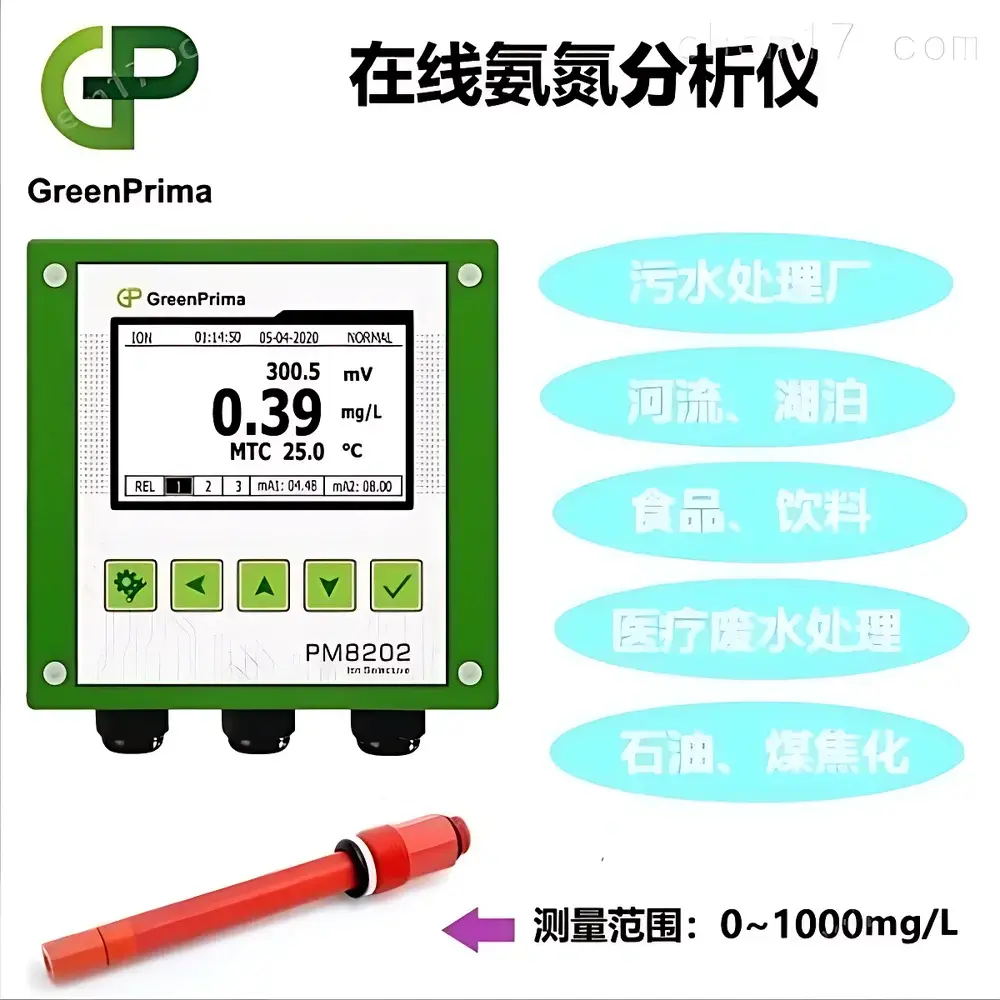
GreenPrima PM8202I Online Ammonia Nitrogen Analyzer
| Brand | GreenPrima |
|---|---|
| Origin | United Kingdom |
| Manufacturer Type | Original Equipment Manufacturer (OEM) |
| Product Category | Imported Instrument |
| Model | PM8202I |
| Instrument Type | Online Analyzer |
| Measurement Principle | Ion-Selective Electrode (ISE) Method |
| Measurement Range | 0.00–20,000 ppm NH₃–N |
| Accuracy | ±0.01 ppm / ±0.1 ppm / ±1 ppm (range-dependent) |
| Resolution | 0.01 / 0.1 / 1 ppm (selectable) |
| Temperature Compensation | –10 to +130 °C (manual or automatic |
| Operating Temperature | –10 to +70.0 °C |
| Storage Temperature | –20 to +70.0 °C |
| Display | Backlit large-dot-matrix LCD |
| Language Support | English & Chinese |
| Data Storage Capacity | 600,000 records |
| Power Supply | 90–260 VAC, 50/60 Hz or optional 24 VDC |
| Analog Outputs | Two isolated 4–20 mA outputs (max. loop resistance 500 Ω, accuracy ±0.1% FS) |
| Communication Interface | RS485 Modbus RTU |
| Cleaning Control Output | Adjustable interval (0.1–1000 h) and duration (1–1000 s) |
| Alarm Outputs | Two independent Hi/Lo relay outputs (5 A / 250 VAC / 30 VDC), with hysteresis setting |
| Enclosure Rating | IP65 |
| Mounting Options | Wall-mounted, pipe-mounted, panel-mounted |
| Dimensions (W×H×D) | 144 × 144 × 108 mm |
| Panel Cutout | 138 × 138 mm |
| Weight | 0.87 kg |
Overview
The GreenPrima PM8202I Online Ammonia Nitrogen Analyzer is an industrial-grade, continuous-monitoring instrument engineered for reliable quantification of ammonia nitrogen (NH₃–N) in aqueous matrices using the ion-selective electrode (ISE) principle. Unlike optical or colorimetric methods, the ISE-based approach delivers real-time, direct potentiometric measurement without reagent consumption, making it particularly suitable for long-term unattended operation in municipal water supply systems, wastewater treatment plants, and process-critical industrial cooling or boiler feedwater circuits. The analyzer integrates a dedicated BSens730 ammonia-selective electrode with a rugged, microprocessor-controlled transmitter unit—designed to maintain stable calibration drift characteristics under variable pH, temperature, and ionic strength conditions typical of raw surface water, activated sludge effluent, or high-conductivity industrial discharges.
Key Features
- IP65-rated sealed enclosure with corrosion-resistant housing, certified for indoor and outdoor wall, pipe, or panel mounting in humid or chemically aggressive environments.
- Large backlit dot-matrix LCD display showing real-time NH₃–N concentration, measured temperature, system status, relay activation states, and timestamped event logs—all simultaneously in English or Chinese interface mode.
- Dual isolated 4–20 mA analog outputs configurable independently for NH₃–N concentration and temperature signals, compliant with standard PLC/DCS input requirements and traceable to NIST-calibrated reference standards.
- RS485 Modbus RTU protocol support enables seamless integration into SCADA, MES, or centralized environmental monitoring platforms—facilitating remote configuration, data polling, and firmware updates without physical access.
- Programmable cleaning cycle control with adjustable frequency (0.1–1000 hours) and duration (1–1000 seconds) ensures consistent electrode surface integrity and minimizes fouling-related drift in suspended-solids-rich streams.
- Two programmable relay outputs with user-defined hysteresis provide fail-safe alarm signaling for exceedance of upper/lower NH₃–N thresholds—critical for regulatory compliance reporting under ISO 5667-3, EN 25667-2, or EPA Method 350.1.
- Password-protected parameter configuration prevents unauthorized modification of calibration constants, alarm setpoints, or communication settings—supporting audit-ready operational discipline per GLP and ISO/IEC 17025 requirements.
Sample Compatibility & Compliance
The PM8202I is validated for use across a broad spectrum of water types: potable water (with residual chlorine < 2 mg/L), secondary-treated wastewater (TSS < 100 mg/L), industrial process water (conductivity up to 5 mS/cm), and low-alkalinity groundwater. It meets electromagnetic compatibility (EMC) requirements per EN 61326-1 and safety standards per EN 61010-1. While not a certified reference method per ISO 14911 or ASTM D1426, its performance aligns with QA/QC benchmarks for routine surveillance when operated within specified pH (6.0–9.0), temperature (5–45 °C), and turbidity (< 50 NTU) limits. Calibration verification against certified NH₄Cl standard solutions (traceable to NPL or NIST SRMs) is recommended prior to commissioning and at intervals defined by site-specific risk assessment.
Software & Data Management
Data logging is performed internally at user-selectable intervals (1 sec to 24 h), storing up to 600,000 timestamped records—including NH₃–N value, temperature reading, electrode millivolt output, and diagnostic flags (e.g., “low slope”, “high impedance”, “calibration overdue”). Logged data can be exported via USB or retrieved remotely via Modbus register mapping. All configuration changes, calibration events, and alarm activations are time-stamped and retained in non-volatile memory—enabling full traceability required under FDA 21 CFR Part 11 for regulated utilities operating under GMP-aligned quality systems. No proprietary software installation is required; configuration is accessible through intuitive on-device navigation or standardized Modbus function codes (03h, 06h, 10h).
Applications
- Real-time ammonia monitoring at drinking water treatment plant intake and finished water discharge points to verify breakpoint chlorination efficacy.
- Effluent compliance tracking at municipal wastewater treatment facilities subject to national discharge permits (e.g., UK Environmental Permitting Regulations, US Clean Water Act NPDES).
- Process control of anaerobic digesters and nitrification/denitrification basins where NH₃–N concentration directly correlates with microbial activity and oxygen demand.
- Monitoring of recirculating cooling water systems to prevent microbiologically influenced corrosion (MIC) linked to elevated ammonia levels.
- Environmental impact assessments for aquaculture operations, where sub-ppm NH₃–N fluctuations affect fish gill function and dissolved oxygen saturation.
FAQ
What calibration standards are required for initial setup and routine maintenance?
Primary calibration requires two-point bracketing with traceable NH₄Cl standards—typically 1 ppm and 100 ppm NH₃–N—prepared in matrix-matched background electrolyte (e.g., 0.1 M NaNO₃). A third point (e.g., 1000 ppm) is recommended for extended-range validation.
Can the PM8202I measure total ammonia (NH₃ + NH₄⁺) or only free ammonia?
The BSens730 electrode responds selectively to unprotonated NH₃ gas diffusing across a hydrophobic membrane; therefore, reported values represent total ammonia nitrogen (NH₃–N) after pH- and temperature-dependent speciation correction embedded in firmware.
Is temperature compensation fully automatic, and which sensor types are supported?
Yes—automatic compensation uses either integrated NTC30K thermistor or external PT1000 probe; manual offset entry is available if reference thermometer data is available.
How often must the electrode be recalibrated under continuous operation?
Calibration frequency depends on sample matrix stability; typical intervals range from daily (in highly variable influent) to weekly (in treated effluent); drift exceeding ±5% of span triggers automatic alert.
Does the device support MODBUS TCP or only RTU over RS485?
Hardware supports RS485 physical layer only; MODBUS TCP requires an external protocol converter or gateway device.
Related Products







