
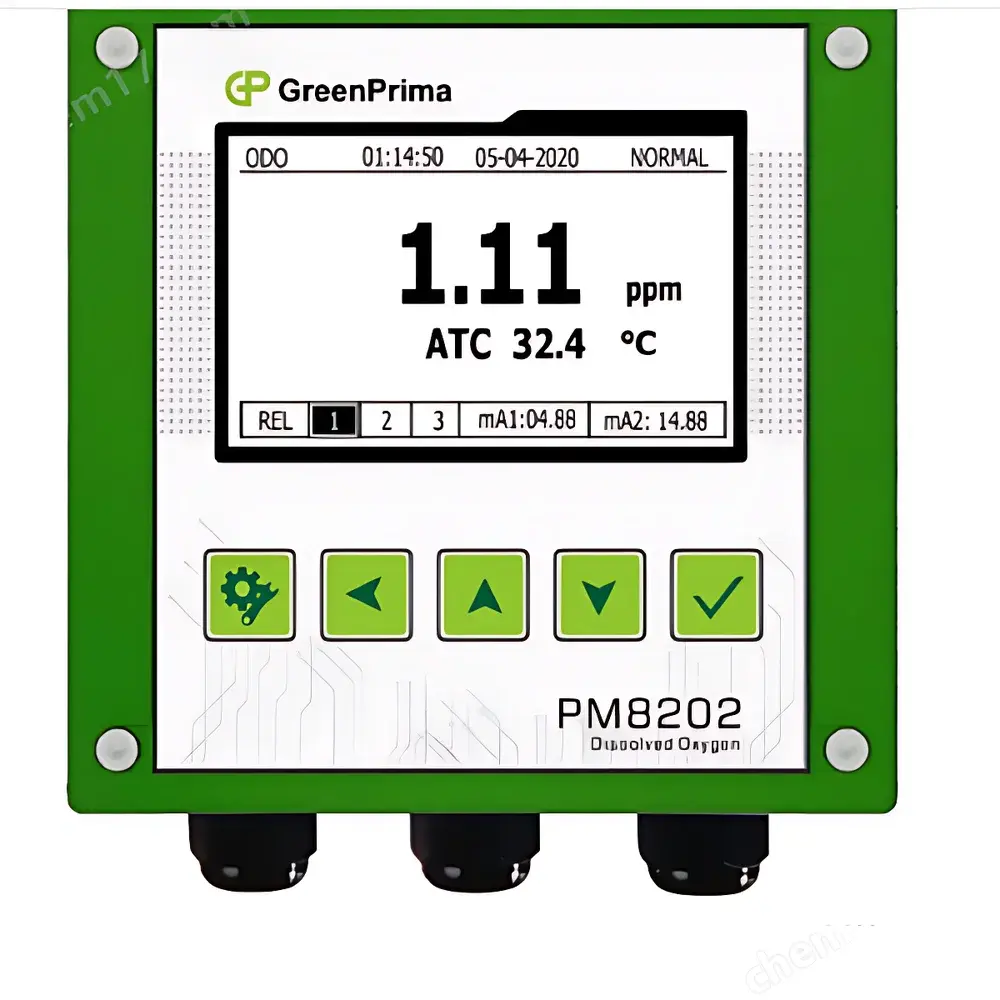
GreenPrima PM8202O Fluorescence-Based Dissolved Oxygen Analyzer
| Brand | GreenPrima |
|---|---|
| Origin | United Kingdom |
| Manufacturer Type | Original Equipment Manufacturer (OEM) |
| Product Category | Imported Instrument |
| Model | PM8202O |
| Instrument Type | Online Analyser |
| Measurement Principle | Fluorescence Quenching |
| Measurement Range | 0.00–20.00 ppm |
| Accuracy | ±0.01 ppm |
| Resolution | 0.01 ppm |
| Temperature Compensation Range | –10 to +130 °C (NTC30k or PT1000 selectable) |
| Operating Temperature | –10 to +70.0 °C |
| Storage Temperature | –20 to +70.0 °C |
| Display | Backlit Graphic LCD |
| Language Interface | English & Chinese |
| Data Storage Capacity | 600,000 records |
| Power Supply | 90–260 VAC, 50/60 Hz or 24 VDC (optional) |
| Output | Two isolated 4–20 mA outputs (max. loop resistance 500 Ω, accuracy 0.1 % FS), configurable for DO and/or temperature |
| Communication | RS485 Modbus RTU |
| Cleaning Function | Optional air-pulse self-cleaning (interval: 0.1–1000 h |
| duration | 1–1000 s) |
| Alarm Outputs | Two independent Hi/Lo relay outputs (5 A / 250 VAC / 30 VDC), with adjustable hysteresis |
| Enclosure Rating | IP65 |
| Mounting Options | Wall-mount, pipe-mount, panel-mount |
| Dimensions (W×H×D) | 144 × 144 × 108 mm |
| Panel Cutout | 138 × 138 mm |
| Weight | 0.87 kg |
| Electrode Material | 316L stainless steel |
| Sensor Type | Digital BSENS410 fluorescence probe |
Overview
The GreenPrima PM8202O is an online fluorescence-based dissolved oxygen (DO) analyzer engineered for continuous, high-stability measurement in demanding water quality monitoring applications. It operates on the principle of optical fluorescence quenching—where molecular oxygen modulates the lifetime and intensity of fluorescent emission from a ruthenium-based luminophore immobilized on the sensor surface. Unlike electrochemical Clark-type sensors, this method requires no oxygen consumption, zero electrolyte replenishment, and eliminates membrane fouling or drift associated with diffusion-limited amperometric detection. The integrated BSENS410 digital sensor communicates directly with the PM8202O controller via a robust industrial interface, delivering real-time DO concentration (0.00–20.00 ppm) with ±0.01 ppm accuracy and 0.01 ppm resolution. Its wide temperature compensation range (–10 to +130 °C) supports operation across diverse media—from chilled aquaculture recirculation systems to thermally elevated industrial effluent streams—while maintaining traceable calibration integrity without routine field recalibration.
Key Features
- Fluorescence quenching technology ensures non-consumptive, flow-independent measurement—ideal for low-circulation or stagnant environments such as sediment pore water interfaces or biofilm reactors.
- Digital BSENS410 sensor architecture provides intrinsic signal stability, eliminating analog drift and minimizing susceptibility to electromagnetic interference in electrically noisy plant environments.
- Zero-maintenance sensing element: no membranes, no electrolyte refills, no polarization time—reducing total cost of ownership and operational downtime.
- Configurable dual 4–20 mA outputs support simultaneous transmission of DO concentration and process temperature, each independently scaled and isolated to 500 Ω load capacity.
- RS485 Modbus RTU interface enables seamless integration into SCADA, DCS, or PLC-based automation systems compliant with IEC 61158 and ISA-88 standards.
- Optional air-pulse self-cleaning system mitigates biofouling on submerged sensor surfaces, programmable from 6 minutes to 41.7 days between cleaning cycles.
- IP65-rated enclosure with 316L stainless steel wetted parts ensures long-term reliability in humid, corrosive, or splash-prone installations—including outdoor wastewater lift stations and coastal monitoring buoys.
- Secure operational interface with password-protected configuration prevents unauthorized parameter modification—supporting audit readiness under ISO/IEC 17025 and EPA Method 360.1 documentation requirements.
Sample Compatibility & Compliance
The PM8202O is validated for use in raw sewage, activated sludge basins, surface water bodies (rivers, lakes, reservoirs), aquaculture ponds, cooling tower circuits, and potable water distribution networks. Its optical sensing mechanism remains unaffected by hydrogen sulfide, chlorine residuals, or heavy metal ions that commonly poison electrochemical electrodes. The instrument conforms to EN ISO 5814:2012 (Water quality — Determination of dissolved oxygen — Electrochemical probe method), though its fluorescence methodology exceeds the standard’s performance thresholds for long-term stability and low-flow applicability. All firmware and data logging functions comply with ALCOA+ principles for data integrity, supporting 21 CFR Part 11-compliant electronic record retention when deployed with validated IT infrastructure.
Software & Data Management
The onboard controller stores up to 600,000 timestamped measurement records—including DO value, temperature, sensor status flags, and cleaning event logs—with automatic rollover and time-synchronized UTC stamping. Data export is supported via USB mass storage mode (FAT32 formatted drive) or Modbus polling. Configuration parameters—including calibration history, alarm setpoints, cleaning schedules, and communication baud rates—are retained through power loss. Firmware updates are performed via signed binary files to prevent unauthorized code injection, aligning with IEC 62443-3-3 security level 1 requirements for industrial control devices.
Applications
- Real-time DO control in municipal wastewater treatment plants (aeration basin optimization, nitrification/denitrification monitoring)
- Continuous dissolved oxygen surveillance in fish hatcheries and marine aquaculture facilities per FAO Technical Paper No. 587 guidelines
- Regulatory compliance reporting for NPDES permits and EU Urban Wastewater Treatment Directive (91/271/EEC) discharge monitoring
- Process validation in pharmaceutical water-for-injection (WFI) loops where oxygen ingress must remain below 10 ppb (using calibrated low-range extension)
- Environmental research deployments involving long-term unattended monitoring of hypolimnetic oxygen depletion in stratified lakes
FAQ
Does the PM8202O require periodic calibration?
No routine calibration is required due to inherent photometric stability; however, a single-point air-saturation verification is recommended every 3–6 months per ISO 5814:2012 Annex B.
Can the sensor operate in seawater or brackish environments?
Yes—the 316L stainless steel housing and fluorinated sensor coating provide corrosion resistance up to 3.5% salinity; optional titanium sensor body available for extended marine service life.
Is temperature compensation automatic or manual?
Both modes are supported: automatic compensation using integrated NTC30k or PT1000 probes, or manual offset entry for fixed-temperature applications.
How is sensor fouling addressed during extended deployment?
The optional air-pulse cleaning system delivers controlled bursts of compressed air directly to the sensing window, programmable for frequency and duration; field trials show >12-month maintenance-free operation in eutrophic pond conditions.
What cybersecurity measures are implemented in the Modbus interface?
Modbus RTU operates over serial physical layer only—no TCP/IP stack is present—eliminating remote exploit vectors; all configuration changes require local physical access and authenticated login.
Related Products







