
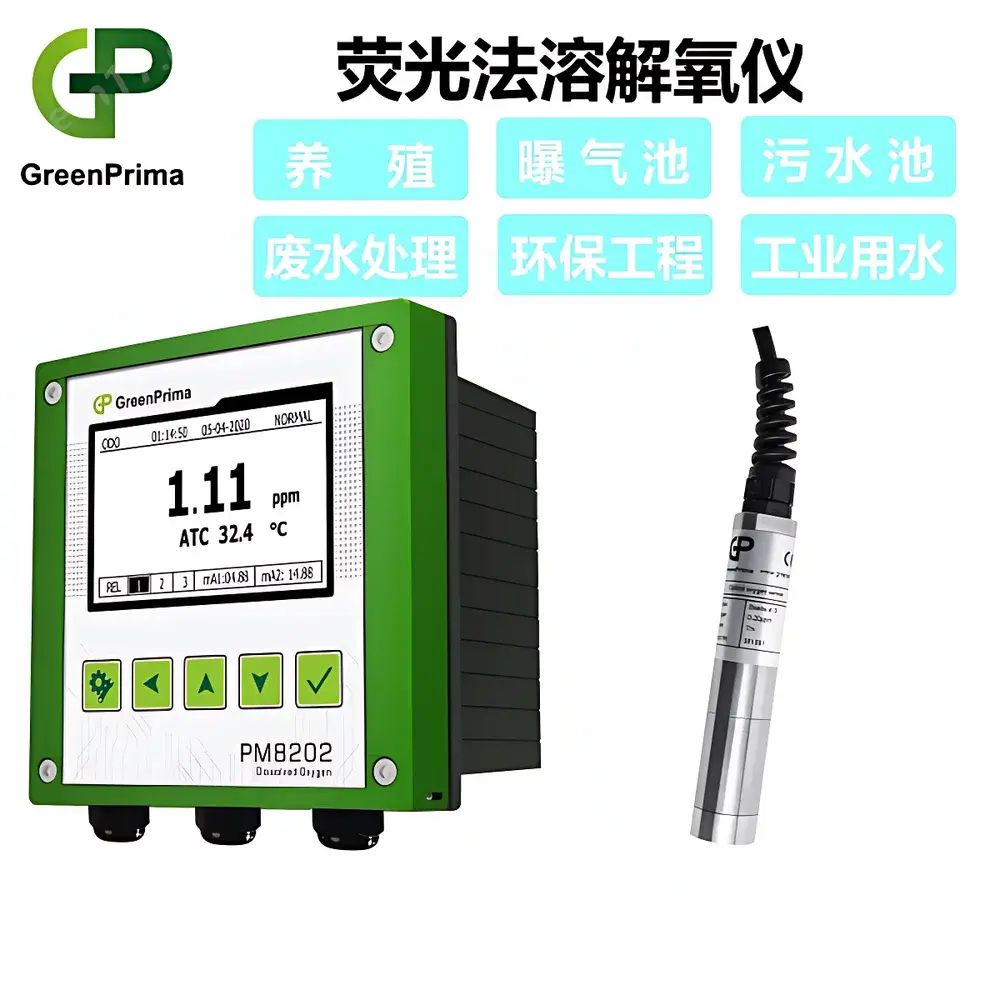
GreenPrima PM8202O Fluorescence-Based Online Dissolved Oxygen Analyzer
| Brand | GreenPrima |
|---|---|
| Origin | United Kingdom |
| Manufacturer Type | Original Equipment Manufacturer (OEM) |
| Import Status | Imported |
| Model | PM8202O |
| Instrument Type | Online Analyzer |
| Measurement Principle | Fluorescence Quenching |
| Measurement Range | 0.00–20.00 ppm |
| Accuracy | ±0.01 ppm |
| Resolution | 0.01 ppm |
| Temperature Compensation | -10–130 °C (NTC30K or PT1000 selectable) |
| Operating Temperature | -10–70.0 °C |
| Storage Temperature | -20–70.0 °C |
| Display | Backlit Graphic LCD |
| Language Support | English & Chinese |
| Data Storage | 600,000 records |
| Power Supply | 90–260 VAC, 50/60 Hz or 24 VDC optional |
| Output | Dual isolated 4–20 mA (max. 500 Ω, 0.1% FS), RS485 Modbus RTU |
| Cleaning Output | Adjustable interval (0.1–1000 h) and duration (1–1000 s) |
| Alarm Outputs | Two independent Hi/Lo relay outputs (5 A / 250 VAC / 30 VDC) |
| Enclosure Rating | IP65 |
| Mounting Options | Wall-mounted, pipe-mounted, panel-mounted |
| Dimensions (W×H×D) | 144 × 144 × 108 mm |
| Cutout Size | 138 × 138 mm |
| Weight | 0.87 kg |
| Sensor Material | 316L stainless steel |
| Optional Feature | Air-driven self-cleaning system |
Overview
The GreenPrima PM8202O is an online dissolved oxygen (DO) analyzer engineered for continuous, high-stability measurement in demanding water quality monitoring applications. It employs optical fluorescence quenching technology—where molecular oxygen modulates the intensity and lifetime of fluorescent emission from a proprietary ruthenium-based luminophore immobilized on the sensor surface. Unlike electrochemical Clark-type sensors, this method eliminates oxygen consumption during measurement, removes dependence on sample flow velocity, and avoids membrane fouling or electrolyte depletion. The absence of consumables ensures long-term signal stability and eliminates routine recalibration requirements under steady-state conditions. Designed for deployment in wastewater treatment plants, aquaculture systems, surface water monitoring stations, and industrial process streams, the PM8202O delivers trace-level DO quantification with sub-ppm resolution across a broad operational temperature range.
Key Features
- Fluorescence-based sensing principle—zero oxygen consumption, no membrane or electrolyte required
- Stable optical signal with negligible drift; calibration intervals extended significantly beyond conventional amperometric analyzers
- Dual isolated 4–20 mA analog outputs configurable for DO concentration and temperature, each with full-scale accuracy of ±0.1% FS
- RS485 interface supporting Modbus RTU protocol for seamless integration into SCADA, DCS, or PLC-based control systems
- Backlit high-contrast graphic LCD with intuitive bilingual (English/Chinese) menu navigation and real-time trend visualization
- Robust 316L stainless steel sensor body rated for immersion in aggressive aqueous environments including saline, chlorinated, and organic-laden effluents
- Configurable air-driven self-cleaning mechanism to mitigate biofilm accumulation on the sensing window—interval and duration fully programmable
- Comprehensive data logging: 600,000 timestamped records stored onboard with automatic overwrite policy
- Two programmable relay outputs with adjustable hysteresis for alarm signaling—rated at 5 A / 250 VAC / 30 VDC
- IP65-rated enclosure compatible with wall, pipe, or panel mounting; compact 144 × 144 × 108 mm form factor
Sample Compatibility & Compliance
The PM8202O is validated for use in municipal and industrial wastewater, potable water distribution networks, natural surface waters (rivers, lakes, reservoirs), recirculating aquaculture systems (RAS), and cooling tower circuits. Its non-invasive optical design ensures reliable performance even under low-flow or stagnant conditions where diffusion-limited electrochemical sensors exhibit response lag or drift. Temperature compensation utilizes either NTC30K or PT1000 input—supporting compliance with ISO 5814:2012 (Water quality — Determination of dissolved oxygen — Electrochemical probe method) and ASTM D888-22 (Standard Test Methods for Dissolved Oxygen in Water), though fluorescence-based operation extends applicability beyond the scope of these electrochemical standards. The analyzer’s firmware architecture supports audit-trail functionality and user-access controls (password protection), aligning with GLP and GMP documentation expectations for regulated environmental monitoring.
Software & Data Management
Data acquisition and configuration are managed via the front-panel interface or remotely through Modbus-enabled supervisory software. All logged measurements include embedded timestamps, temperature readings, and sensor status flags (e.g., cleaning activation, signal saturation, low battery warning). The internal memory retains up to 600,000 records with cyclic overwrite—sufficient for >12 months of 1-minute sampling. Export is supported via USB-to-serial adapter (optional) or direct Modbus polling. Firmware updates are performed over RS485 using signed binary packages to ensure integrity. Configuration parameters—including measurement units (ppm or mg/L), alarm thresholds, cleaning schedules, and communication baud rates—are protected by multi-level password access to prevent unauthorized modification.
Applications
- Real-time DO monitoring in activated sludge basins and anaerobic digesters to optimize aeration energy use and biological treatment efficiency
- Early detection of hypoxic events in riverine and estuarine ecosystems for regulatory reporting and ecological risk assessment
- Critical DO control in high-density fish farming operations where dissolved oxygen below 4 ppm may induce stress or mortality
- Verification of deaerator performance and boiler feedwater quality in power generation facilities
- Long-term unattended deployment in remote hydrological stations powered by solar-battery systems (24 VDC option)
- Compliance monitoring per EU Urban Wastewater Treatment Directive (91/271/EEC) and US EPA Clean Water Act discharge permits
FAQ
Does the PM8202O require periodic calibration?
Calibration is recommended at commissioning and after sensor replacement. Under stable environmental conditions and with routine air cleaning, recalibration intervals typically exceed 3–6 months. A one-point air-saturated water check is sufficient for verification.
Can the sensor operate in seawater or brackish water?
Yes—the 316L stainless steel housing and optical sensing element are corrosion-resistant and validated for continuous immersion in salinities up to 35 ppt.
Is temperature compensation automatic?
Yes—temperature is measured in real time via integrated NTC30K or external PT1000 probe, and compensation is applied continuously across the full -10 °C to 130 °C range.
What maintenance is required beyond the air cleaning cycle?
No routine maintenance is required. Optical windows should be inspected annually for persistent fouling; gentle wiping with isopropyl alcohol is sufficient if needed.
How is data security ensured during remote access?
Modbus communication does not transmit credentials over the bus. Local configuration requires physical access and password authentication; all parameter changes are logged with timestamp and operator ID.







