
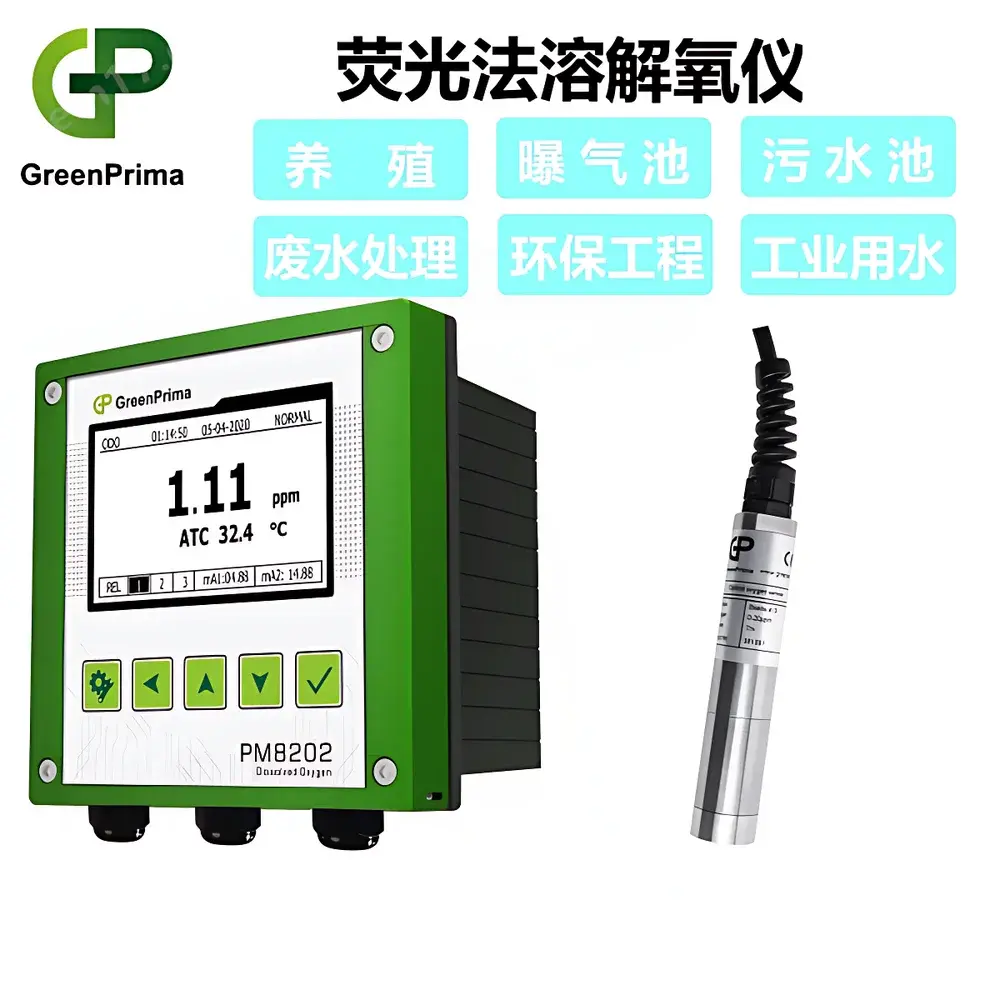
GreenPrima PM8202O Fluorescence-Based Online Dissolved Oxygen Analyzer
| Brand | GreenPrima |
|---|---|
| Origin | United Kingdom |
| Manufacturer Type | Original Equipment Manufacturer (OEM) |
| Product Category | Imported Instrument |
| Model | PM8202O |
| Instrument Type | Online Analyzer |
| Measurement Principle | Fluorescence Quenching |
| Measurement Range | 0.00–20.00 ppm |
| Accuracy | ±0.01 ppm |
| Resolution | 0.01 ppm |
| Temperature Compensation Range | –10 to +130 °C (NTC30K or PT1000 selectable) |
| Operating Temperature | –10 to +70.0 °C |
| Storage Temperature | –20 to +70.0 °C |
| Display | Backlit dot-matrix LCD |
| Language Support | English & Chinese |
| Data Storage Capacity | 600,000 records |
| Power Supply | 90–260 VAC, 50/60 Hz or optional 24 VDC |
| Output | Dual isolated 4–20 mA (max. loop resistance 500 Ω, accuracy 0.1% FS), configurable for DO and/or temperature |
| Communication | RS485 Modbus RTU |
| Cleaning Function | Optional air-pulse self-cleaning (interval: 0.1–1000 h |
| duration | 1–1000 s) |
| Alarm Outputs | Two independent Hi/Lo relay outputs (5 A / 250 VAC / 30 VDC), with hysteresis setting |
| Enclosure Rating | IP65 |
| Mounting Options | Wall-mount, pipe-mount, panel-mount |
| Dimensions (W×H×D) | 144 × 144 × 108 mm |
| Panel Cutout | 138 × 138 mm |
| Weight | 0.87 kg |
| Electrode Material | 316L stainless steel |
| Sensor Interface | Digital (integrated BSENS410 optical sensor) |
Overview
The GreenPrima PM8202O is an online dissolved oxygen (DO) analyzer engineered for continuous, high-stability measurement in demanding water quality monitoring applications. It operates on the principle of fluorescence quenching—where molecular oxygen modulates the lifetime and intensity of fluorescent emission from a ruthenium-based luminophore immobilized on the sensor surface. Unlike electrochemical Clark-type sensors, this optical method requires no oxygen consumption, eliminates dependence on sample flow velocity, and avoids membrane fouling or electrolyte depletion. The system comprises a microprocessor-controlled transmitter (PM8202O controller) and the BSENS410 optical probe, which features a solid-state fluorophore layer and integrated temperature compensation via NTC30K or PT1000 thermistor. Designed for long-term unattended operation, it delivers stable baseline performance across fluctuating environmental conditions—from low-flow aquaculture channels to turbulent wastewater effluent streams.
Key Features
- Fluorescence-based sensing technology ensures zero oxygen consumption and eliminates flow-rate dependency.
- Membrane-free and electrolyte-free architecture reduces maintenance to near-zero—no routine recalibration, membrane replacement, or electrolyte refills required.
- Digital sensor interface provides inherent immunity to electrical noise and signal drift; output stability exceeds 12 months between verification checks under typical field conditions.
- Integrated temperature compensation supports accurate DO reporting across –10 to +130 °C, with user-selectable sensor types (NTC30K or PT1000).
- Backlit dot-matrix LCD display with dual-language (English/Chinese) menu navigation and intuitive parameter configuration.
- Dual isolated 4–20 mA analog outputs, independently assignable to DO concentration and/or temperature values, compliant with IEC 61000-6-2/4 EMC standards.
- RS485 Modbus RTU communication enables seamless integration into SCADA, DCS, or PLC-based monitoring networks.
- Optional air-pulse self-cleaning mechanism mitigates biofilm accumulation on the optical window—configurable cleaning interval (0.1–1000 hours) and duration (1–1000 seconds).
- Robust 316L stainless steel sensor body rated IP65, suitable for wall, pipe, or panel mounting in industrial or outdoor enclosures.
- Configurable relay alarm outputs (two independent Hi/Lo channels) with adjustable hysteresis, supporting fail-safe process control in compliance with ISA-84 SIL1 considerations.
Sample Compatibility & Compliance
The PM8202O is validated for use in raw sewage, activated sludge basins, secondary clarifiers, surface water bodies (rivers, lakes, reservoirs), recirculating aquaculture systems (RAS), and drinking water distribution networks. Its optical design tolerates suspended solids up to 500 mg/L and resists interference from chloride, hydrogen sulfide, and redox-active compounds that commonly affect amperometric sensors. The instrument complies with ISO 5814:2012 (Water quality — Determination of dissolved oxygen — Electrochemical probe method), though its fluorescence methodology aligns with the performance benchmarks defined in ASTM D888-20 (Standard Test Methods for Dissolved Oxygen in Water). Data logging functionality meets GLP traceability requirements, with timestamped records stored internally (600,000 entries) and exportable via Modbus. While not FDA 21 CFR Part 11-certified out-of-the-box, audit trail metadata (user ID, parameter change time, value before/after) can be retrieved for internal validation protocols.
Software & Data Management
The embedded firmware supports local configuration via front-panel keypad and LCD, as well as remote parameter adjustment through Modbus register mapping. All calibration events (including factory default restoration), alarm triggers, cleaning cycles, and power-up sequences are logged with UTC timestamps. Data export is supported via Modbus polling (holding registers 40001–40120); no proprietary software is required. For centralized deployment, the device integrates natively with industry-standard platforms including Ignition SCADA, Siemens Desigo CC, and Honeywell Experion PKS. Firmware updates are performed via USB-C port using signed binary files—ensuring integrity verification prior to installation. Password protection (four-level access: view-only, setup, service, admin) enforces role-based operational security per IEC 62443-3-3 recommendations.
Applications
- Real-time DO monitoring in biological nutrient removal (BNR) processes within municipal wastewater treatment plants.
- Process optimization in aerobic digesters and membrane bioreactors (MBRs), where precise DO setpoint control directly impacts nitrification efficiency and energy consumption.
- Early-warning detection of hypoxic conditions in eutrophic surface waters, supporting regulatory reporting under EU WFD (Water Framework Directive) Article 8 obligations.
- Critical DO control in high-density fish farming systems, ensuring compliance with OIE (World Organisation for Animal Health) aquatic animal health standards.
- Performance verification of oxygen injection systems in industrial cooling towers and boiler feedwater circuits.
FAQ
Does the PM8202O require periodic calibration?
No—fluorescence quenching is inherently stable over time. Zero-point verification using nitrogen-purged water or air-saturated water is recommended every 6–12 months depending on application severity.
Can the sensor operate in low-flow or stagnant water?
Yes. Unlike electrochemical sensors, it imposes no minimum flow requirement and functions reliably in static or laminar-flow environments such as sediment pore water or deep reservoir profiling stations.
Is the BSENS410 probe compatible with seawater?
Yes. The 316L stainless steel housing and optical polymer coating resist chloride-induced corrosion; long-term deployments up to 35 ppt salinity have demonstrated <0.5% signal drift over 18 months.
How is temperature compensation handled?
The BSENS410 incorporates either an NTC30K or PT1000 thermistor co-located with the luminophore. Compensation is applied in real time using the Stern–Volmer equation modified for thermal dependence, referenced to ISO 5814 Annex C algorithms.
What cybersecurity provisions are implemented?
Modbus communication uses read-only register segmentation for sensitive parameters; firmware signing prevents unauthorized code execution; and password-protected configuration modes limit exposure to unintended changes during routine maintenance.







