
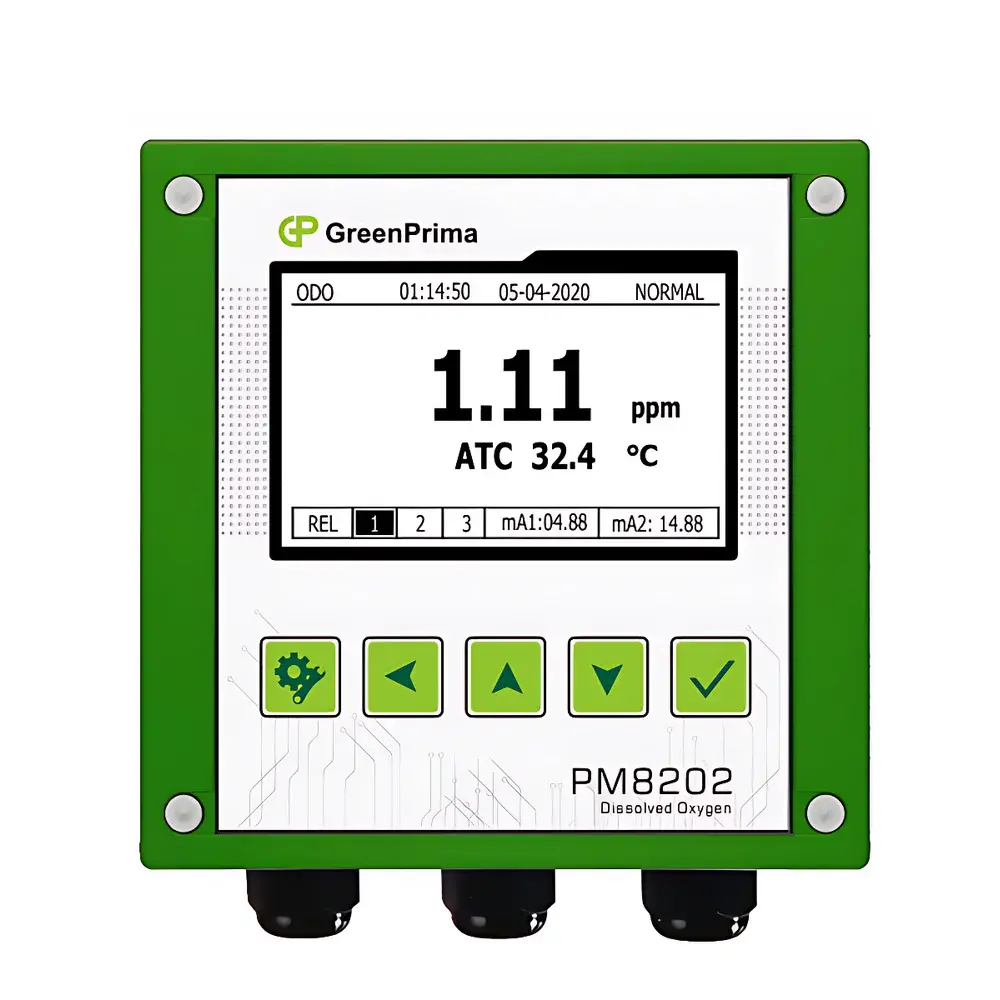
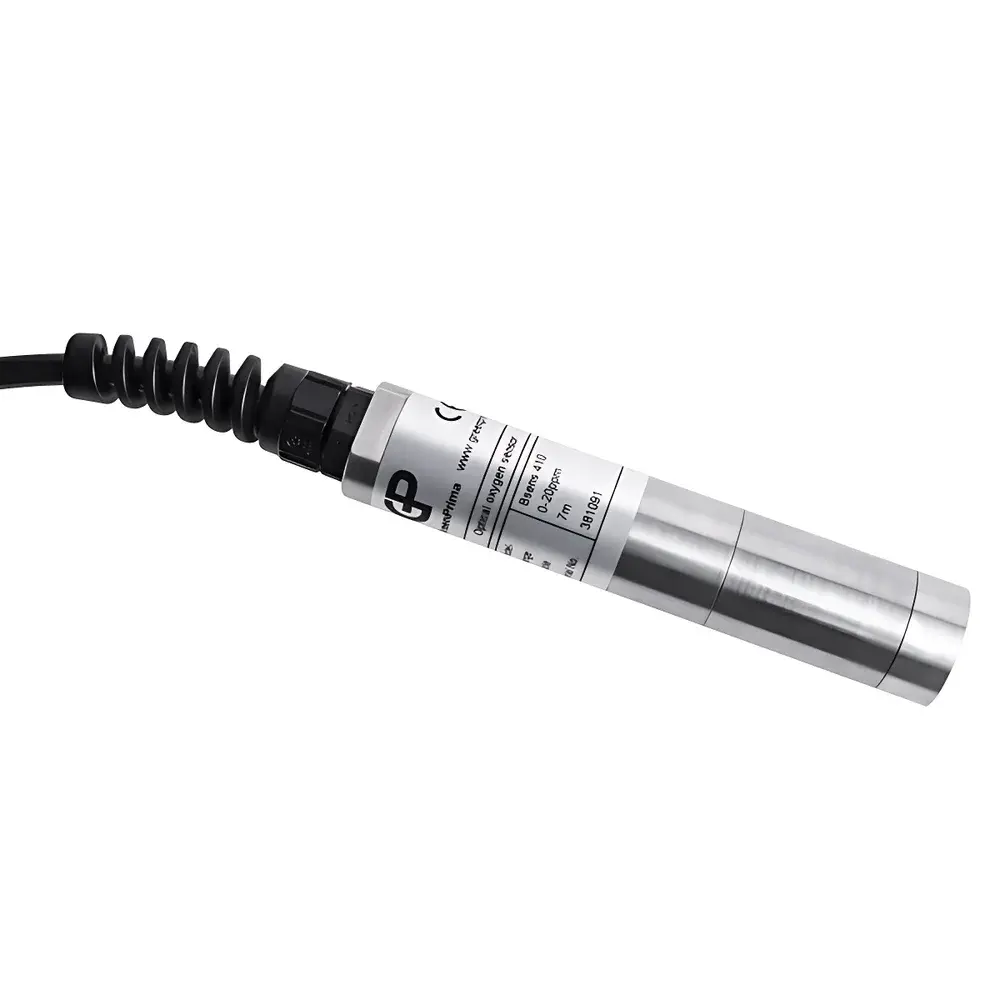
GreenPrima PM8202O Online Fluorescence-Based Dissolved Oxygen Analyzer
| Brand | GreenPrima |
|---|---|
| Origin | United Kingdom |
| Manufacturer Type | Original Equipment Manufacturer (OEM) |
| Product Category | Imported Instrument |
| Model | PM8202O |
| Instrument Type | Online |
| Measurement Principle | Fluorescence Quenching |
| Measurement Range | 0–20 ppm |
| Accuracy | ±0.1 ppm or ±1% of reading |
| Repeatability | ±0.01 ppm |
| Detection Limit | 0 ± 1 ppm |
| Sensor Model | BSens 410 |
| Sensor Body Material | 316L Stainless Steel |
| Sensor Cable Length | 7 m (standard) |
| Max. Operating Pressure | 5 bar |
| Response Time (t₉₀) | <60 s |
| Temperature Compensation | Built-in NTC (22 kΩ) |
| Resolution | 0.01 ppm |
| IP Rating (Controller) | IP65 |
| IP Rating (Sensor) | IP68 |
| Display | Dot-matrix LCD with bilingual (English/Chinese) menu |
| Power Supply | 90–260 VAC, 50/60 Hz |
| Analog Outputs | Two isolated 4–20 mA outputs (DO and temperature), load ≤600 Ω |
| Digital Output | RS485 Modbus RTU |
| Alarm Outputs | Two independent relay outputs (5 A / 250 VAC, configurable Hi/Lo with hysteresis) |
| Operating Temperature (Controller) | −10 to +60 °C |
| Operating Temperature (Sensor) | 0 to +60 °C |
| Storage Temperature | −10 to +60 °C |
| Dimensions (Controller) | 144 × 144 × 108 mm |
| Weight (Controller) | 0.87 kg |
| Sensor Dimensions | Ø25 × 146 mm |
| Sensor Weight | 450 g |
| Maintenance Interval | Fluorescent cap replacement every 12–24 months |
Overview
The GreenPrima PM8202O Online Fluorescence-Based Dissolved Oxygen Analyzer is an industrial-grade, maintenance-optimized system engineered for continuous, high-fidelity dissolved oxygen (DO) monitoring in demanding aqueous environments. It operates on the well-established principle of fluorescence quenching: a blue LED excites an oxygen-sensitive fluorophore immobilized on the sensor’s optical surface; molecular oxygen collides with the excited-state fluorophore, non-radiatively deactivating it and shortening both the intensity decay lifetime and phase shift of emitted red fluorescence. The PM8202O precisely measures the phase difference between the modulated excitation signal and the resulting fluorescent emission—quantitatively correlating this parameter to DO concentration via factory calibration curves traceable to NIST-standardized reference gases and saturated aqueous standards. Unlike electrochemical Clark-type sensors, this optical method consumes no oxygen during measurement, imposes zero flow dependency, and eliminates membrane fouling, electrolyte depletion, and polarization drift—making it uniquely suited for low-flow, high-fouling, or intermittently circulated applications such as wastewater influent channels, aquaculture recirculation tanks, and reservoir stratification profiling.
Key Features
- Optical sensing architecture: No membrane, no electrolyte, no cathode/anode degradation—eliminates routine consumables and associated calibration drift.
- Zero-oxygen-consumption measurement: Enables accurate DO quantification in stagnant or laminar-flow conditions where conventional amperometric sensors fail.
- Phase-shift fluorescence detection: Provides inherent temperature compensation and immunity to ambient light interference, turbidity, and coloration.
- Dual-channel analog output: Simultaneous 4–20 mA signals for DO concentration and integrated NTC temperature (22 kΩ), each electrically isolated and configurable for process integration.
- RS485 Modbus RTU interface: Enables seamless integration into SCADA, DCS, or PLC-based control systems for centralized data acquisition and alarm management.
- Robust hardware design: Controller housed in IP65-rated enclosure; BSens 410 sensor rated IP68 and constructed from 316L stainless steel for long-term immersion stability in aggressive municipal and industrial effluents.
- ARM-based embedded controller: Ensures deterministic real-time processing, firmware upgradability, and operational stability under variable power conditions (90–260 VAC, 50/60 Hz).
Sample Compatibility & Compliance
The PM8202O system is validated for continuous operation in raw sewage, activated sludge basins, tertiary filtration outflows, surface water bodies (rivers, lakes, estuaries), and closed-loop aquaculture systems—including saline and brackish media up to 35 ppt conductivity. Its optical design inherently rejects interference from chloride ions, hydrogen sulfide, and redox-active species that compromise electrochemical DO sensors. While not certified to a single harmonized standard, the analyzer’s measurement methodology aligns with the technical requirements of ISO 5814:2012 (Water quality — Determination of dissolved oxygen — Electrochemical probe method) for optical alternatives, and its digital architecture supports audit-ready data logging compliant with GLP and GMP principles. The Modbus protocol implementation conforms to Modbus Organization specifications v1.1b, and relay outputs meet IEC 61000-4 electromagnetic compatibility standards.
Software & Data Management
The PM8202O does not rely on proprietary PC software for core functionality; all configuration, calibration verification, and alarm threshold setting are performed locally via the front-panel dot-matrix display and tactile keypad. However, optional Modbus-enabled SCADA integration allows remote readout of real-time DO (ppm and % saturation), temperature (°C), sensor status flags (e.g., cap aging warning), and relay states. Internal event logging records timestamped alarm activations and configuration changes—accessible via Modbus function code 0x03 (Read Holding Registers). For facilities subject to FDA 21 CFR Part 11 requirements, external historian systems may capture and archive these registers with full user authentication, electronic signature, and audit trail capabilities—provided the host SCADA platform implements appropriate validation protocols.
Applications
- Municipal and industrial wastewater treatment: Real-time monitoring of DO in aerobic digesters, oxidation ditches, and membrane bioreactors (MBRs) to optimize blower energy use and nitrification efficiency.
- Surface water quality surveillance: Long-term deployment in monitoring buoys or fixed stations for eutrophication assessment and regulatory reporting under EU WFD or US Clean Water Act frameworks.
- Recirculating aquaculture systems (RAS): Closed-loop DO control in fish hatcheries and shrimp farms where oxygen demand fluctuates rapidly and flow rates are deliberately minimized to conserve energy.
- Drinking water distribution networks: Detection of anaerobic zones in storage reservoirs or dead-end mains where low DO may indicate biofilm development or stagnation.
- Environmental research: Field-deployable measurements in wetlands, groundwater discharge zones, and hypolimnetic layers where minimal sensor intrusion and zero oxygen drawdown are critical.
FAQ
Does the PM8202O require zero or span calibration during routine operation?
No. The fluorescence quenching principle provides intrinsic stability. Factory calibration is retained over time; only periodic verification against a certified air-saturated or water-saturated standard is recommended annually—or after fluorescent cap replacement.
What is the expected service life of the BSens 410 fluorescent cap?
Under typical municipal wastewater conditions, the cap maintains metrological integrity for 12–24 months. Lifespan decreases under UV exposure, high chlorine residuals (>2 mg/L), or abrasive particulate loading—monitoring the built-in cap age counter (accessible via Modbus register) is advised.
Can the sensor operate under pressure or submersed at depth?
Yes. The BSens 410 is rated for continuous immersion up to 5 bar (≈50 m H₂O static head); however, dynamic pressure fluctuations exceeding ±0.5 bar/s must be avoided to prevent mechanical stress on the optical window seal.
Is temperature compensation automatic and traceable?
Yes. An integrated NTC thermistor (22 kΩ at 25 °C) provides real-time temperature measurement with ±0.2 °C accuracy across 0–60 °C. Compensation algorithms follow the temperature-dependent solubility curve per APHA Standard Methods 4500-O G.
How is sensor cleaning managed in high-fouling applications?
The optical surface is chemically inert and smooth; manual wiping with lint-free cloth is sufficient for most biofilms. For persistent scaling, brief immersion in 5% citric acid (pH ~2) for ≤5 minutes restores performance—no ultrasonic cleaning or abrasive agents required.
Related Products







