
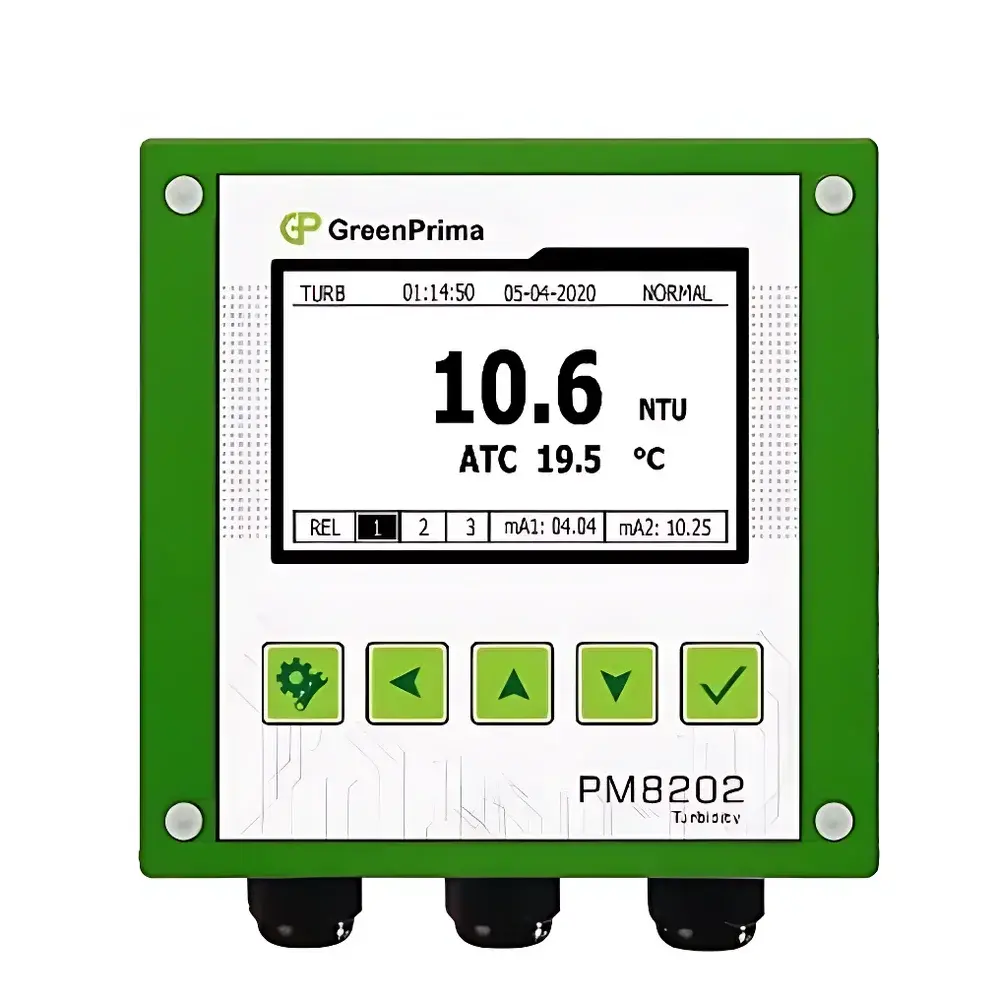
GreenPrima PM8202T Online Turbidimeter
| Brand | GreenPrima |
|---|---|
| Origin | United Kingdom |
| Manufacturer Type | Manufacturer |
| Origin Category | Imported |
| Model | PM8202T |
| Product Type | Online |
| Operating Temperature | -10 to 70.0 °C |
| Storage Temperature | -20 to 70.0 °C |
| Temperature Compensation Range | -10 to 130 °C (NTC30K/PT1000) |
| Display | Backlit Graphic LCD |
| Language Support | English & Chinese |
| Data Storage Capacity | 600,000 records |
| Power Supply | 90–260 VAC, 50/60 Hz or 24 VDC optional |
| Analog Outputs | Two isolated 4–20 mA outputs (max. loop resistance 500 Ω, accuracy ±0.1% FS) |
| Communication | RS485 Modbus RTU |
| Cleaning Output | Adjustable interval (0.1–1000 h), duration (1–1000 s) |
| Alarm Outputs | Two independent Hi/Lo relay outputs (5 A / 250 VAC / 30 VDC) |
| Mounting Options | Wall-mounted, pipe-mounted, panel-mounted |
| Enclosure Rating | IP65 |
| Dimensions (H×W×D) | 144 × 144 × 108 mm |
| Panel Cutout | 138 × 138 mm |
| Weight | 0.87 kg |
Overview
The GreenPrima PM8202T Online Turbidimeter is an industrial-grade optical analyzer engineered for continuous, real-time measurement of turbidity and suspended solids (SS) in aqueous process streams. It operates on the principle of near-infrared (NIR) 90° light scattering—compliant with EN ISO 7027—ensuring high specificity to particulate matter while minimizing interference from color, dissolved organics, or ambient light fluctuations. Its dual-beam reference light architecture actively compensates for LED intensity drift, optical path contamination, and spectral shifts caused by lens fouling or sample chromaticity—enabling long-term stability without frequent recalibration. Designed for permanent installation in demanding water treatment, municipal wastewater, industrial effluent, and surface water monitoring applications, the system integrates a rugged controller with either the Bsens580 or Bsens580L submersible sensor, supporting both inline and immersion configurations.
Key Features
- NIR 90° scattering detection with built-in reference photodiode for dynamic compensation of light source aging, temperature-induced wavelength shift, and optical window soiling
- Multi-range sensor options (e.g., 0–10 NTU, 0–100 NTU, 0–1000 NTU) enabling application-specific sensitivity and resolution
- IP65-rated sealed enclosure with corrosion-resistant housing—rated for operation across -10 °C to +70 °C ambient conditions and storage down to -20 °C
- Backlit high-contrast graphic LCD displaying turbidity, temperature, timestamp, relay status, and system diagnostics simultaneously
- Dual isolated 4–20 mA analog outputs configurable for turbidity and/or temperature signals; RS485 Modbus RTU interface for SCADA/HMI integration
- Programmable cleaning output supporting pneumatic, ultrasonic, or mechanical wiper systems with fully adjustable cycle timing (0.1–1000 h) and duration (1–1000 s)
- Two independent relay alarm outputs with user-defined setpoints, hysteresis control, and fail-safe logic—certified for 5 A switching at 250 VAC or 30 VDC
- Password-protected configuration menu with audit trail logging to prevent unauthorized parameter changes—supports GLP-compliant operational integrity
Sample Compatibility & Compliance
The PM8202T is validated for use with natural waters (rivers, lakes, reservoirs), secondary-treated wastewater, cooling tower make-up, boiler feedwater, and low-viscosity industrial process streams. It excludes samples containing highly reflective particles (e.g., metallic colloids), air-saturated fluids prone to microbubble formation, or viscous suspensions exceeding 50 cP. All optical components meet EN ISO 7027:2016 requirements for formazin-based calibration traceability. The instrument’s electrical design conforms to IEC 61000-6-2 (immunity) and IEC 61000-6-4 (emissions); its analog outputs comply with NAMUR NE43 signaling standards. For regulated environments, data logging adheres to ALCOA+ principles—retaining 600,000 timestamped records with millisecond resolution, including operator ID, parameter change history, and alarm event logs.
Software & Data Management
No proprietary PC software is required for basic operation; all configuration is performed via the onboard menu system with intuitive navigation. For centralized deployment, the Modbus RTU protocol enables seamless integration into existing DCS, PLC, or cloud-based IIoT platforms (e.g., Ignition, Siemens Desigo, or Azure IoT Hub). Logged data can be exported via Modbus register polling or triggered manual dump over RS485. Firmware updates are performed via secure USB interface (optional adapter), with version rollback capability and SHA-256 signature verification. Audit trails include user login attempts, configuration modifications, calibration events, and alarm acknowledgements—supporting FDA 21 CFR Part 11 readiness when deployed with external identity management and electronic signature workflows.
Applications
- Real-time turbidity monitoring at drinking water filtration plant effluent points to ensure regulatory compliance with WHO and EU Directive 98/83/EC limits
- Activated sludge process control in municipal wastewater treatment—correlating turbidity trends with MLSS concentration and clarifier performance
- Early-warning detection of sediment resuspension or algal bloom onset in raw water intakes for reservoir management
- Quality assurance of industrial rinse water in semiconductor, pharmaceutical, and food & beverage production lines
- Continuous verification of membrane integrity in ultrafiltration and reverse osmosis systems
- Regulatory reporting for EPA NPDES permits requiring hourly turbidity data submission with certified timestamps
FAQ
Does the PM8202T require periodic calibration with formazin standards?
Yes—initial factory calibration is traceable to NIST-certified formazin standards. Field verification is recommended every 3–6 months depending on fouling risk; calibration intervals may be extended under GLP protocols with documented stability studies.
Can the sensor operate submerged in pressurized pipelines?
The Bsens580L variant supports static pressure up to 10 bar (145 psi) and is rated for direct insertion into pressurized flow cells with appropriate flange adapters; the Bsens580 is optimized for open-channel or tank immersion.
Is temperature compensation automatic or manual?
Both modes are supported: automatic compensation using integrated NTC30K or external PT1000 probes, or manual offset entry for fixed-temperature applications where probe integration is impractical.
How is data integrity ensured during power interruptions?
Non-volatile flash memory retains all configuration, calibration coefficients, and logged data across power cycles; the real-time clock maintains accurate timestamps with ±2 s/month drift tolerance.
What maintenance is required beyond scheduled cleaning?
Annual inspection of O-rings, optical window clarity, and cable gland integrity is advised; no routine lamp replacement is needed—the NIR LED has a rated lifetime exceeding 50,000 hours at nominal drive current.



