
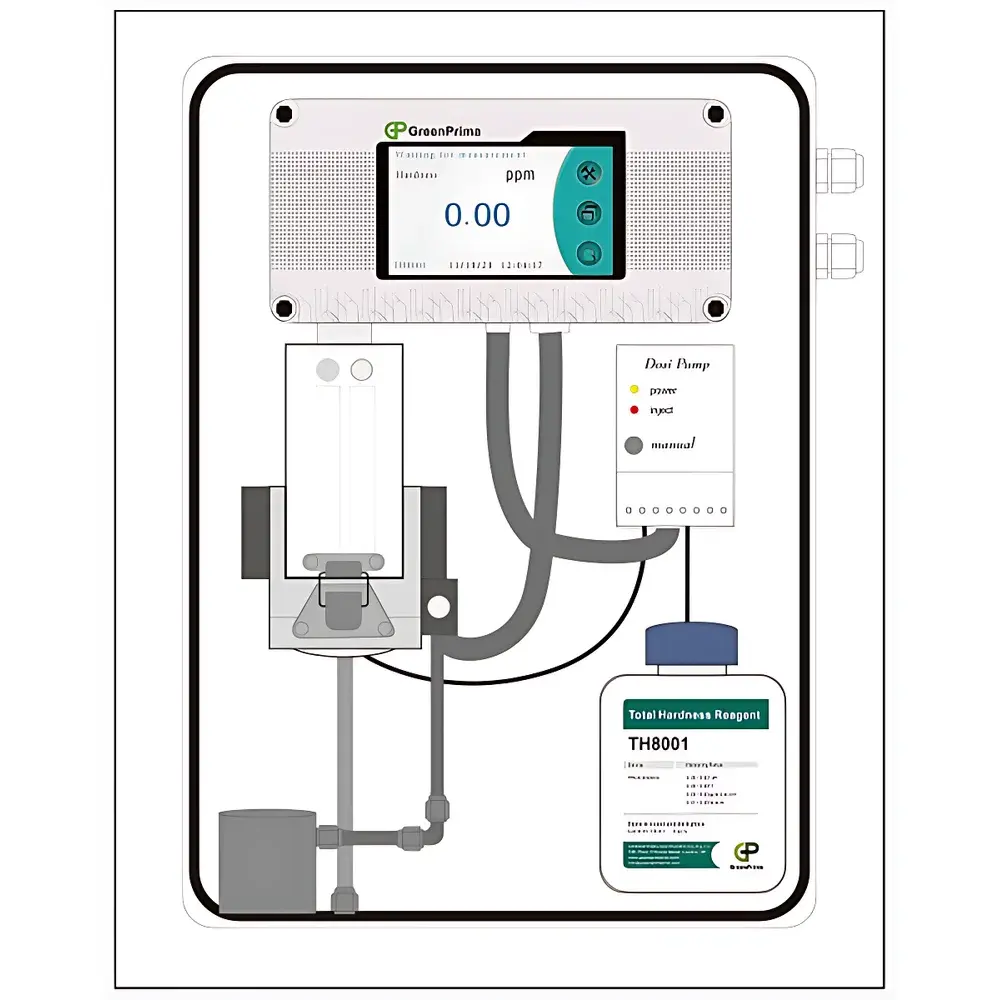
GreenPrima PROCON 8000 Online Hardness Analyzer
| Brand | GreenPrima |
|---|---|
| Origin | Germany |
| Manufacturer Type | Manufacturer |
| Origin Category | Imported |
| Model | PROCON 8000 |
| Measurement Principle | Titrimetric Colorimetry |
| Range | 0.89–448 mg/L as CaCO₃ |
| Accuracy | ±2% of selected reagent upper limit |
| Repeatability | ±1% of selected reagent upper limit |
| Measurement Time | ~3 min (hardness-dependent) |
| Display | Graphical backlit LCD |
| Power Supply | 230 V or 24 V ±10%, 50–60 Hz |
| Power Consumption | 25 VA (operational), 3.5 VA (standby) |
| Dimensions | 300 × 400 × 180 mm (W×H×D) |
| Enclosure Rating | IP65 |
| Installation | Wall-mounted |
| Output Interfaces | 2× programmable digital inputs, 4–20 mA analog output, RS485, CAN bus |
| Data Storage | SD card (fault logging, event history) |
| Sample Requirements | pH 4–10 |
| Sample Temp. | 5–40 °C |
| Ambient Temp. | 10–50 °C |
| Operating Pressure | 0.3–8 bar (recommended: 1–5 bar) |
| Flush Duration | 0–99 s (configurable) |
| Cycle Mode | Time-based (0–255 min), external trigger, or flow-synchronized |
| Units | °dH, °f, mg/L as CaCO₃, mmol/L |
Overview
The GreenPrima PROCON 8000 Online Hardness Analyzer is an industrial-grade, fully automated titrimetric colorimetric system engineered for continuous, real-time monitoring of total hardness—expressed as calcium carbonate (CaCO₃)—in process water streams. Unlike optical absorption or ion-selective electrode methods, the PROCON 8000 implements a standardized endpoint titration using calibrated reagents and photometric detection (absorbance measurement at defined wavelengths), ensuring traceable accuracy aligned with ISO 6059 and ASTM D1126 practices. Its design targets critical applications where hardness control directly impacts equipment integrity and operational safety: boiler feedwater conditioning, reverse osmosis (RO) pretreatment verification, groundwater–surface water blending validation, and centralized softening plant effluent compliance. The analyzer operates autonomously with minimal operator intervention, delivering stable performance over extended unattended intervals—particularly suited for environments such as thermal power station boiler rooms, municipal water treatment facilities, and pharmaceutical purified water loops requiring GLP-aligned data integrity.
Key Features
- Titrimetric colorimetric measurement with dual-wavelength photometric endpoint detection for high specificity and reduced interference from turbidity or colored organics
- Automated calibration verification and system diagnostics—including reagent depletion alerts, cuvette fouling detection, and pump stroke validation
- Compact, wall-mountable IP65-rated enclosure optimized for harsh industrial settings (e.g., boiler houses, pump stations)
- Precision peristaltic dosing pumps with pulse-controlled reagent delivery to ensure stoichiometric accuracy across the full 0.89–448 mg/L range
- Low-maintenance architecture: no consumable electrodes, no optical path cleaning mechanisms, and reagent consumption averaging <1.2 mL per analysis cycle
- Bilingual (English/Chinese) graphical interface with intuitive menu navigation—designed for operation by technical staff without advanced English proficiency
- Configurable digital inputs for integration with external flow meters or PLC-triggered sampling events
- Onboard SD card logging with timestamped fault records, calibration logs, and maintenance history—supporting audit-ready documentation
Sample Compatibility & Compliance
The PROCON 8000 is validated for use with potable water, softened water, RO permeate, and low-iron groundwater. It requires sample pH between 4.0 and 10.0, with strict upper limits on interfering metal ions: iron < 3 ppm, copper < 0.2 ppm, aluminum < 0.1 ppm, and manganese < 0.2 ppm. These thresholds align with standard pretreatment specifications for steam generation systems per VGB-R 450 and EN 12952-12. The analyzer’s mechanical and electrical design complies with IEC 61000-6-2 (immunity) and IEC 61000-6-4 (emission), while its analog outputs meet NAMUR NE43 standards. For regulated environments, the device supports configurable audit trails and user-access levels compatible with FDA 21 CFR Part 11 requirements when integrated with compliant SCADA or LIMS platforms.
Software & Data Management
Data handling is managed via embedded firmware supporting three independent output modalities: (1) isolated 4–20 mA current loop for direct connection to DCS or PLC analog inputs; (2) Modbus RTU over RS485 for bidirectional parameter configuration and real-time value polling; and (3) CAN bus interface for distributed sensor network architectures common in modern water utilities. All measurement events, alarms (e.g., low reagent, clogged line, out-of-range pH), and maintenance actions are time-stamped and stored on removable SD media with cyclic overwrite protection. Optional remote access modules enable secure HTTPS-based configuration and historical data retrieval without local HMI interaction—facilitating predictive maintenance planning and regulatory reporting workflows.
Applications
- Continuous hardness verification upstream of high-pressure boilers to prevent scale formation per ASME B31.1 guidelines
- Performance monitoring of ion exchange softeners and nanofiltration units in municipal and industrial water treatment plants
- Blending control at groundwater–surface water intake points to maintain consistent hardness profiles for distribution networks
- Quality gate monitoring for purified water (PW) and water-for-injection (WFI) systems in pharmaceutical manufacturing (aligned with USP and EU Annex 1)
- Early-warning detection of resin exhaustion or membrane breakthrough in closed-loop cooling water circuits
FAQ
What measurement principle does the PROCON 8000 employ?
It uses automated titrimetric colorimetry based on EDTA complexation, with photometric endpoint detection at 580 nm.
Is manual calibration required during routine operation?
No—automatic zero and span checks occur before each analysis cycle; full calibration is only needed after reagent replacement or service intervention.
Can the analyzer operate under variable flow conditions?
Yes—it supports flow-synchronized measurement cycles and includes pressure-compensated sampling to accommodate fluctuations between 0.3–8 bar.
Does it support integration into existing SCADA systems?
Yes—via Modbus RTU (RS485), CAN bus, or 4–20 mA analog output with NAMUR-compliant signal scaling.
What is the typical reagent shelf life and storage requirement?
Reagents are supplied in sealed, light-protected cartridges with 12-month stability at 5–30 °C; no refrigeration is required.







