
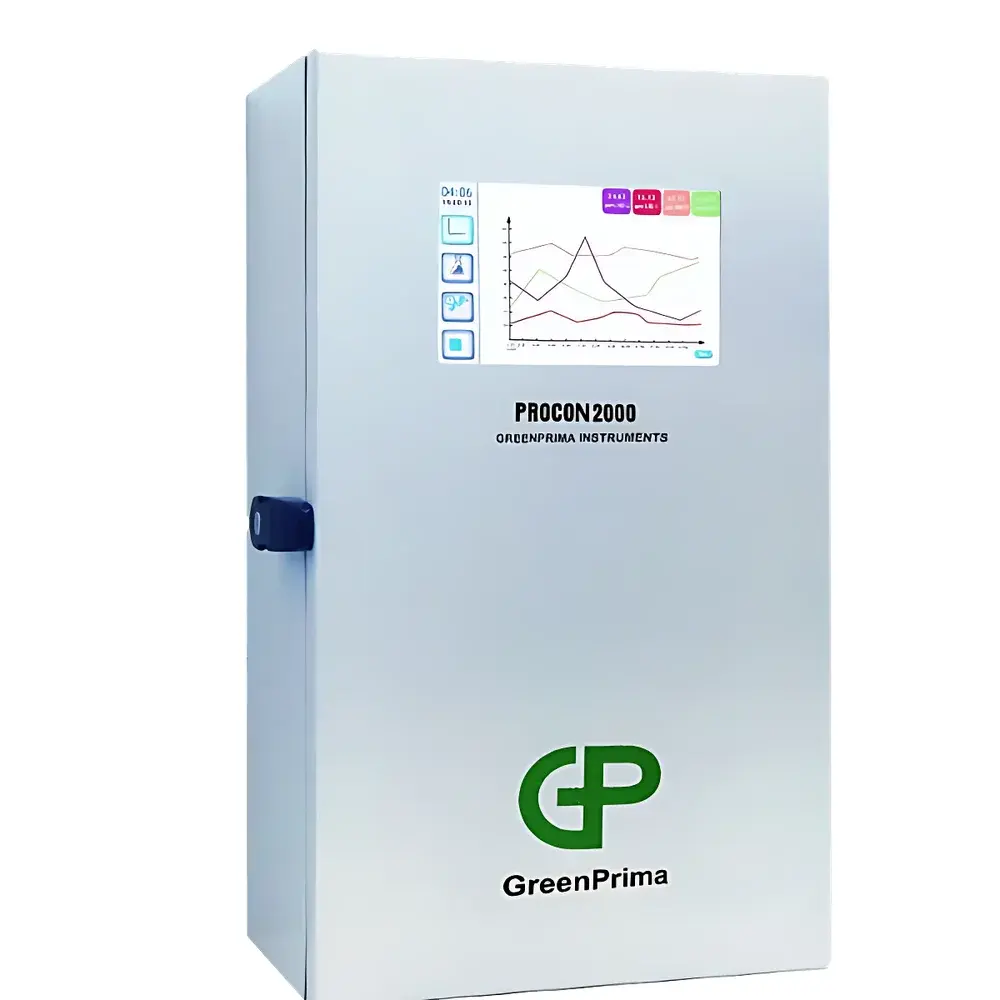
GreenPrima PROCON2000 Pulp & Paper Industry Colorimeter for Water Quality Analysis
| Brand | GreenPrima |
|---|---|
| Origin | United Kingdom |
| Manufacturer Type | Manufacturer |
| Origin Category | Imported |
| Model | PROCON2000 |
| Price | Upon Request |
| Measurement Principle | UV-VIS Absorption Spectrophotometry |
| Compliance | ASTM D1209, ISO 6271, USP <631>, EN ISO 7887 |
| Sensor Range | 0–100 Pt-Co and 0–2000 Pt-Co (custom ranges available) |
| Accuracy | < ±5 % F.S. |
| Repeatability | < ±5 % F.S. |
| Response Time | < 5 s |
| Sample Flow Rate | 0–2 L/min |
| Max Operating Pressure | < 2 bar |
| Operating Temperature | 0–50 °C |
| Sample Volume per Measurement | < 100 mL |
| Wetted Materials | Quartz, Polypropylene, FPM Fluoroelastomer, SS 316L, Borosilicate Glass |
| Display | 8.5" TFT Color Touchscreen (800 × 480 px, LED backlight) |
| Data Storage | 8 GB SD card |
| Communication | 4–20 mA isolated analog output (≤500 Ω load, <0.5% accuracy), RS485 Modbus RTU (Slave/Master), programmable relay outputs (5 A NO / 3 A NC @ 277 VAC) |
| Power Supply | 100–240 VAC or 24 VDC, 50–60 Hz |
| Power Consumption | < 20 W |
| Enclosure | Wall-mounted stainless steel (EN 1.4435 / AISI 316L), IP65 rated |
| Dimensions (H×W×D) | 430 × 340 × 200 mm |
| Weight | < 14 kg |
| Hazardous Area Certification | ATEX Zone 1/2 (optional) |
Overview
The GreenPrima PROCON2000 is a dedicated UV-VIS absorption-based colorimeter engineered for continuous, reagent-free colorimetric analysis of aqueous process streams in pulp and paper manufacturing, textile effluent treatment, and municipal water infrastructure. Unlike conventional visual comparison or filter photometer methods, the PROCON2000 employs dual-beam spectrophotometric detection across the 320–700 nm spectral range to quantify color intensity in accordance with internationally standardized Pt-Co (Platinum-Cobalt) units—also known as Hazen units. Its optical architecture integrates a stabilized xenon flash lamp and high-stability quartz flow cell, enabling precise absorbance measurement at 455 nm (the primary wavelength for Pt-Co compliance), while compensating for turbidity-induced scattering via reference channel normalization. Designed for permanent installation in industrial environments, it delivers trace-level sensitivity down to 0.5 Pt-Co with minimal drift over extended operation—critical for detecting subtle chromophore shifts during bleaching stages or wastewater neutralization.
Key Features
- Reagent-free operation: Eliminates chemical consumption, hazardous waste generation, and calibration drift associated with wet-chemistry methods.
- Multi-mode measurement scheduling: Supports manual spot checks, user-defined time-triggered cycles (e.g., every 15 min), and event-driven acquisition synchronized with process valves or PLC signals.
- Robust optical path design: Dual-beam configuration with temperature-compensated detector array ensures long-term photometric stability; quartz flow cell resists fouling and UV degradation.
- Self-maintaining operational sequence: Fully automated zeroing (using deionized water or air blank), span calibration (with NIST-traceable Pt-Co standards), optical surface cleaning (pneumatic or ultrasonic), and diagnostic self-checks.
- Extended service life: LED/Xenon hybrid light source rated for >10 years (≥50,000 hours), no consumable filters or lamps requiring replacement.
- Process-integrated hydraulics: Patented laminar-flow sample chamber minimizes bubble entrapment and eliminates cross-contamination from suspended solids—even in sludge-laden streams up to 1.5% w/w total suspended solids (TSS).
Sample Compatibility & Compliance
The PROCON2000 accommodates a broad range of liquid matrices without pretreatment: clarified process water, unfiltered pulp wash liquor, biologically treated effluent, seawater-influenced discharge, and low-turbidity potable supplies. All wetted components—including flow cell windows, gaskets, and inlet/outlet manifolds—comply with FDA 21 CFR §177.2470 (food-contact polymers) and EU Regulation (EC) No 1935/2004. Measurement performance adheres to ASTM D1209 (Standard Test Method for Color of Clear Liquids), ISO 6271 (Water Quality – Determination of Color), and USP (Color and Achromicity). Optional audit-trail firmware enables full GLP/GMP data integrity support, including electronic signatures, change control logs, and 21 CFR Part 11–compliant user access management.
Software & Data Management
Embedded firmware provides real-time visualization of Pt-Co trends, alarm thresholds (high/low deviation, sensor fault, flow loss), and maintenance counters (cleaning cycles, lamp usage hours). Data are timestamped and stored locally on the 8 GB industrial-grade SD card with cyclic overwrite protection. USB 2.0 port enables secure offline export of CSV-formatted datasets for LIMS integration or statistical process control (SPC) analysis. The RS485 Modbus interface supports bidirectional communication with DCS/SCADA systems (e.g., Siemens Desigo, Honeywell Experion), allowing remote configuration of measurement intervals, alarm setpoints, and diagnostic enablement. Firmware updates are performed via signed binary packages to ensure cryptographic integrity.
Applications
- Pulp mill bleach plant monitoring: Real-time tracking of lignin-derived chromophores post-oxygen delignification and chlorine dioxide stages.
- Effluent compliance verification: Continuous reporting against local discharge limits (e.g., EU Industrial Emissions Directive Annex I, US EPA NPDES permit conditions).
- Recycled fiber processing: Detection of dye carryover from deinking operations affecting brightness consistency.
- Textile dye-house wastewater: Quantification of residual azo dyes and metal-complex pigments prior to advanced oxidation treatment.
- Municipal water reclamation: Verification of color removal efficiency in activated carbon or ozone contactor trains.
FAQ
Does the PROCON2000 require daily calibration?
No. Factory-calibrated with NIST-traceable standards, it performs automatic zero and span verification at user-configurable intervals (e.g., once per shift). Manual recalibration is only necessary after sensor replacement or major maintenance.
Can it operate in explosive atmospheres?
Yes—when equipped with optional ATEX-certified explosion-proof housing (II 2G Ex db IIB T4 Gb / II 2D Ex tb IIIC T135°C Db), it is approved for Zone 1 and Zone 2 classified areas per EN 60079-0 and EN 60079-1.
Is turbidity compensation built into the algorithm?
Yes. The dual-wavelength ratio method (455 nm / 700 nm) inherently corrects for Mie scattering effects up to 200 NTU, eliminating need for separate turbidimeter integration.
What is the minimum detectable color change?
The system resolves ΔPt-Co ≥ 0.5 units with <5% relative standard deviation under controlled flow conditions (1.2 L/min, 25 °C), validated per ISO 5725-2 repeatability protocols.
How is sample integrity preserved during high-pressure applications?
A pressure-regulating bypass valve maintains constant 0.8–1.2 bar differential across the flow cell, preventing cavitation and ensuring laminar Reynolds number (<2000) regardless of upstream pump fluctuations.





