
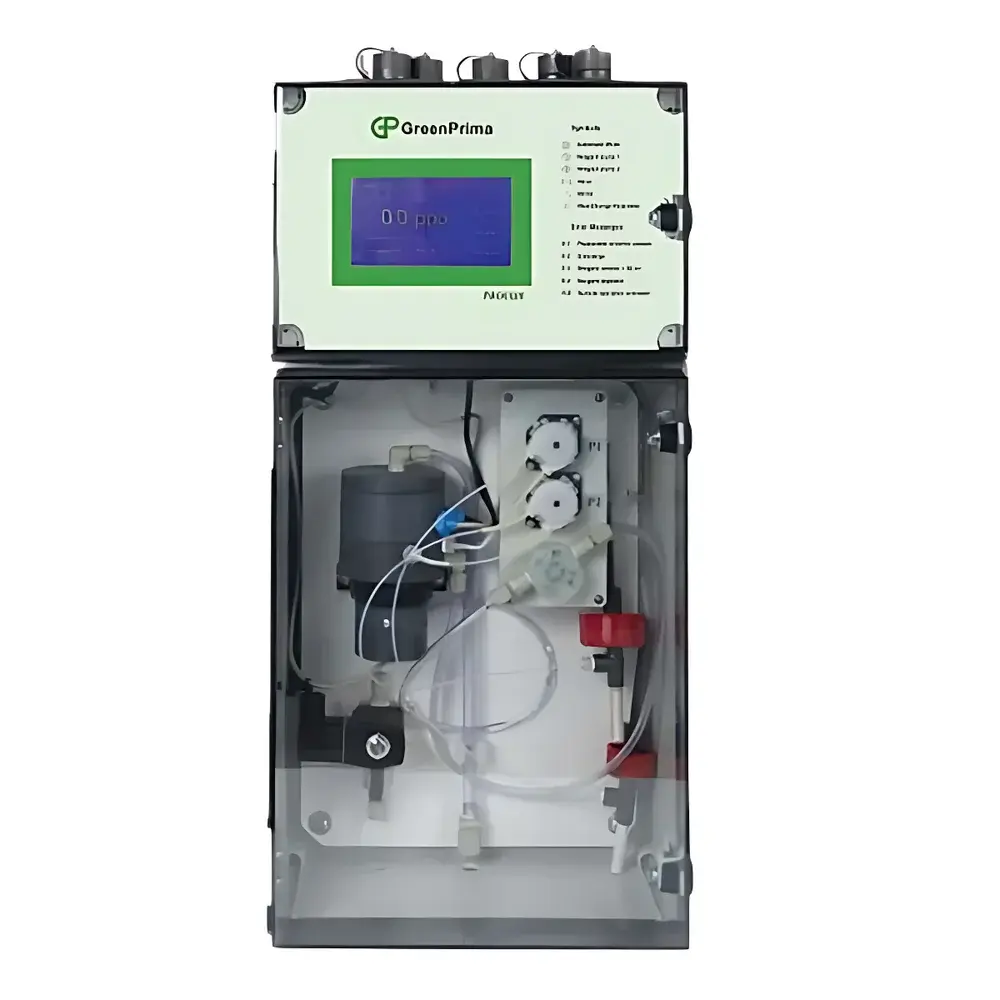
GreenPrima PROCON5000 Total Iron Analyzer
| Brand | GreenPrima |
|---|---|
| Origin | United Kingdom |
| Manufacturer Type | Manufacturer |
| Origin Category | Imported |
| Model | PROCON5000 |
| Price | Upon Request |
Overview
The GreenPrima PROCON5000 Total Iron Analyzer is a fully automated, laboratory-grade online instrument engineered for continuous or periodic quantification of total iron (Fe²⁺ and Fe³⁺) in aqueous matrices. It operates on the principle of colorimetric spectrophotometry, leveraging two well-established complexation chemistries: the formation of the pink-colored 5-(2-pyridylazo)-2,3-dihydroxynaphthalene (PADN) complex—commonly referred to as pyridyltriazine—for low-concentration detection (10–500 ppb), and the orange-red 1,10-phenanthroline–ferrous complex for higher-range analysis (0.1–20.0 ppm). The analyzer integrates a microprocessor-controlled fluidic system with precise peristaltic metering, sequential reagent addition, temperature-stabilized reaction timing, and dual-wavelength photometric detection (typically at 565 nm and reference wavelength) to ensure high specificity and minimal interferences from common water matrix constituents. Designed for unattended operation in fixed-site monitoring applications, the PROCON5000 meets the functional requirements of regulatory compliance frameworks including ISO 11929 (evaluation of measurement uncertainty), ISO 7027 (turbidity interference mitigation), and ASTM D1068 (standard test methods for iron in water).
Key Features
- Fully autonomous operation with integrated self-diagnostic routines, automatic zero-point drift compensation, and scheduled cleaning cycles
- Configurable measurement intervals (4–7 minutes per cycle, extendable up to 99 minutes) and external trigger capability via dry-contact input
- Wide dynamic range with dual-mode detection: 10–500 ppb (resolution: 1 ppb) and 0.1–20.0 ppm (resolution: 0.1 ppm)
- High-precision photometric detection system with <2% endpoint accuracy and <1% endpoint repeatability under controlled conditions
- Touchscreen HMI (240 × 128 pixel monochrome LCD) with intuitive menu navigation and real-time status visualization
- Programmable 0/4–20 mA analog output (500 Ω load) with configurable scaling and fault signaling
- Robust IP65-rated enclosure (640 × 315 × 190 mm H×W×D) suitable for industrial environments; electrical connections via screw-terminal ring connectors
- Three independent relay outputs: alarm (3 A, 230 V AC), limit (3 A, 230 V AC), and analysis status (3 A, 230 V AC)
- Universal power supply (110–230 V AC, 50/60 Hz; ~16 VA consumption) with wide ambient operating temperature range (5–45 °C)
Sample Compatibility & Compliance
The PROCON5000 is validated for use with clarified aqueous samples having pH 6.0–8.0 and turbidity <5 NTU. Sample pressure must be maintained between 0.1–10 bar, and inlet temperature within 5–30 °C. Each analysis consumes 25 mL of sample (excluding rinse volume). The system requires no pre-filtration for typical potable water, wastewater effluent, or process cooling water applications. Reagents are stored at 5–25 °C (Fe2001) or 0–30 °C (Fe1001/1002/1003); single-cycle reagent consumption is ≤0.8 mL per reagent (total ≤2.4 mL/cycle). All reagent formulations comply with EU REACH Annex XIV restrictions and are non-hazardous for transport under UN 3082 classification. The analyzer supports GLP/GMP data integrity requirements through timestamped event logging and optional USB data export (CSV format), traceable to IEC 62443-3-3 for industrial cybersecurity baseline.
Software & Data Management
Internal firmware implements deterministic state-machine control logic with non-volatile memory retention for calibration history, maintenance logs, and error codes. USB data export (optional module) enables batch download of time-stamped concentration values, diagnostic flags, and relay activation events. No proprietary software installation is required—data files are natively readable in Excel or LIMS-compatible platforms. The system does not require routine recalibration due to built-in optical stability verification and auto-zero referencing prior to each measurement cycle. Audit trail functionality includes operator ID tagging (via optional network authentication), change logs for setpoint modifications, and power-cycle timestamps—aligned with FDA 21 CFR Part 11 principles for electronic records where local validation protocols are implemented.
Applications
- Real-time monitoring of iron breakthrough in granular activated carbon (GAC) or ion exchange polishing units
- Compliance verification against WHO Guideline Values (0.3 mg/L) and EU Drinking Water Directive (2020/2184) limits
- Corrosion product tracking in closed-loop industrial cooling systems and boiler feedwater circuits
- Effluent quality assurance in municipal wastewater treatment plants prior to discharge
- Process control in metal finishing, semiconductor ultrapure water (UPW), and pharmaceutical purified water (PW) distribution loops
FAQ
Does the PROCON5000 measure both dissolved and particulate iron?
Yes—it quantifies total iron after acid digestion (integrated into the onboard reaction sequence), converting all Fe²⁺, Fe³⁺, and colloidal/hydrated iron oxides into measurable ferrous ions prior to complexation.
Is field calibration required after installation?
No—factory calibration is retained across power cycles; only initial verification using NIST-traceable iron standard solutions (e.g., SRM 1643e) is recommended per ISO/IEC 17025 QA protocols.
Can the analyzer interface with SCADA or DCS systems?
Yes—via isolated 4–20 mA output, dry-contact relay signals, and Modbus RTU (optional RS-485 module) for bidirectional integration.
What maintenance intervals are recommended?
Daily visual inspection; monthly tubing replacement; quarterly optical path cleaning; annual pump roller and valve seal replacement—documented in included maintenance log template.
Is the system compliant with US EPA Method 365.4?
While not certified as an EPA-listed method instrument, its analytical methodology aligns with the core principles of EPA 365.4 (spectrophotometric determination of iron using 1,10-phenanthroline), and it is routinely deployed in EPA-regulated facilities under site-specific validation.
Related Products







