
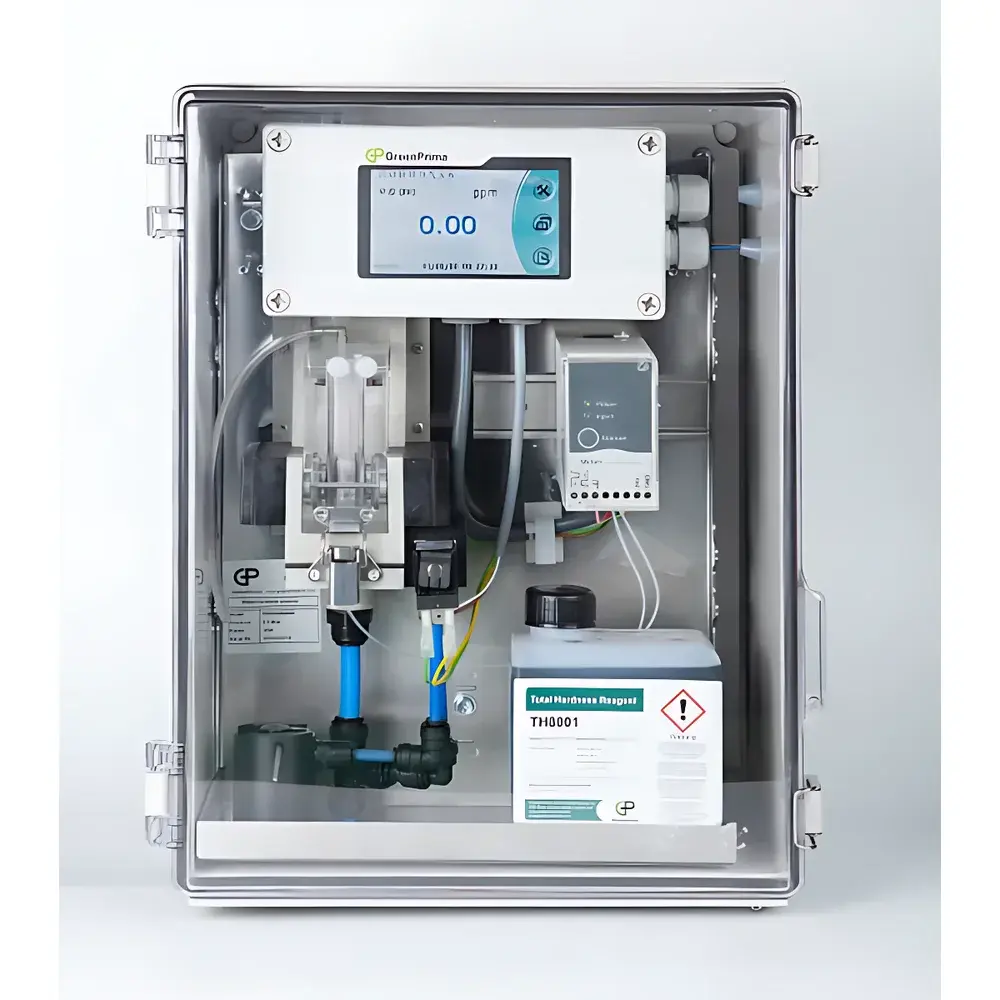
GreenPrima PROCON8000 Online Water Hardness Analyzer
| Brand | GreenPrima |
|---|---|
| Origin | Germany |
| Manufacturer Type | Original Equipment Manufacturer (OEM) |
| Country of Origin | Imported |
| Model | PROCON 8000 |
| Instrument Type | Online Water Quality Analyzer |
| Measured Parameter | Calcium and Magnesium Hardness (as CaCO₃) |
| Detection Principle | Automated Potentiometric Titration with Colorimetric Endpoint Detection |
| Output Signals | 4–20 mA analog output, RS485 Modbus RTU |
| Measurement Mode | Continuous or Programmable Interval Sampling |
| Enclosure Rating | IP65 |
| Wetted Materials | PTFE, PVDF, Borosilicate Glass, EPDM |
| Reagent Consumption | ≤1.2 mL per measurement cycle |
| Power Supply | 230 VAC ±10%, 50/60 Hz |
| Operating Temperature | 5–45 °C |
| Storage Temperature | –20–60 °C |
| Dimensions (W×H×D) | 400 × 500 × 220 mm |
| Weight | 18 kg |
Overview
The GreenPrima PROCON8000 Online Water Hardness Analyzer is an industrial-grade, fully automated titrimetric analyzer engineered for continuous, real-time monitoring of total calcium and magnesium hardness—expressed as calcium carbonate (CaCO₃)—in critical water streams. Unlike conductivity- or ISE-based proxies, the PROCON8000 employs a validated potentiometric titration method with colorimetric endpoint detection, delivering metrologically traceable results aligned with ASTM D1126 and ISO 6059 standards for hardness determination. Its primary application domain includes closed-loop cooling water systems in petrochemical refining, steelmaking, power generation, and pharmaceutical utilities—where precise hardness control prevents scale formation on heat exchangers, condensers, and boiler feedwater circuits. The instrument integrates a precision peristaltic dosing pump, dual-wavelength photometric sensor, and temperature-compensated reaction cell to ensure stoichiometric accuracy across variable water matrices, including low-conductivity purified water (e.g., WFI, PW) and high-TDS recirculated cooling water.
Key Features
- Automated endpoint-detection titration using standardized EDTA reagent, eliminating operator bias and inter-laboratory variability
- Touchscreen HMI with bilingual (English/Chinese) interface, intuitive menu navigation, and context-sensitive help
- Modular multi-channel configuration support (MCS-2 to MCS-6) for simultaneous monitoring of up to six independent sample points
- Low-reagent consumption design: ≤1.2 mL per analysis cycle, enabling >6 months of unattended operation with standard 500-mL reagent bottles
- Chemically resistant fluid path constructed entirely from PTFE, PVDF, borosilicate glass, and EPDM—validated for continuous exposure to chlorine, oxidants, and pH 4–10 aqueous media
- Flexible sampling protocol: configurable continuous flow mode or programmable interval sampling (1–240 min intervals)
- Integrated diagnostics including reagent level monitoring, pump stroke verification, photometric signal stability logging, and air bubble detection
- Robust IP65-rated enclosure suitable for installation in utility corridors, pump rooms, and outdoor instrument shelters
Sample Compatibility & Compliance
The PROCON8000 is validated for use with clarified, filtered, and non-turbid aqueous samples having suspended solids <5 mg/L and free chlorine <2 ppm. It meets the operational requirements of EU Directive 2000/60/EC (Water Framework Directive) Annex V monitoring protocols and supports compliance with ASME B31.1 Power Piping Code Section 112.2.2 for boiler feedwater hardness limits. All firmware and calibration routines are designed to satisfy GLP and GMP data integrity expectations, including electronic signature capability, audit trail activation (per FDA 21 CFR Part 11), and timestamped event logging for maintenance, calibration, and alarm events. Reagent lot traceability is embedded in the system’s calibration history, enabling full chain-of-custody documentation during regulatory audits.
Software & Data Management
Data acquisition and instrument control are managed via the embedded GreenPrima Analytical Suite v3.2 firmware, which supports dual communication pathways: isolated 4–20 mA analog outputs (with HART-enabled diagnostics) and RS485 Modbus RTU for integration into DCS, SCADA, or MES platforms. Historical measurement data—including raw absorbance curves, titrant volume consumed, calculated hardness values, temperature, and diagnostic flags—is stored locally for ≥90 days and exportable via USB or Ethernet. Optional cloud connectivity (via MQTT or OPC UA) enables remote configuration, predictive maintenance alerts, and centralized fleet monitoring across multi-site operations. Calibration reports, QC check logs, and reagent expiry tracking are auto-generated in PDF format compliant with ISO/IEC 17025 laboratory documentation standards.
Applications
- Real-time hardness surveillance in open- and closed-loop industrial cooling towers to optimize antiscalant dosing and prevent heat transfer degradation
- Boiler feedwater quality assurance in thermal power plants, ensuring compliance with ASME D12.1 hardness limits (<0.002 ppm for ultra-supercritical units)
- Monitoring softener effluent and reverse osmosis permeate in pharmaceutical water systems (PW, WFI) per USP and EU GMP Annex 1
- Process water hardness control in food & beverage production lines where mineral deposition affects heat exchanger efficiency and product consistency
- Environmental compliance reporting for discharge permits requiring hardness-based effluent limitations under NPDES or local wastewater ordinances
FAQ
What hardness range does the PROCON8000 measure?
The standard configuration measures 0.1–500 ppm CaCO₃; extended-range variants (PROCON8000-HR) cover 0.05–2000 ppm CaCO₃ upon factory calibration.
Is manual calibration required?
No—calibration is performed automatically using certified hardness reference standards (NIST-traceable) loaded into the reagent module; user intervention is limited to periodic verification checks every 30 days.
Can it operate in high-chlorine environments?
Yes—the wetted materials and optical components are chemically inert to free chlorine concentrations up to 2 ppm; for higher levels, optional dechlorination pre-filtration is recommended.
How often must reagents be replaced?
At typical 2-hour sampling intervals, a 500-mL reagent bottle lasts approximately 2000 analyses—equivalent to 6–8 months of continuous operation.
Does the system support remote firmware updates?
Yes—secure over-the-air (OTA) updates are supported via authenticated HTTPS connection; all update packages are cryptographically signed and version-verified prior to installation.







