
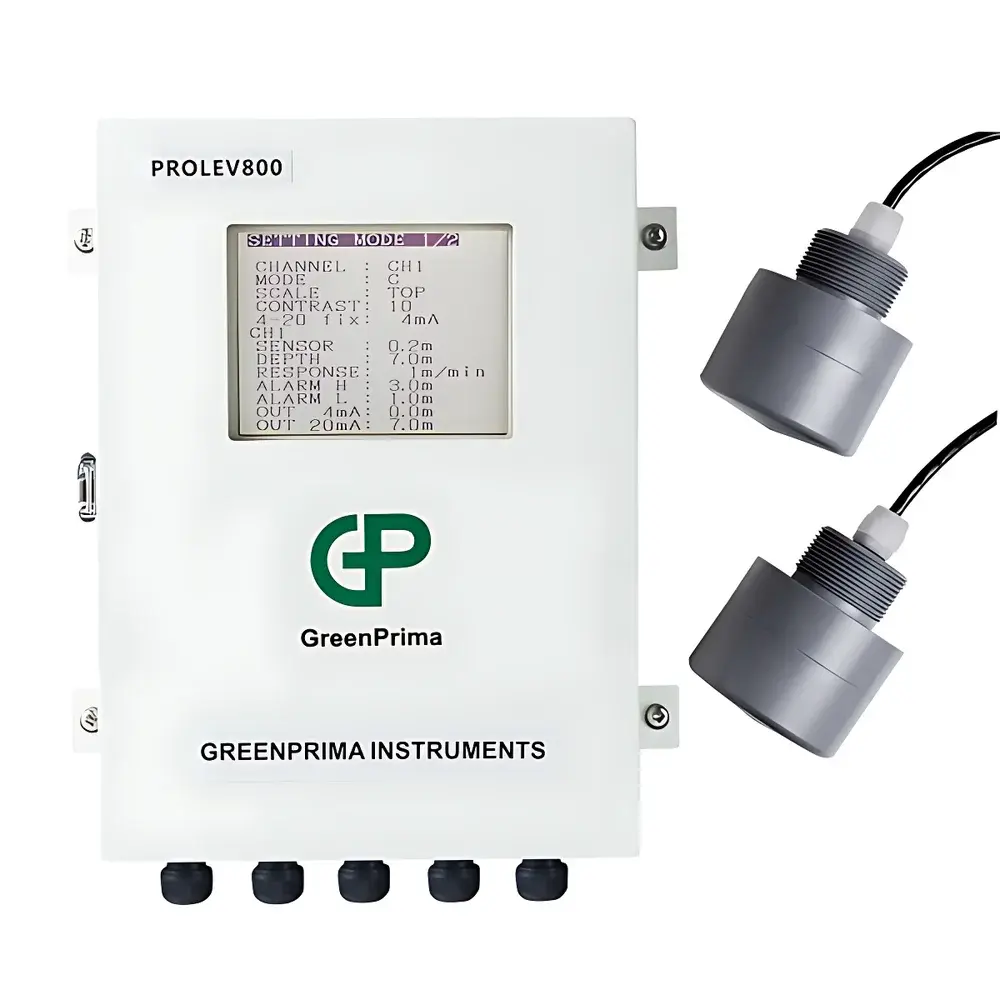
GreenPrima PROLEV800 Ultrasonic Sludge Blanket Level Monitor for Power Plant Ash Settling Tanks
| Brand | GreenPrima |
|---|---|
| Origin | Japan |
| Manufacturer Type | Original Equipment Manufacturer (OEM) |
| Product Category | Imported Instrument |
| Model | PROLEV800 |
| Measurement Range | 0.4–10 m |
| Sensor Capacity | Up to 2 independent ultrasonic transducers |
| Accuracy | ±1 cm |
| Response Time | 1 s |
| Operating Ambient Temperature | −20 to +60 °C |
| Display | Large-backlit LCD with graphical interface (digital readout, trend plot, echo waveform visualization) |
| Enclosure Rating | IP68 |
| Weight | 3.6 kg (transmitter), 3.0 kg per sensor |
| Output | 4–20 mA analog (isolated), dual high/low alarm relays |
| Communication | RS-232C (cable length ≤10 m) |
| Power Supply | 85–264 VAC, 10 VA |
| Cable Length | 20 m standard |
| Trend Logging | 5 min to 48 h history viewable on display |
| Brightness Adjustment | Yes |
| Transducer Mounting | Non-invasive, top-mounted immersion or fixed bracket |
| Maintenance | No moving parts, solid-state design |
Overview
The GreenPrima PROLEV800 is an industrial-grade ultrasonic sludge blanket level monitor engineered for continuous, non-contact measurement of the sludge–water interface in deep-settling basins—particularly ash settling tanks within thermal power plants. It operates on the principle of time-of-flight ultrasonic pulse reflection: a high-frequency transducer emits short-duration acoustic pulses downward into the suspension; the instrument precisely calculates the distance to the first major acoustic impedance discontinuity—the sludge blanket surface—by measuring the elapsed time between pulse emission and echo return. Unlike optical or conductivity-based methods, ultrasonic sensing remains unaffected by turbidity, color, suspended solids concentration gradients, or chemical composition variations typical in coal ash effluent streams. The PROLEV800 delivers real-time, millimeter-resolution interface positioning with ±1 cm repeatability under stable hydraulic conditions, enabling robust process feedback control for sludge recirculation pumps and clarifier optimization.
Key Features
- Large-format backlit LCD display supporting simultaneous numeric depth readout, real-time ultrasonic echo waveform visualization, and dynamic trend plotting (5-minute to 48-hour history)
- Dual-transducer capability: single transmitter unit interfaces with two independent ultrasonic sensors—ideal for differential profiling across tank width or redundant monitoring configurations
- Embedded microprocessor with adaptive signal filtering algorithms to suppress noise from surface turbulence, gas entrainment, or mechanical vibration
- No mechanical wear components: fully solid-state architecture ensures long-term stability and minimal scheduled maintenance
- Configurable brightness control and intuitive menu navigation via membrane keypad for field parameter adjustment without PC dependency
- IP68-rated transmitter housing and submersible transducers rated for continuous immersion in aggressive ash-laden wastewater environments
- Isolated 4–20 mA analog output with user-defined scaling, plus two programmable relay outputs for high/low blanket level alarms
Sample Compatibility & Compliance
The PROLEV800 is validated for use in heterogeneous, high-density suspensions characteristic of coal-fired power plant ash settling systems—including fly ash slurries with solids concentrations up to 25% w/w and particle size distributions ranging from submicron colloids to >100 µm aggregates. Its ultrasonic frequency (typically 1–5 MHz) provides optimal penetration through variable density gradients while maintaining sufficient resolution at the interface. The instrument conforms to IEC 61326-1 (EMC for industrial environments) and IEC 60529 (IP68 ingress protection). While not intrinsically safe, it is suitable for Zone 2 classified areas when installed per local electrical codes. Data integrity meets GLP-aligned operational requirements; though not FDA 21 CFR Part 11 certified out-of-the-box, audit-trail-capable data logging can be implemented via optional RS-232 integration with SCADA or DCS historian systems compliant with ISO/IEC 17025 traceability frameworks.
Software & Data Management
Local configuration and diagnostics are performed directly via the onboard LCD interface—no external software required for routine operation. The embedded firmware supports user-defined damping filters, echo threshold calibration, and blanking zone setup to exclude false returns from tank structures or floating scum layers. RS-232 serial communication enables ASCII protocol access for remote polling (e.g., Modbus RTU over RS-232 emulation), facilitating integration into existing plant automation infrastructures. Raw echo amplitude and time-stamped interface position data can be streamed at configurable intervals (1–60 s) for third-party trend analysis or predictive maintenance modeling. Firmware updates are delivered via USB-to-serial adapter; version history and checksum verification ensure secure deployment.
Applications
- Real-time monitoring of sludge blanket elevation in coal ash settling ponds and electrostatic precipitator (ESP) hopper overflow tanks
- Feedback control of underflow pump speed in gravity thickeners serving flue gas desulfurization (FGD) wastewater treatment trains
- Early detection of abnormal compaction or deflocculation events during seasonal temperature shifts or coagulant dosage changes
- Performance validation of lamella settlers and tube settlers in combined ash-water recycling circuits
- Interface profiling in pre-concentration basins upstream of dewatering centrifuges or filter presses
- Cross-comparison with offline grab sampling and settleometer tests to refine empirical settling velocity models (e.g., Vesilind-type analysis)
FAQ
What installation orientation is recommended for the ultrasonic transducer in ash settling tanks?
Vertical top-down mounting is mandatory; angled or side-wall installations introduce path-length errors due to beam divergence and multi-path reflections in non-homogeneous media.
Can the PROLEV800 distinguish between multiple layers (e.g., scum, sludge, and supernatant)?
No—it identifies only the strongest impedance transition, typically the primary sludge blanket surface. Multi-layer resolution requires advanced multi-frequency or pulsed-echo spectral analysis not supported by this model.
Is calibration required after initial setup?
Field zero-point calibration (dry calibration using known air gap) is recommended upon installation; no periodic recalibration is needed unless transducer geometry or tank geometry changes.
How does the instrument handle foam or floating debris on the surface?
Foam layers thinner than 5 cm generally do not impede measurement; thicker or dense biofilm-covered scum may attenuate the signal—blanking zones and echo gain adjustment mitigate such interference.
Does the system support HART or Profibus communication protocols?
No—only RS-232C serial interface and 4–20 mA analog output are provided. HART or fieldbus compatibility requires external protocol converters.
Related Products







